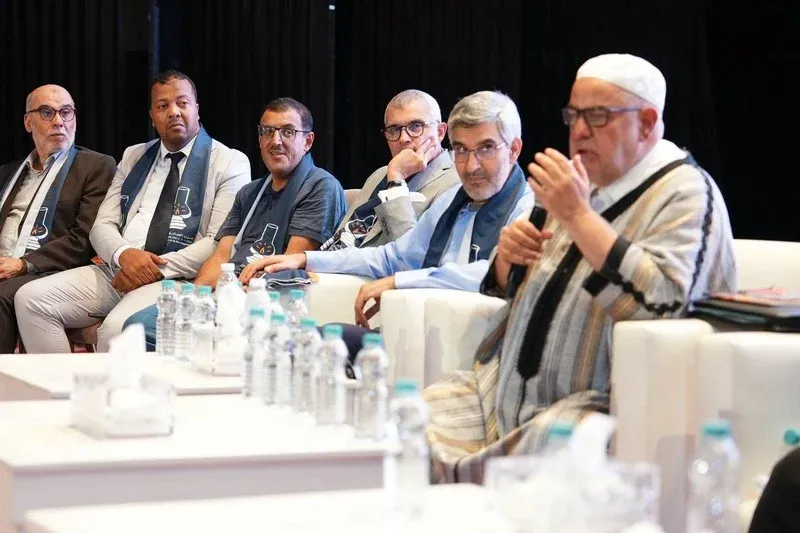

Political Tensions Rise as Benkiran Critiques Rivals
In a recent political rally held on Monday evening in Casablanca, Abdelilah Benkiran, the Secretary-General of the Justice and Development Party (PJD), unleashed a series of strong criticisms against prominent political figures, particularly targeting Aziz Akhannouch, Hamid Chabat, Idriss Lachgar, and Fouad El Lajjali. This gathering highlighted the growing tensions within the Moroccan political landscape, as Benkiran voiced his frustrations regarding various political maneuvers and decisions that he deems detrimental to the interests of the citizens.
Benkiran’s remarks came in response to the return of Hamid Chabat, the former Secretary-General of the Istiqlal Party, with the PJD leader suggesting that many political actors have become ineffective and need assistance to confront the pressing issues at hand. He did not spare Idriss Lachgar from his attacks, criticizing him for his recent comments, which he claimed lacked substance. Benkiran provocatively asked Lachgar how much he had profited from the political situation, referring to past negotiations in 2016 where he had initially intended to allocate five ministerial positions to Lachgar before being sidelined by Akhannouch.
Benkiran's Stance on Government Policies and Allegations of Corruption
Shifting his focus to Akhannouch's government, Benkiran accused the administration of colluding to raise fuel prices to the detriment of the Moroccan populace, suggesting that this was a direct violation of competitive practices. He stated that if his claims were untrue, the government should sue him. Benkiran also brought up the controversial handling of Moroccan migrants in Ceuta, expressing disbelief that Akhannouch would travel to Spain amidst such a crisis, and called for accountability in the government’s actions.
Additionally, Benkiran commented on the increasing visibility of Fouad El Lajjali, a key member of the Authenticity and Modernity Party (PAM), during recent political discussions. While acknowledging a friendly relationship with El Lajjali, he alluded to the questionable nature of his political dealings, hinting at potential coercion of business leaders to secure votes. He urged businessmen to adopt a courageous stance against political pressures, emphasizing that Moroccans should not fear injustice.
In a bold declaration, Benkiran rejected the notion of a political party acting on behalf of the monarchy, asserting that there is no 'royal party' and challenging anyone to claim otherwise. He expressed the sentiment that the Moroccan people are weary of political manipulation and emphasized the importance of elected representatives defending the interests of their constituents. This statement underscores a significant moment in Moroccan politics, as Benkiran calls for transparency and accountability among political leaders.
As reported by hespress.com.