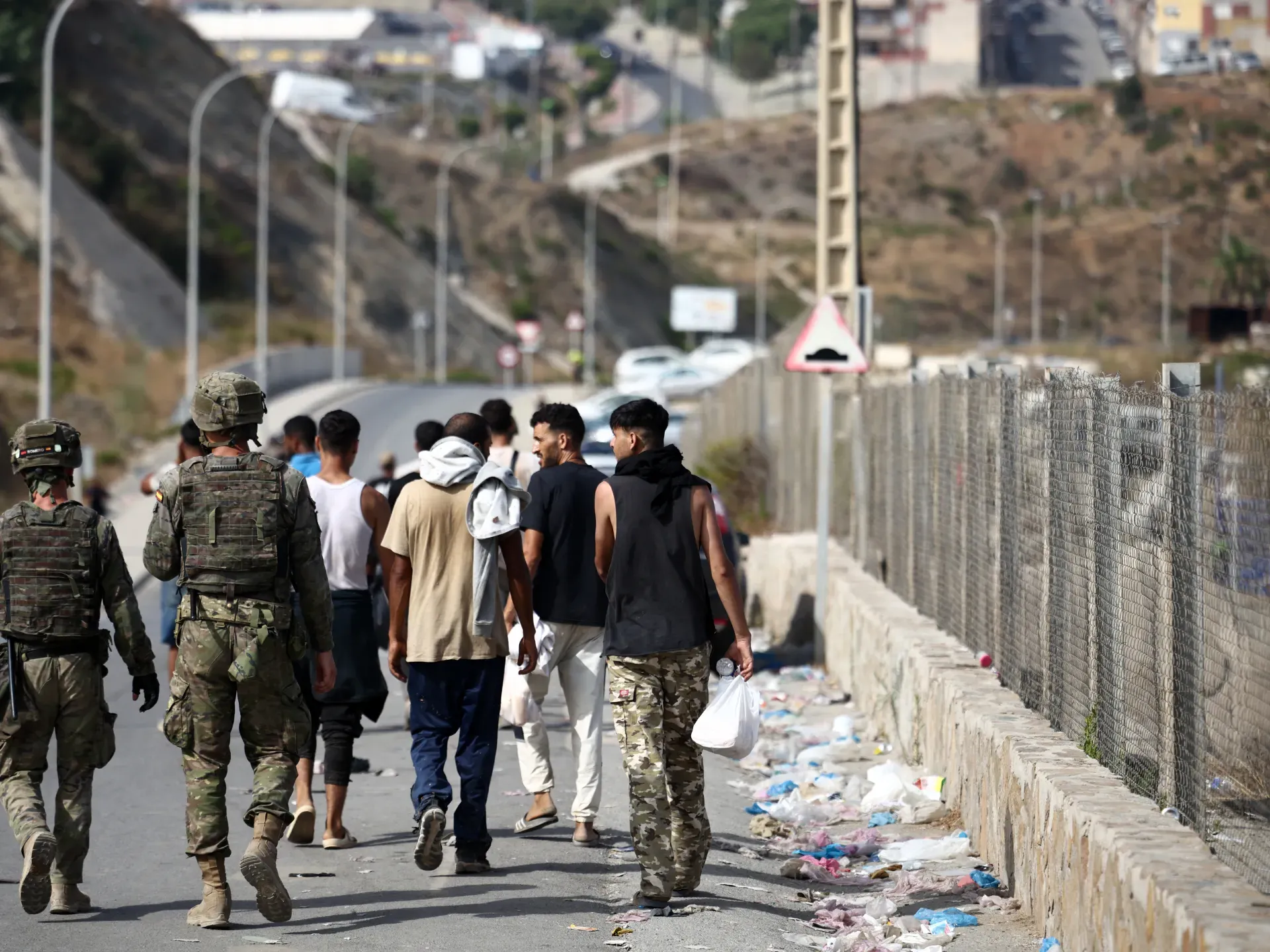

Calm is gradually returning to the city of Ceuta after days of turmoil caused by the sudden influx of tens of thousands of migrants to its shores via the Mediterranean Sea. However, this calm is laced with caution and anticipation, as European Union interior ministers convene on Tuesday to discuss the ongoing crisis. Most of those who arrived in Ceuta, carrying with them their hopes and sorrows, believed that the gates of the old continent had suddenly opened for them. Yet, many have returned to Morocco empty-handed, bearing only stories of the hunger, thirst, and struggles endured during their brief journey toward what they envisioned as a "European paradise."
Reports indicate that approximately 69,500 undocumented migrants have crossed from Morocco to the Spanish-administered city only to return to Moroccan territory. While the Moroccan authorities have not released official figures regarding the number of those who left or returned during this mass crossing wave, Spanish security sources confirmed the return of nearly all migrants who flooded into Ceuta in recent days. Nevertheless, the toll of this crisis is also tragic, with 67 migrants drowning while attempting to swim to Ceuta, their dreams swallowed by the sea.
Spain has announced a halt to crossings into Ceuta, coinciding with the installation of a 500-meter floating barrier by the Spanish police along the maritime border with Morocco, a measure aimed at preventing the recurrence of such mass migration waves. Despite the Spanish authorities’ attempts to convey a sense of normalcy, the reality on the ground tells a different story. Journalists and observers report an atmosphere of anxiety, tension, and vigilance in Ceuta, following the shock of seeing a number of migrants nearly equal to the city’s population.
In a report by Al Jazeera's correspondent in Spain, Ayman Al-Zubair, this prevailing sentiment of unease is apparent, with fears that the repercussions of this crisis will extend beyond migration issues to affect security and political aspects, potentially straining relations between Rabat and Madrid. For migrants, although most have returned, the disappointment is as great as the hopes they carried, as many discovered that the city they believed was their gateway to Europe was merely a short stop that ended with their return. The plight of those still missing continues, including mothers searching for their children who undertook perilous journeys without their families’ knowledge, some of which ended in tragedy.
On the Spanish side, the return of migrants has not sufficiently assuaged political or public concerns. The leader of the Spanish conservative party labeled the situation as tantamount to an "occupation" of the disputed city with Morocco, demanding that the government adopt stricter border protection policies. He stated, "The situation is not normal; thousands of people still remain in the city, and alarmingly, some refuse to leave. If the Minister of the Interior considers this a normal situation, it is clear that we differ in our perception of reality." Meanwhile, residents of Ceuta have not been reassured by the government's attempts to calm fears. Shops that closed during the crisis are gradually resuming activity, yet anxiety persists, and many residents agree that the wounds left by those tumultuous days will not heal quickly.
The repercussions of the Ceuta crisis have transcended the city and the Spanish landscape, quickly extending to the level of the European Union. A collective of 22 European nations has called for tighter control of the EU's external borders and stricter measures to prevent unauthorized mass crossings. This group includes countries such as Italy, Denmark, Belgium, the Netherlands, Germany, Finland, the Czech Republic, Poland, Lithuania, Slovenia, Slovakia, Croatia, Bulgaria, Romania, Latvia, Estonia, Hungary, Sweden, Greece, Cyprus, Malta, and Austria. Concurrently, Irish Prime Minister Michael Martin announced that EU interior ministers will convene for an emergency meeting to discuss the implications of the crisis and explore responses to the recent developments at the Spanish border.
Martin stated in a post on X that Ireland, which currently holds the rotating presidency of the EU Council, will call for a meeting of the Justice and Home Affairs Council in an effort to coordinate a unified European stance on the crisis that has raised concerns about the EU's ability to protect its external borders and handle sudden waves of migration. Ceuta's strategic significance is highlighted in this context, being located at the northernmost point of Morocco near the southern Mediterranean coast, surrounded by the sea on three sides and separated from the Spanish coast by only 26 kilometers across the Strait of Gibraltar. This makes it one of the most sensitive crossing points between Africa and Europe, with political and security dimensions affecting Moroccan-Spanish relations and EU policies on migration and external borders.
As reported by aljazeera.net.