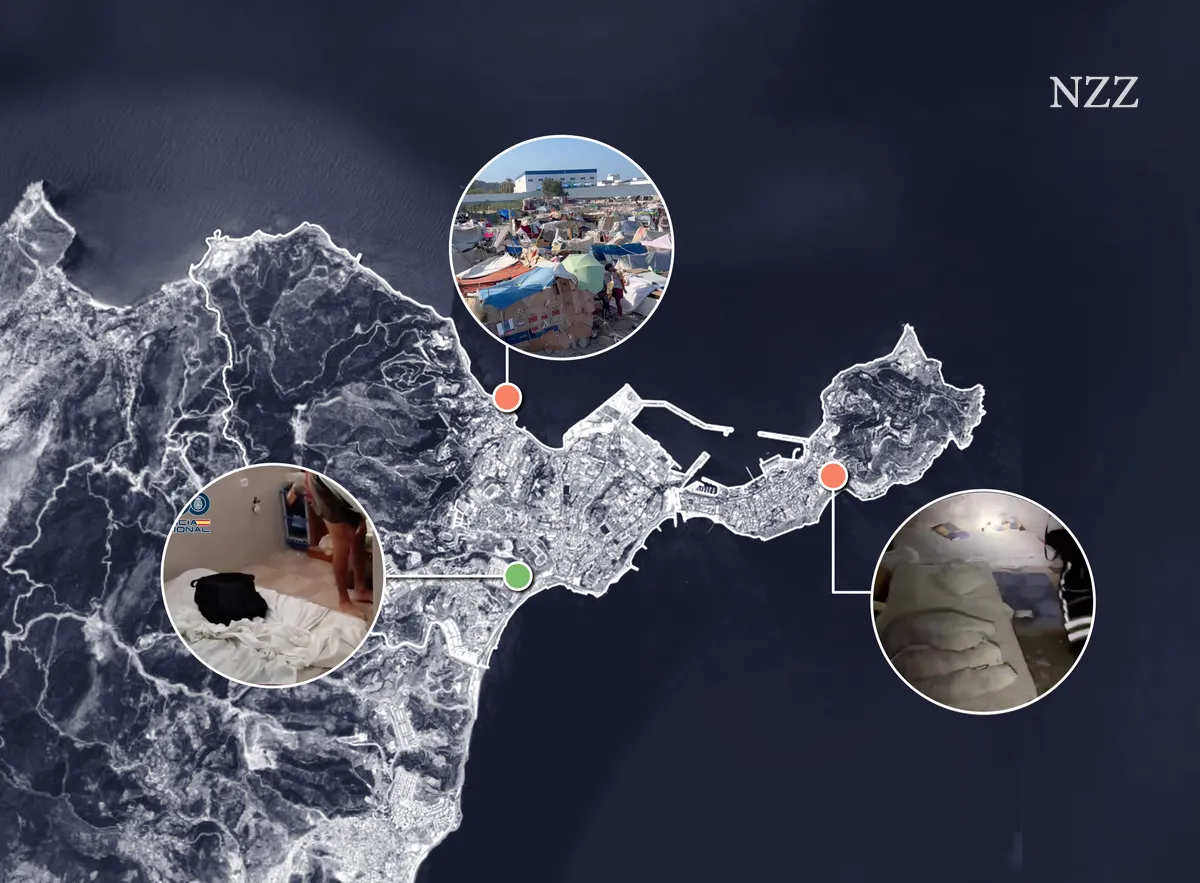

Calm Restored at Ceuta and Melilla Borders After Recent Migrant Incident
In a significant development regarding the migrant situation at the Spanish enclaves of Ceuta and Melilla, stability has gradually returned following a large-scale crossing attempt that was thwarted by Moroccan authorities. On August 15, 2026, a robust security operation was launched by Rabat, resulting in the detention of nearly 300 individuals, predominantly from Sub-Saharan Africa. These migrants had reportedly been misled by false information spreading through private messaging applications, which claimed that Spain would open its borders to them on that date.
Witnesses confirmed that the urban center of Fnideq remained calm, alongside the nearby hills close to the Ceuta border, where clashes had erupted between Moroccan security forces and migrants seeking to cross irregularly. During the operation, riot police deployed batons, tear gas, and police dogs, supported by a helicopter, to disperse the crowds. Meanwhile, the situation at the Melilla border also stabilized after an exceptional mobilization of Moroccan forces in the vicinity of Beni Ensan Fajar and the access routes to Nador, as noted by the Moroccan Association for Human Rights.
Interviews conducted with detained migrants revealed a common narrative: many had traveled collectively to Ceuta based on rumors indicating that the Spanish authorities would allow passage on August 15. One young Guinean migrant, Abu Bakr, recounted his journey from Casablanca, where he had spent two weeks in the forest awaiting the purported opening of the border. "We are not here to cause harm; we only wish to cross and build a future," he stated, reflecting the aspirations of many who seek better lives. Another migrant, Ibrahim Yabril from Sudan, mentioned that he was drawn to Ceuta after viewing a video purportedly from the Spanish Prime Minister, which circulated widely on WhatsApp, suggesting that the border would open.
The detained migrants were subsequently transported by bus to an undisclosed location, although it is customary for them to be released in central and southern cities of Morocco, far from the Mediterranean coast. The Moroccan authorities took a stern approach during this recent incident, expelling journalists from EFE and TVE from Fnideq while they covered the unfolding events, a move interpreted by local media as a retaliatory measure against perceived difficulties faced by Moroccan journalists in Spain.
This display of force by Morocco comes in the wake of significant incidents that unfolded on July 30 and 31, when an estimated 70,000 individuals crossed into Ceuta, leading to a humanitarian crisis that resulted in numerous casualties, and subsequently prompting severe criticism of Spain's immigration policies from Rabat.
As reported by emol.com.