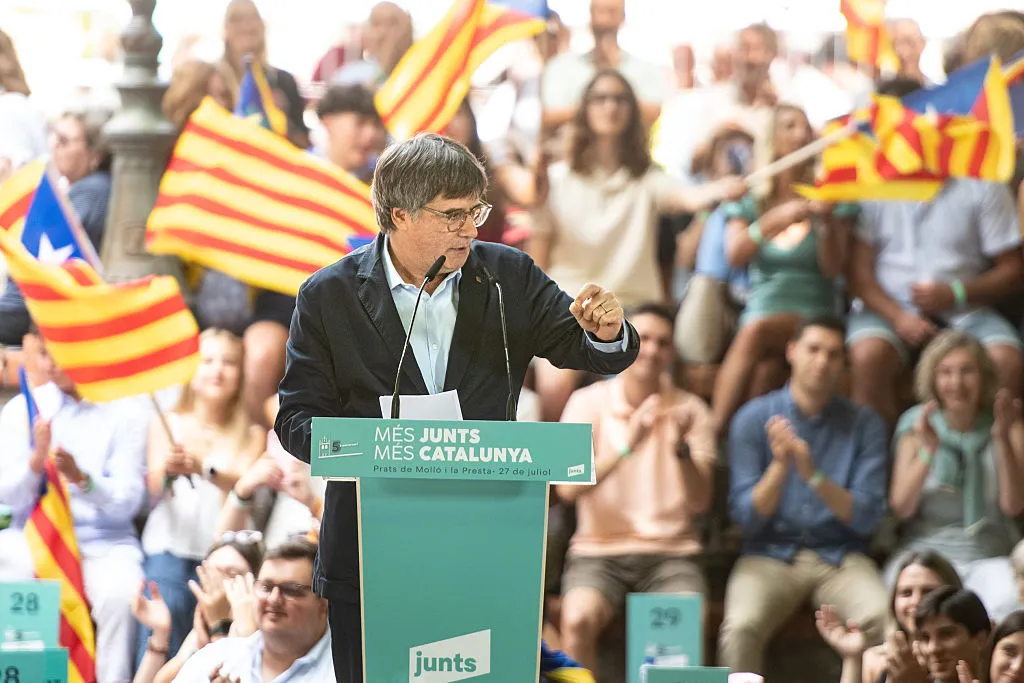

Carles Puigdemont, the former President of the Catalonia government and leader of the "JxCat" party, has reignited a contentious debate within Spanish politics regarding the cities of Ceuta and Melilla. During a recent interview published by the newspaper La Razón and originally sourced from The Times, Puigdemont referred to these cities as "colonies within Morocco," and advocated for a referendum allowing their inhabitants to express their views on their political future. This assertion places the cities at the center of a significant geopolitical discussion, as Puigdemont acknowledged that while the people of Ceuta identify strongly as Spanish, their legitimacy would be enhanced through the opportunity to vote on their self-determination.
This perspective is not a new one for Puigdemont, who, during the height of tensions between Madrid and Rabat in May 2021, labeled Ceuta and Melilla as "African cities" and connected their status to what he described as a "legacy of colonialism." He argued for Morocco's right to raise sovereignty issues concerning these territories and called for direct dialogue between Rabat and Madrid to address the ongoing disputes. In September of this year, Puigdemont took his stance further by publicly endorsing an article by academic Joseph Massad, which discusses Ceuta and Melilla from a decolonization viewpoint. He specifically highlighted the conclusion that advocates for addressing the future of these cities within the framework of decolonization, paving the way for his more explicit call for a referendum.
Notably, this proposal has transcended Puigdemont's personal views. On September 9th, his party, "JxCat," brought the discussion to the Spanish Senate, urging the government to address Moroccan demands "democratically" and asserting that any decision regarding the political future of Ceuta and Melilla should be based on the "freely expressed will" of their residents through a referendum. Senator Eduard Pujol defended this proposition within the council, indicating a shift in the political landscape regarding these territories.
These developments highlight a clear divergence within the Spanish political discourse on how to approach the matter. The Spanish government continues to reaffirm its commitment to Spain's sovereignty and territorial integrity, a position reiterated by Foreign Minister José Manuel Albares during his recent visit to the occupied city of Ceuta. Simultaneously, the parliament has witnessed initiatives affirming "full Spanish sovereignty" over the cities and rejecting Moroccan claims, even as many voices call for a solution with Morocco, framing the two cities as remnants of European colonialism in Africa.
Ultimately, the issue at stake is not merely a change in Madrid's official stance; rather, a question that has historically been raised primarily from the Moroccan perspective has now become a subject of open political contention within Spanish institutions themselves. With Puigdemont and "JxCat" advocating for a referendum, juxtaposed against the Spanish government's and other parties' insistence on Spanish sovereignty, the future of these geographically North African cities has become part of an internal Spanish debate that transcends the traditional confrontations between Rabat and Madrid.
As reported by assahifa.com.