
The Chinese manufacturer CCCC Chenzhou Road Construction Machinery, a subsidiary of CCCC under the control of CCCC South Central Engineering Bureau, has launched a new procurement process for mixing plant parts aimed at two significant Moroccan construction projects. The announcement, made on Friday, September 4, outlines the procurement for the Rabat-Casablanca continental highway and the rail section "3Bis" of the high-speed line connecting Kenitra to Marrakech. Bids are due by September 9, with delivery scheduled at the Port of Shanghai within ten days following contract signing.
This procurement encompasses four sets of supplies, with two designated for the highway project and two for the 3Bis railway initiative. The detailed specifications include various components such as circuit breakers, contactors, relays, weight transmitters, power supplies, seals, hydraulic cylinders, bearings, belts, sealing parts, and mechanical elements intended for the mixing plants. CCCC Chenzhou mandates that the electrical components must be compatible with the Moroccan industrial network operating at 400 V/50 Hz and the single-phase network at 220 V/50 Hz. Additionally, the mechanical parts should be suitable for installation with existing setups.
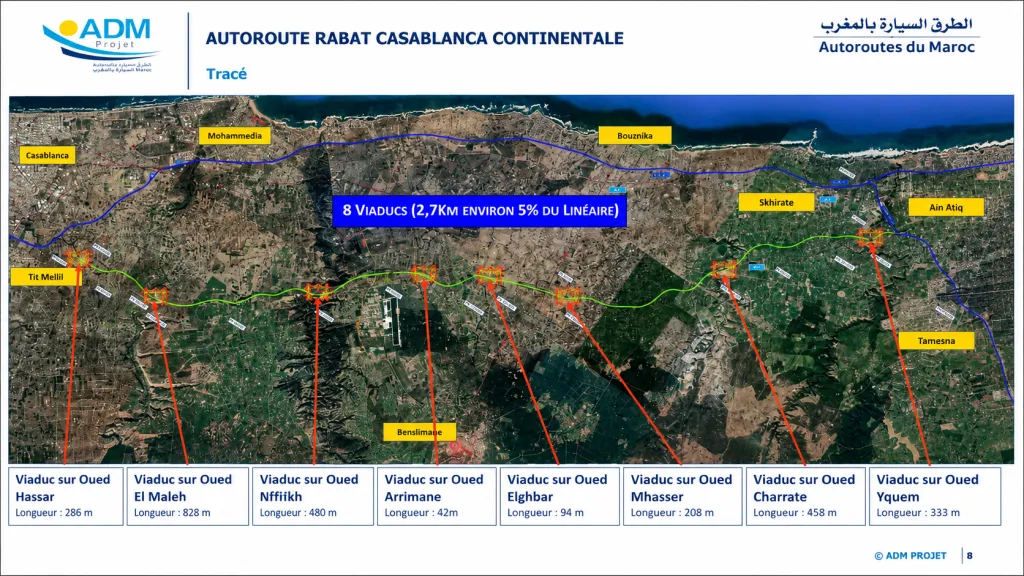
Significantly, this procurement process provides further clarifications regarding the allocation of this equipment for Moroccan projects. For the continental highway, CCCC Chenzhou references lots 5 and 6 of the new Rabat-Casablanca corridor. Specifically, lot 6 is located between the Yquem river viaduct and provincial road RP4022, spanning from kilometer point 55+830 to 58+370, which amounts to 2.54 kilometers designed with three lanes in each direction. Regarding the railway aspect, the document links the 3Bis project to the Kenitra-Marrakech high-speed line and lists several constructions assigned to the contractor, including bridges, an open-cut tunnel, cast-in-place concrete works, prefabricated beam bridges, and culverts.
The suppliers must deliver the four sets to the Port of Shanghai within ten days after the contract is finalized. CCCC Chenzhou plans to select bids based on the lowest evaluated price and requires candidates to submit their offers by September 9 at 3 PM Beijing time. The estimated value of the order has not been disclosed in the public notice. The payment terms stipulate that at least 70% of the invoiced amount will be paid within three months of receipt and billing, followed by 27% within six months, with the remaining 3% held as a retention guarantee payable within twelve months after the completion of the supplies.
The Rabat-Casablanca continental highway represents one of the most substantial roadworks currently underway in this region. The National Company of Motorways of Morocco estimates its projected investment at 6.5 billion dirhams. Its annual financial report for 2025 outlines a length of 60 kilometers, featuring three lanes in each direction and six successive sections between the highway interchanges of Rabat and Casablanca. The route will pass through Benslimane near the Grand Stade Hassan II and is designed to provide a secondary connection between the two urban centers, parallel to the existing corridor.
The Chinese document confirms that CCCC Chenzhou is playing a crucial role in the supply chain for this project. The company had previously initiated a procurement process for compactors for the Moroccan project back in March, explicitly identifying it as the Rabat-Casablanca continental highway and as an infrastructure linked to preparations for the 2030 World Cup.
The second project supplied by this new order pertains to the Kenitra-Marrakech high-speed line, with construction activities having commenced on April 24, 2025. The National Railway Office estimates the investment for this extension, excluding rolling stock, at 53 billion dirhams, covering nearly 430 kilometers designed for operation at speeds of 320 km/h. This line will connect Kenitra to Marrakech via Rabat and Casablanca, including a tunnel of approximately three kilometers in Rabat.
It is important to note that the designation "3Bis" used by CCCC Chenzhou does not refer to the entire 430 kilometers of the new high-speed line but rather to the scope of work for which the supplies in this consultation are allocated. Technical documents for the project utilize the same designation "LGV Kenitra-Marrakech 3BIS," thereby unambiguously linking the September 4 order to the Kenitra-Marrakech railway program.
As reported by barlamane.com.