
Ceuta Experiences Tense Calm Amidst Heightened Security
The looming threat of another massive human influx into Ceuta this Saturday has been effectively mitigated, at least for the time being, thanks to the formidable security measures enforced by Moroccan forces. From early morning, these forces have thwarted the arrival of hundreds of sub-Saharan migrants, who attempted to reach the Spanish enclave in multiple waves, well before they could get close to the border. Consequently, the residents of Ceuta are experiencing a tense calm, heavily monitored by police, yet without any sign of the anticipated new assault that had been circulated on social media, which had kept the city on edge for two weeks due to the thousands of individuals still wandering its streets in irregular situations. This continues to cast a shadow over the so-called "relative normality" that Spanish Minister Fernando Grande-Marlaska had boasted about just days prior. Thousands remain sleeping rough in public spaces, squares, beaches, and vacant lots as assistance services grapple with the aftermath of the open wounds inflicted on July 30.
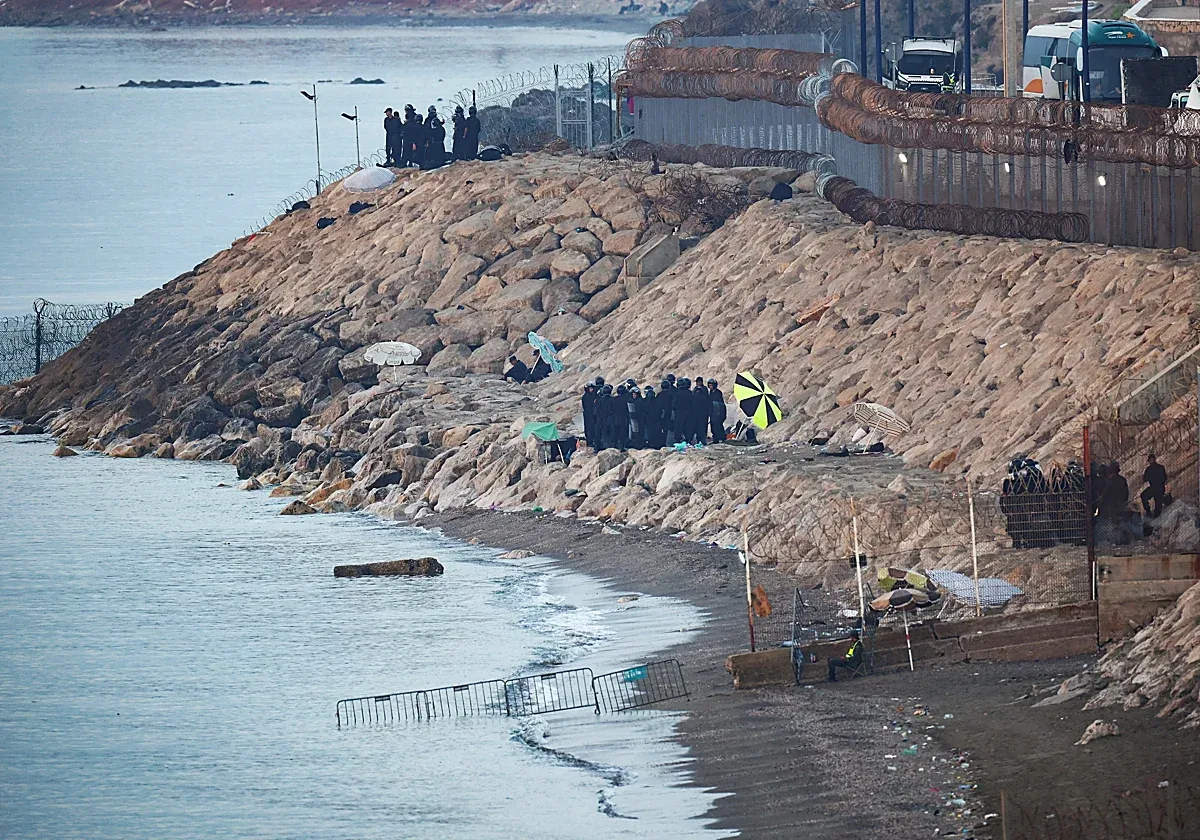
Visible from the beach, the El Tarajal pier presents a striking yet deserted image this Saturday, with dozens of Moroccan riot police forming multiple security rings, vehicles, and barriers blocking access, while not a single migrant approaches what has now become a restricted area.
Morocco's Preemptive Measures and Spain's Response
The critical contest is not fought at the Spanish fence or on Ceuta's shore; rather, it is determined many kilometers away in Morocco’s stations, roads, mountains, beaches, and secondary paths. Rabat has successfully prevented groups from even gathering in Castillejos, effectively nullifying the calls spread across social networks. Spanish diplomatic sources have informed that in recent hours, Moroccan forces have intercepted hundreds of sub-Saharan individuals in the wooded areas near Fnideq (formerly Castillejos), southwest of the Spanish enclave, dispersing them into various groups. These African citizens attempted to approach in different waves starting at 6 AM but were dispersed, yet not completely driven away.
Uniformed and plainclothes Moroccan police began inspecting buses, taxis, and private vehicles from the early hours. The contrast to the situation on July 30 is stark; back then, tens of thousands of people—over 80,000 by the latest estimates—managed to reach the pier despite the Moroccan controls. This time, they were intercepted before they could board a train, get on a bus, or venture into paths leading towards Ceuta. Morocco has once again demonstrated that when it wishes, it can effectively close off the route to the border.
After days of heightened tensions, Rabat decided on Saturday to ease its pressure. The regime of Mohamed VI scaled back its measures after two weeks marked by the largest human influx experienced in the city and following a low-intensity diplomatic crisis characterized by new sovereignty claims over Ceuta and Melilla, threats to suspend extradition agreements, and allegations of mistreatment of migrants by Spanish security forces.
Madrid's response has been one of appeasement, voiced by various ministers, except for Defense Minister Margarita Robles. Marlaska praised this week the "extraordinary, exceptional collaboration" with Rabat’s authorities, emphasizing relations "based on loyalty." Dozens of buses stood ready in Fnideq to immediately transport those intercepted back inland.
These praises—criticized as excessive not only by the opposition but also by partners on the left of Sánchez—had their repercussions this Saturday. Moroccan security operations began long before reaching Castillejos, according to various state security officials. The vigilance was "extreme" at bus stations in the Moroccan capital, Rabat-Agdal and Fez, with controls extending from Thursday afternoon in Kenitra, Uezán, Chauen, Larache, and Alcazarquivir. While there was no outright travel ban to Tangier, the Moroccan government intensified passenger filtering measures.
Groups deemed suspicious were prevented from boarding towards the north in Casablanca, Fez, and Kenitra. National Security, the Royal Gendarmerie, and Auxiliary Forces extended their operations through Tetuán, Rincón, Belyounech, Fahs-Anjra, and Fnideq. Inspections multiplied along the 80 kilometers between Tangier and Castillejos, with riot police checking vehicles even just eight kilometers from Ceuta, according to local media reports.
Access controls were also implemented in Tetuán, with multiple checkpoints within the city and along routes to M'Diq and Fnideq. The security measures were sequential, and in Martil, those intercepted were transported by bus to police facilities in Tetuán. Only travelers with passports, Schengen visas, residency, or tickets were allowed to reach Bab Sebta, the entry point to Ceuta. Uniformed and plainclothes officers inspected public transport and vehicles throughout the day, according to police sources. Searches in wooded areas, forests, and secondary paths that had been securing routes to avoid the main road to the autonomous city continued under high alert.
On the Moroccan side, the last line of defense included the Royal Armed Forces, National Security, Gendarmerie, Auxiliary Forces, local authorities, and Civil Protection. Dozens of vehicles arrived on Friday; officers occupied hills, and drones continuously monitored the area from above on Saturday. Patrols with more than five members traversed neighborhoods close to the crossing. Riot police were mobilized, along with vehicles equipped with water cannons, tear gas, and stun devices; vans, ambulances, firefighters, and helicopters were all part of the extensive operation. Various Moroccan media outlets reported more than 3,000 personnel deployed around the border, although Rabat did not provide an official tally.
The maritime front was similarly sealed with intensity. The beach of Fnideq closest to Ceuta was partially closed, and the coast in front of the Spanish city was cordoned off. Morocco reinforced the fence, installing dozens of meters of mesh and driving steel pillars five to ten meters into the water to connect them with wire. Barbed wire was doubled, concertina wire added, and barriers extended into the water. Two large vessels from the Royal Navy and fast patrol boats blocked maritime exits. El Tarajal dawned with dozens of riot police on the opposite side of the border, clearly visible from Spanish territory, with no migrants in sight.
On this Saturday, Morocco even planned for the immediate removal of citizens apparently willing to repeat the illegal episode from late July. At a gas station and in the Economic Activities Zone of Fnideq, dozens of empty buses awaited to transport intercepted individuals inland. The official newspaper Le360 estimated approximately 540 suspicious individuals were removed over three days.
Spain did not leave the situation on August 15 to chance, showcasing a considerable presence at the border, particularly with legionnaires and Civil Guard agents at the pier. Across Ceuta, there were 880 national police and 714 civil guards—almost 500 more than before—along with around 2,000 military personnel on support duties. This brought the total to approximately 3,600 operatives, though not all were stationed at the border. The Interior Ministry also ordered the deployment of an additional 45 agents from the Prevention and Reaction Unit (UPR) and 20 immigration specialists. Police Intervention Units (UIP), intelligence units, Civil Guard reserves, eight GEAS divers, drones, and a helicopter were activated. On the water, the Duque de Ahumada, maritime service vessels, and naval ships Rayo, Santa María, and Navarra were in operation.
However, no one on this side of the border had to act this August 15. No one dared even approach the floating barrier of 500 meters that rises between 30 to 70 centimeters and submerges one meter, established by the Interior to mark the border and comply with the Supreme Court ruling allowing 'hot returns' only if a physical limit is breached, which faced hours of anxiety but remained calm, shrouded in mist, with the tranquility only interrupted by maintenance work by operatives.
The Interior Ministry estimates that around 5,000 migrants remain in Ceuta, while the local government raises the figure to approximately 9,000. There are 1,898 minors registered. The CETI is currently assisting over 700 residents, with more than a hundred waiting outside. At the Trampolín beach, conditions are dire: what started as 14 or 15 huts on Sunday has ballooned to between 70 and 80 makeshift shelters made from reeds, plastics, and cardboard, lacking proper hygiene. The hospital has conducted 1,149 assistances during critical days, now recording between 300 and 400 daily. Ceuta is hastily preparing a care center and constructing 118 niches, with 38 already completed, to accommodate unclaimed bodies. In its waters, 82 corpses have been recovered, although various sources suggest that the fatalities from the late July influx may have reached 150, including those who died on the other side of the border.
While Ceuta breathed a sigh of relief this Saturday, the fear, anguish, and anger remain far from healed. The alleviation of the threat this August 15 does not erase the camps, the minors without quick solutions to their vulnerable situations, or the deaths. Nor does it diminish the sense that the city’s security hinges on Rabat's willingness to open or close the floodgates of human waves at will. The substantial deployment on Moroccan territory confirmed the reality: when Rabat shuts down stations, roads, paths, and beaches, a viral call can fizzle out far from El Tarajal.
As reported by elcorreo.com.