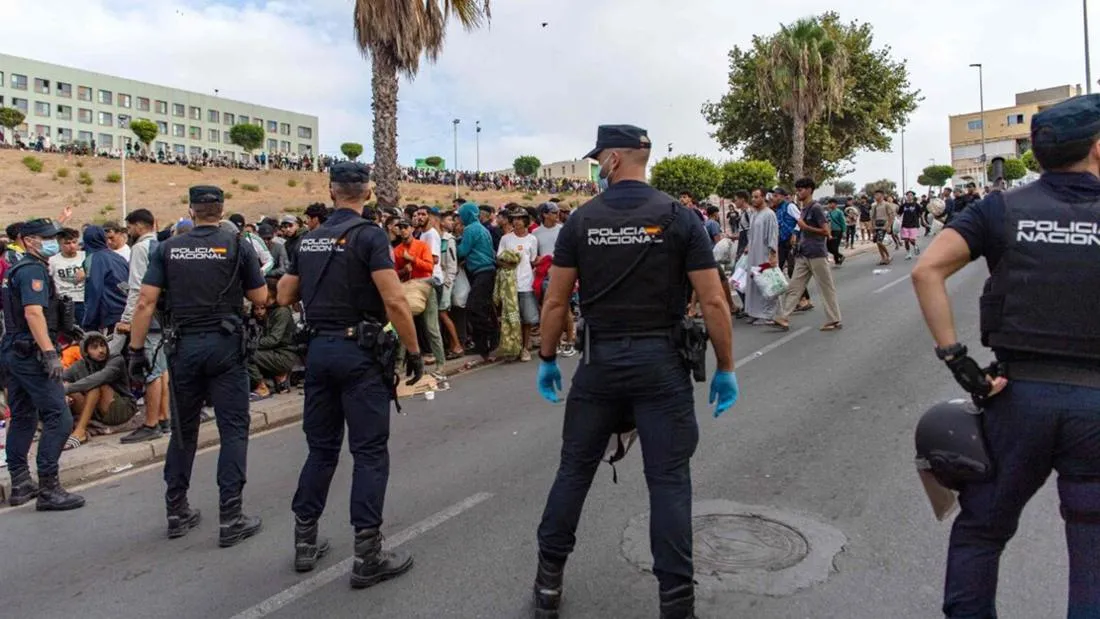

Italy's Decision to Extend Border Controls Amid Ceuta Crisis
The ongoing crisis in Ceuta has prompted the Italian government to inform the European Union of its decision to extend border controls at air and sea entry points to Spain for an additional 15 days. This move continues the suspension of the free movement of persons as stipulated by the Schengen Agreement, a decision made in light of the persistent concerns raised by the Immigration and Border Security Committee. These concerns were central to the reintroduction of controls on August 1, following the entry of tens of thousands of migrants from Morocco into the Spanish enclave of Ceuta. Italy's decision reflects a commitment to enhance monitoring of irregular migration flows while also considering Spain's ongoing initiatives with the EU aimed at stabilizing the situation in the region.
Matteo Piantedosi, Italy's Interior Minister, communicated the reasoning behind this extension to his Spanish counterpart, Fernando Grande-Marlaska, emphasizing the need for improved border security. Meanwhile, Madrid is advocating for European coordination and solidarity to effectively manage the escalating crisis in affected regions.

In the face of this critical scenario, Spanish Prime Minister Pedro Sánchez has urgently called for European solidarity to tackle the migration crisis. He highlighted Spain's past actions during similar crises, notably its willingness to accept migrants arriving on Italian soil during the Lampedusa incidents. Sánchez expressed that Spain now expects similar support, as the pressure on the Spanish enclaves and islands has significantly increased.
Spain's Appeal for Enhanced European Cooperation
Sánchez, in a recent radio interview, stressed the necessity for Europe to demonstrate solidarity not only in Ceuta but also across various migration hotspots, including Lampedusa and the Canary Islands. He questioned the lack of unified support from EU member states towards Spain and suggested that political dynamics, including Spain's progressive coalition government and its stance on issues like Gaza, may play a role in this discrepancy.
Moreover, Sánchez pointed to the rampant misinformation circulating on social media as a significant factor contributing to the surge in migrant arrivals in Ceuta. He noted that misleading narratives have fueled hopes for easier entry and residency, distorting the reality of border policies and the actual legal framework regarding migrant returns.
The Prime Minister also raised concerns about misinformation campaigns allegedly originating from Russia and Israel, questioning whether their interest in the migration crisis stems from genuine concern for Spain or broader geopolitical motives aimed at influencing European unity. He accused these networks of spreading falsehoods that misrepresent the legal challenges migrants face when attempting to enter Ceuta.
In light of these developments, Sánchez has ruled out any official accountability from Morocco regarding the crisis, emphasizing that Rabat has shown willingness for immediate cooperation on security and border management. He underscored that such cooperation is strategically vital for both nations and essential in curbing irregular crossings while facilitating legitimate mobility.
Additionally, Sánchez announced that the Spanish cabinet is set to approve an allocation of 168 million euros in aid for Ceuta, aimed at mitigating the economic repercussions of the crisis. This funding is intended to enhance accommodation capacities, security measures, and local infrastructure, assisting Ceuta in managing ongoing migration flows and ensuring social stability in the region.
As reported by merkur.de.