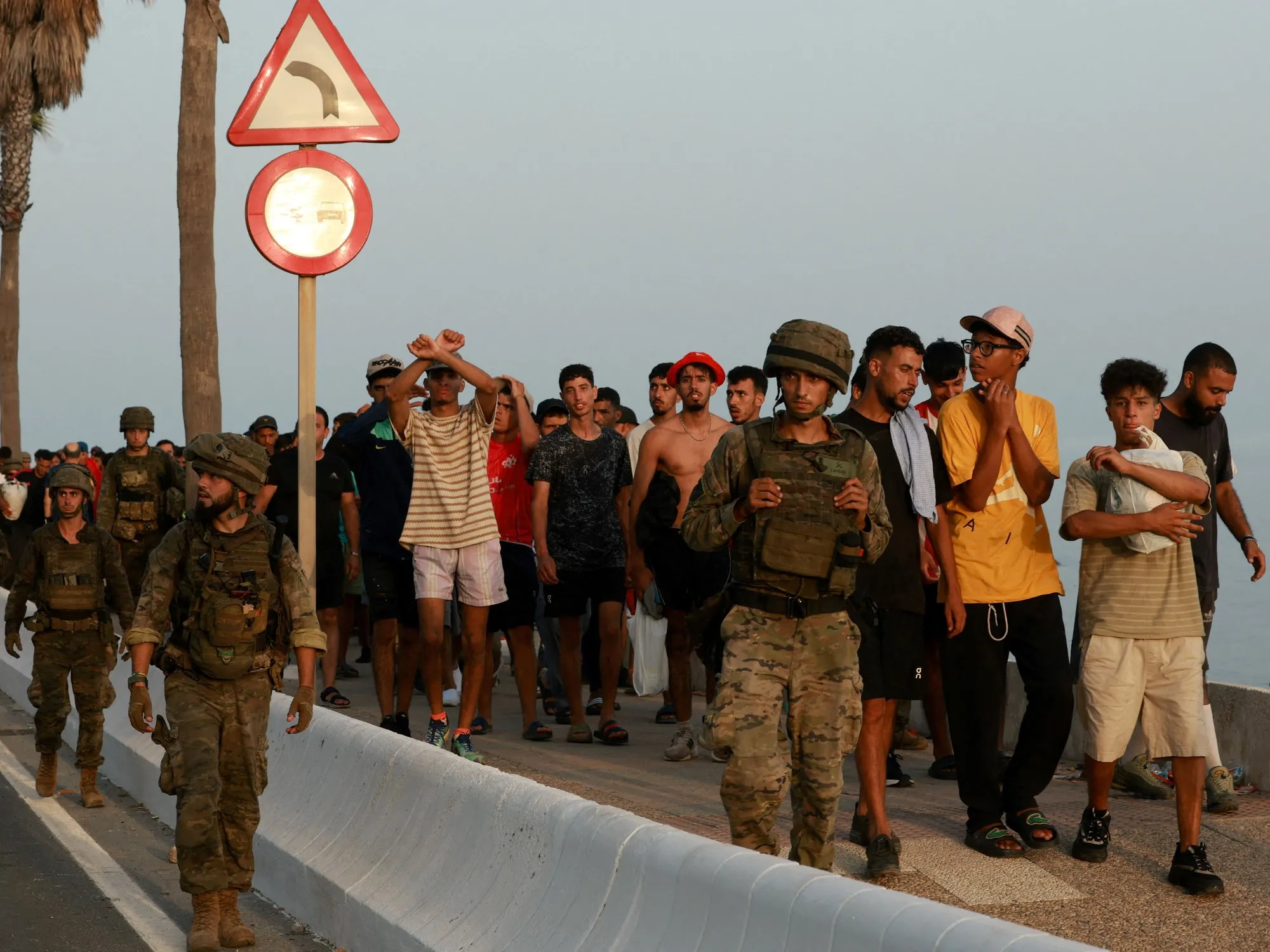

Escalating Crisis in Ceuta: Death Toll and Political Reactions
The Government delegate in Ceuta, Miguel Ángel Pérez Triano, reported this Sunday that the death toll from the massive crossing of Moroccan migrants into Spain has now reached 72, although unofficial counts suggest the number may be higher. In a related development, Italy has decided to suspend its Schengen agreement with Spain for one month, which had previously allowed for visa-free travel across borders.
Protests and Political Responses
Demonstrators have begun gathering outside the Moroccan embassy in Madrid, voicing their concerns over the situation in Ceuta and Melilla following the arrival of thousands of illegal immigrants. Social media broadcasts show attendees carrying Spanish flags, mobilizing peacefully. Moreover, the Spanish Ministry of the Interior announced that the containment barriers installed in Ceuta are now "fully operational," with the Civil Guard taking permanent responsibility for their protection. This measure aims to curb further illegal crossings.
In a show of solidarity, Ángel Víctor Torres Pérez, the Minister of Territorial Policy and Democratic Memory, defended the citizens of Ceuta, stating they are "welcoming, multicultural, and open," qualities that shine through even in dire circumstances. He called for unity in the face of division, integration over hatred, and democracy against fascism. Concurrently, the Spanish political party VOX has organized a march scheduled for this Sunday evening in front of the Moroccan embassy to express their stance on the matter.
Criticism of the government's handling of the crisis has been loud and clear. Alberto Núñez Feijóo, president of the Popular Party, slammed Prime Minister Pedro Sánchez, asserting that the "normality" the government claims exists in Ceuta is far from reality. He urged for continued efforts to end the crisis and ensure it does not recur. Similarly, Santiago Abascal, leader of VOX, labeled the situation an "invasion and an act of war," placing blame on both Sánchez and Morocco for the ongoing turmoil.
As the crisis unfolds, many families are left agonizing over the fate of their loved ones. Ibrahim and his wife await news of their 17-year-old son, who embarked on a perilous journey towards Spain. Their pleas for information underscore the human cost of the ongoing migrant crisis. Meanwhile, the Spanish Civil Guard has deployed a team of forensic specialists to assist in the identification of victims, having already conducted autopsies of those who did not survive the dangerous crossing.
In a broader context, the Italian Minister of the Interior, Matteo Piantedosi, plans to propose a new strategy for migrant repatriation centers across Europe, particularly in Africa, aimed at addressing the ongoing migration challenges. As neighboring countries grapple with their own migrant influx, the situation remains fluid and contentious.
As reported by clarin.com.