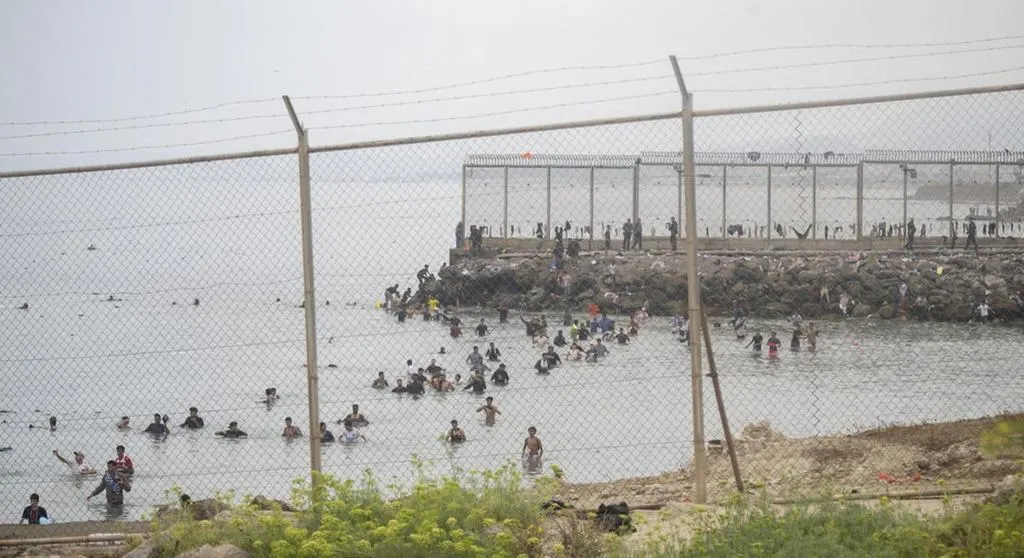

Ceuta's Ongoing Struggles with Immigration and Government Response
On August 15, an attempted new wave of migration, incited through social media, was thwarted; however, it left a significant psychological impact on the residents of Ceuta and reignited criticism of the central government's handling of the situation. The National Intelligence Center (CNI) of Spain had issued warnings about a 'credible threat,' prompting Spain to bolster security measures at the borders of Ceuta and Melilla, the two autonomous cities located at the periphery of Morocco.
Various sources indicate that Morocco intervened to halt the migration attempt, but not in the decisive manner that Madrid had hoped for, which included the expulsion of journalists from EFE and RTVE. Juan Jesús Vivas, the President of the Ceuta government, reiterated his criticisms of the Moncloa administration on Monday, highlighting the alarming influx of thousands of irregular immigrants and over a thousand minors in the city. Vivas pointed out the 'lack of an adequate response' from the Spanish government, accusing it of 'sugarcoating reality' by claiming that normalcy had been restored in Ceuta within 48 hours.
He warned that if conditions do not improve within the next 30 days, he would take the issue to the Parliament or the Judiciary. Vivas criticized the government for stating that only 2,500 individuals remained in Ceuta after the mass entry, while his estimates suggest that between 8,000 and 10,000 people are still present in the autonomous city.
Meanwhile, Health Minister Mónica García stressed the urgent need to establish temporary medical centers to care for the newcomers, whose health conditions remain unknown. After visiting Ceuta, she indicated, 'We are risking public health and the transmission of diseases in my area of responsibility. The government has been present from the very beginning; there has been no abandonment, but rather an effort to resolve a very complex situation by seeking shared solutions.'
Despite the repeated assertions from various Spanish government officials praising cooperation with Rabat, local analysts and international experts contend that Morocco's inaction contributed to the arrival of 72,000 people in Ceuta on July 30. Defense Minister Margarita Robles received near-unanimous public support when she emphasized two days ago that Ceuta and Melilla are 'very much Spanish' and 'should not be touched.' Any aggression towards Ceuta or Melilla is viewed as an aggression against all of Spain, she stated, in reference to the nationalist sentiments expressed by senior Moroccan officials.
As reported by prensa-latina.cu.