
Escalating Tensions Over Migrant Influx in Ceuta
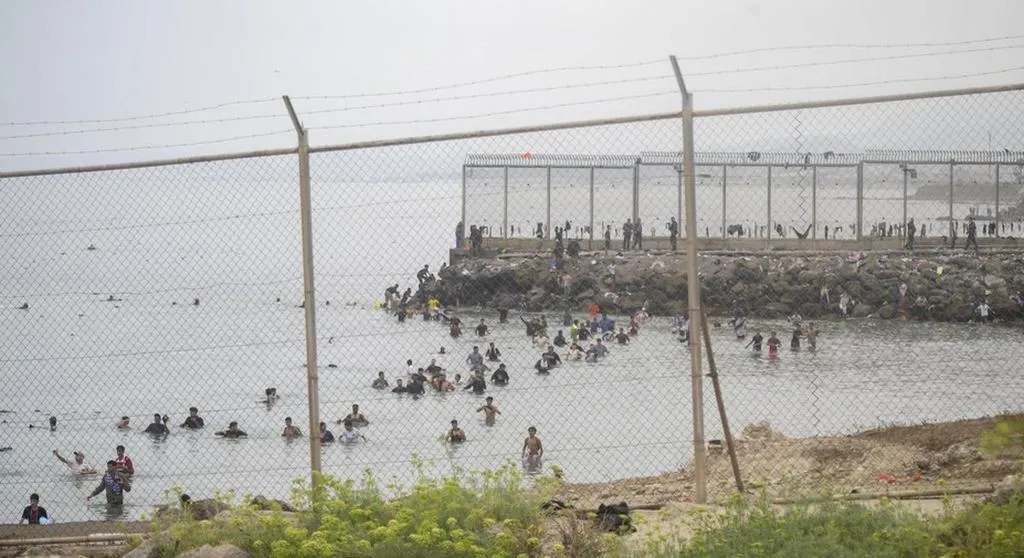
Despite the summer holiday period, the political landscape in Ceuta has become increasingly fraught since July 30, when nearly 80,000 individuals entered the autonomous city irregularly. The local government, led by President Juan Jesús Vivas of the conservative Popular Party (PP), has engaged in a continuous clash with the national government, reflecting deep-seated political divisions that show no signs of abating. Vivas has consistently criticized Prime Minister Pedro Sánchez and his cabinet, particularly following a series of meetings with Sánchez and various ministers, highlighting the ongoing frustrations regarding the handling of the migration crisis.
During a recent encounter at his summer residence in Mallorca, Vivas met with King Felipe VI, who expressed concern over the situation and promised to visit Ceuta, although no specific date was provided. In response to the crisis, Elma Saiz, the Government’s spokesperson and Minister of Inclusion, Social Security, and Migration, emphasized that the central administration is in “permanent contact” with Vivas and that both parties are committed to collaboration. Saiz remarked, “Everything related to enabling spaces and responding to this situation inevitably involves cooperation between administrations, and that is what I am engaged in, which is also the case with Mr. Vivas,” during an interview with Radio Nacional de España.
European Commission Calls for Return of Migrants
In the midst of these escalating tensions, the European Commission has made it clear that all individuals who illegally entered Ceuta must be returned to Morocco, including unaccompanied foreign minors. Markus Lammert, the spokesperson for Internal Affairs, reiterated the Commission’s stance, stating, “We continue to insist that the expectation is that all those who remain illegally in Ceuta should be returned.” Meanwhile, the Ministry of Youth and Childhood has announced urgent plans to relocate 500 migrant girls currently in Ceuta to the mainland as part of a coordinated emergency response plan with the autonomous city. This comprehensive plan includes a royal decree-law to ensure binding and solidarity-based reception by all Autonomous Communities, as well as family hosting options and other measures to expedite the process.
Despite repeated affirmations from Spanish government officials praising Morocco's cooperation, local analysts and international experts argue that Morocco's inaction has, at the very least, contributed to the influx of 72,000 individuals into Ceuta on July 30. Defense Minister Margarita Robles has garnered near-unanimous public support for her assertion that Ceuta and Melilla are “deeply Spanish” and “should not be touched.” In a related political development, PP leader Alberto Núñez Feijóo is set to make his second visit to Ceuta today, signaling an intensified opposition campaign against Sánchez and his administration’s handling of the ongoing crisis.
As reported by prensa-latina.cu.