
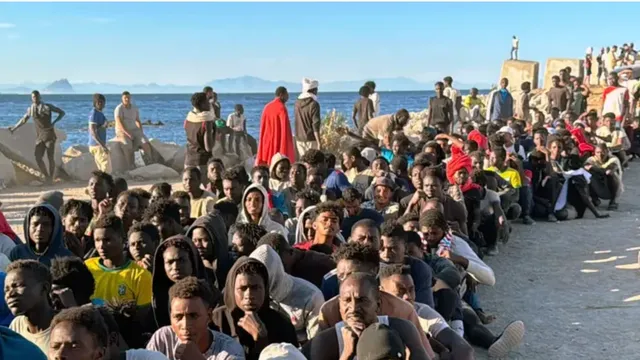

Understanding the Migration Surge in Ceuta
Ceuta, located on the northern coast of Africa, is uniquely positioned just across the Strait of Gibraltar from the Spanish mainland, making it one of only two European border cities adjacent to Africa. For many years, this city has acted as a crucial transit point for migrants seeking a better life in Europe. The summer months often see a peak in migration waves to Ceuta, frequently organized through social media platforms. The latest crisis unfolded dramatically on July 30, when tens of thousands of migrants attempted to cross the approximately five-kilometer maritime route to reach Ceuta. Some endured harrowing swims lasting up to eight hours, resulting in nearly 100 fatalities. Eyewitness accounts described the overwhelming scene of thousands of individuals, soaked and exhausted, staggering ashore in swimwear after their grueling journeys. Among the arrivals, a significant number were young men, though women, children, and even infants were also part of this influx. Alarmingly, it is estimated that at least 7,000 of these migrants were minors.
The sudden influx of immigrants, nearly equal to Ceuta's population of 85,000, overwhelmed local resources. The streets and squares became crowded with people primarily seeking food, prompting police to advise shop owners to close their businesses to prevent incidents fueled by the large crowds. Fear gripped the local residents, causing many to stay indoors. Spanish Prime Minister Pedro Sánchez commented on the rapid escalation of the situation, likening it to a wildfire spreading through mafia networks involved in human trafficking.
Legal Challenges and Responses to the Crisis
On July 29, a Spanish court ruled that migrants arriving by sea would not necessarily face immediate deportation and could seek legal reprieve. According to this ruling, individuals who swam to Ceuta had not physically crossed a border and thus needed to undergo more stringent legal processes before any potential repatriation to Morocco. Earlier this year, Prime Minister Sánchez had expanded a program allowing 500,000 undocumented migrants to legalize their status in Spain. However, this decision quickly circulated online, interpreted by many as an open invitation for migrants. Numerous new social media accounts and news outlets claimed that Spain had paved the way for those arriving by sea, leading to a surge in misinformation from human trafficking rings in Morocco, Africa, France, and the USA, which portrayed a false narrative of opportunity in Europe.
In response to the unfolding chaos, Spain deployed its military alongside the national police and Guardia Civil to bolster border security at key entry points like Tarajal. Prime Minister Sánchez visited Ceuta to expedite the deportation process. Working with Moroccan authorities, Spanish police and soldiers escorted tens of thousands back across the land border to Morocco. Local authorities and aid organizations coordinated efforts to address the overcrowding in reception centers, providing emergency assistance and focusing on special accommodations for particularly vulnerable groups, such as unaccompanied minors.
While many Ceuta residents expressed hostility and fear toward the immigrants, others showed compassion, believing that those who risked their lives in search of a better future deserved a chance to stay. However, the situation on the ground proved harsh for the migrants, who faced rejection, hunger, chaos, and stringent regulations, contrasting sharply with the false information they had initially received. It is estimated that around 70,000 individuals were returned to Morocco within just 48 hours, highlighting the complexities of the crisis.
This event, although not unprecedented, ignited a diplomatic crisis within the European Union (EU). The issue of illegal migration was exacerbated not solely by misinformation but also by discord and lack of coordination within Brussels. Shortly after the influx, EU member states began blaming Spain for supposedly encouraging migrant journeys through its policies. Twenty-two out of the 27 EU member states signed a letter initiated by Italy and Denmark, implicitly criticizing Spain's plan to legalize 500,000 undocumented migrants and asylum seekers, viewing it as an incentive for illegal migration while calling for stricter external border controls.
Italy, which does not share a land border with Spain, decided to temporarily suspend parts of its Schengen agreements with Spain and close its sea and air borders to prevent migrants who had reached Ceuta from continuing their journey to Italy. This decision received support from Finland and Denmark, while the Czech Republic demanded a temporary suspension of Spain's Schengen exit. Madrid dismissed these claims, arguing they were based on unfounded assumptions, as migrants arriving in Ceuta had no means of entering the Schengen area, and the majority had already returned to Morocco. In response, Madrid implemented border controls for incoming travelers from Italy.
On August 4, the situation took a turn when EU interior ministers convened a virtual meeting to learn from the crisis in Ceuta and discuss further actions. Following the meeting, the ministers issued a statement expressing solidarity with Spain and condemning attempts to divide the EU. They agreed that the migration flow into Ceuta had been halted and would not, as initially feared, spread to other countries. The Danish interior minister, Morten Bodsko, expressed satisfaction with Spain's crisis management while emphasizing the need for stricter EU border controls, stating, "Uncontrolled migration poses a threat to Europe and Denmark." In a subsequent statement from the EU Council, a general consensus emerged about the need for a resolute fight against smuggling networks, increased repatriation of migrants, securing EU external borders, establishing close partnerships with third countries, and enhancing planning capabilities.
Despite these discussions, Europe still faces significant challenges. The differences between Italy and Spain persist, with local authorities in Ceuta reporting that around 1,100 unaccompanied minors remain in the area. Many of these minors are reluctant or unable to return, not only because they hail from Morocco but also from conflict-ridden countries like Sudan. Ultimately, addressing the root causes of illegal migration, such as combatting poverty, creating job opportunities, reducing inequality between Europe and Africa, and providing more opportunities to people in Africa and beyond, remains crucial for an effective solution.
As reported by vietnam.vn.

