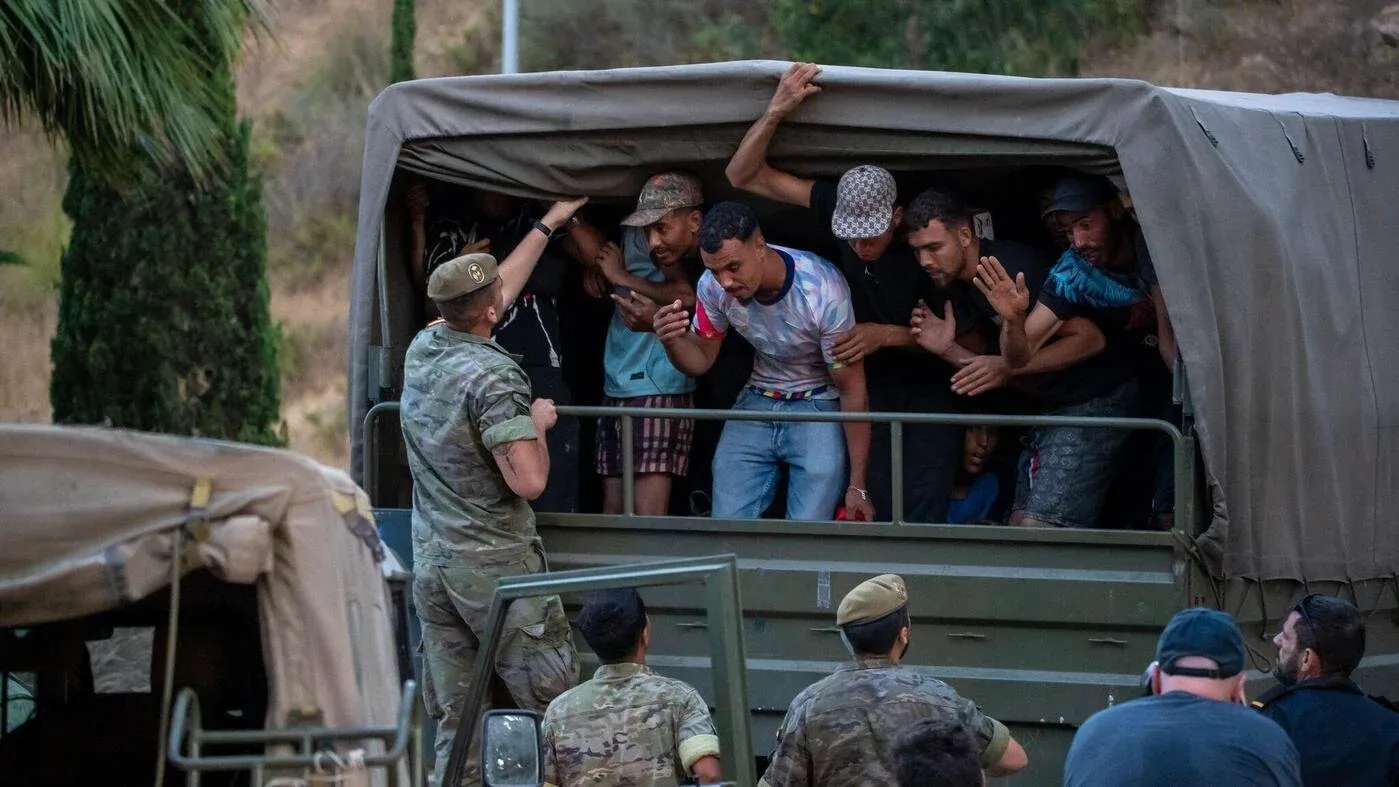

Morocco's Explanation for the Mass Influx of Migrants
The recent surge of migrants reaching the Spanish enclave of Ceuta has reportedly seen the majority return to Morocco. However, the Moroccan government has denied responsibility for this influx, attributing the situation to misinformation circulating on the internet. According to a spokesperson from the Interior Ministry, this sudden wave of migrants was not a coordinated effort but rather a spontaneous occurrence fueled by false claims online, smuggler activities, and a misinterpretation of a Spanish court ruling that limits the repatriation of certain migrants.
In light of the crisis at the border with Morocco, there have been speculations suggesting that the Moroccan government may have intentionally instigated or at least tolerated the mass migration to apply pressure on Spain. Multiple migrants have independently reported to Spanish media that they were not deterred but rather encouraged to cross the border, and many noted that they were made aware of the supposedly open border through videos and messages shared on platforms like TikTok.
On Sunday, the Moroccan Interior Ministry reiterated its commitment to cooperating with Spanish authorities, asserting that it remains a reliable partner in combating irregular migration. Officials estimate that around 40,000 migrants aimed to reach Ceuta, with an additional 1,100 attempting to reach Melilla, another Spanish enclave in North Africa, which is similarly surrounded by Morocco and the Mediterranean Sea.
The Spanish government, however, estimates that 50,000 to 60,000 migrants made their way to the isolated enclave from Morocco in a short period before returning. The Moroccan side has reported 11 fatalities, while Spanish authorities have indicated that at least 72 migrants have died in the attempt to reach Ceuta, many of whom drowned while trying to swim.
Political Repercussions and EU Response
Reports surfaced on Sunday indicating that the Spanish government had received intelligence warnings regarding a potential wave of migrants heading to Ceuta and Melilla, which it allegedly ignored. Intelligence sources warned that Moroccan King Mohammed VI might initiate a "gesture of generosity" coinciding with the Throne Festival. Additionally, in the days leading up to the Thursday surge, numerous buses from various locations in Morocco arrived in the border town of Fnideq.
In the ten days preceding the Thursday influx, at least 1,000 individuals had already reached Ceuta by sea. Intelligence agencies interpreted these movements as a trial run by Morocco and issued further warnings to the government. A high-ranking unnamed government official indicated to the newspaper "El País" that the administration had not anticipated the crisis in Ceuta.
Currently, normalcy is gradually returning to Ceuta, with reports from the Spanish government stating that nearly all of the estimated 50,000 to 60,000 migrants have voluntarily returned to Morocco, as prospects for onward travel appeared bleak. The city, with a population of fewer than 85,000, faced significant shortages in accommodation and resources.
To bolster its control, Spanish authorities have installed a 500-meter floating barrier between the Moroccan coast and Ceuta's Tarajal beach, alongside buoys from the Spanish Navy to enhance monitoring and surveillance of the coastline. Meanwhile, the Ceuta crisis continues to spark political debates at the EU level. German Foreign Minister Johann Wadephul has called on the EU Commission to prioritize the protection of external borders, emphasizing that the recent situation in Ceuta has tested their resolve.
Wadephul highlighted the vulnerability of Europe and stressed the necessity of swift action against misinformation that endangers lives. Reports indicated that false information about an "open" Spanish border circulated widely on social media. He further noted that effective migration policies cannot succeed without cooperation from third countries, citing Morocco as an essential partner in controlling illegal migration.
As the situation stabilizes, several European leaders have increased pressure on Spain through an open letter expressing grave concern over the situation and indirectly blaming Madrid for sending mixed signals with recent decisions regarding immigration policies. This includes Spain's legalization of approximately 500,000 irregular migrants as a measure against labor shortages. The letter also connects the surge to a ruling from Spain's Supreme Court, which stipulated that immediate rejection of migrants is permissible only if they have crossed a physical barrier during illegal entry.
The letter is addressed to EU Council President António Costa, EU Commission President Ursula von der Leyen, and Irish Prime Minister Micheál Martin, who currently holds the EU Council presidency. The initiative for the letter came from Italian Prime Minister Giorgia Meloni and Danish Prime Minister Mette Frederiksen, with 22 European leaders signing it. Notably, Spain, Ireland, France, Luxembourg, and Portugal did not endorse it.
“We cannot allow uncontrolled mass crossings or the manipulation of migration to create the impression that illegal entry into the European Union is possible,” the letter states. The signatories have requested an extraordinary video conference of interior ministers, which is now scheduled for Tuesday. In response to the European criticism regarding Spain's handling of the migration crisis in Ceuta, Prime Minister Pedro Sánchez has also called for a digital special session of the interior ministers of all 27 EU member states.
Sánchez expressed concerns over the behavior of certain member states during the Ceuta crisis, stating that such attitudes driven by bias, misinformation, ignorance, or political interests contravene European law, humanitarian law, and the principles of solidarity that bind the EU. He characterized the events during his visit to Ceuta as an "attack" on Spain's territorial integrity, attributing the rumors regarding an open border to the "smuggler mafia".
By Friday morning, tens of thousands of migrants had crossed the border between Morocco and Ceuta within 24 hours. To restore order, the government deployed 60 soldiers and 200 special police forces to Ceuta, marking the first time since 2021 that the Madrid government has utilized military support for border security.
“It is not the first time Morocco has used migrants as leverage against the EU and particularly Spain,” noted observers, highlighting the complex dynamics between the nations. Tensions persist, especially in light of recent confrontations reported at the border with Melilla, where individuals reportedly threw stones at security forces using tear gas. The situation remains fluid, with further developments expected in the coming days.
As reported by tagesspiegel.de.