
Political Accusations Amidst the Migrant Surge
In a significant political uproar, France’s right and far-right factions have openly criticized the Spanish government and Prime Minister Pedro Sánchez for allegedly fostering an influx of undocumented migrants crossing from Morocco into the Spanish enclave of Ceuta. This assertion has ignited fierce debates, especially as the French left countered these claims, accusing their political opponents of disseminating misinformation and exploiting the situation as the presidential election approaches. The tensions surrounding this migration crisis have drawn in various European nations, with Italy taking notable measures by suspending the Schengen agreement, which typically allows for free movement across borders within the EU. Despite Italy not sharing a land border with Spain, the suspension directly impacts air and sea travel, emphasizing the interconnectedness of European nations when faced with migration challenges.
Understanding the Migrant Influx and Its Implications
Recent reports indicate that approximately 60,000 migrants have crossed into Ceuta from Morocco, with Spain’s Interior Ministry confirming that around 48,300 have since returned to Morocco. This mass crossing has been labeled by Sánchez as an “attack on Spain’s territorial integrity,” amidst Morocco's long-standing claim over Ceuta. The political ramifications of this migration are far-reaching, with French far-right leader Marine Le Pen condemning the situation, asserting that it was a result of Spanish governmental policies promoting mass legalization of undocumented migrants. This assertion has sparked calls from leaders such as Jordan Bardella, president of the National Rally in France, for the EU to reconsider Spain’s Schengen membership amid concerns of 'passive complicity' in the crisis. The political landscape is further complicated by a variety of viewpoints, including those from the center of French politics, where figures like Édouard Philippe argue against unilateral immigration policies that could create a pull factor for the continent.
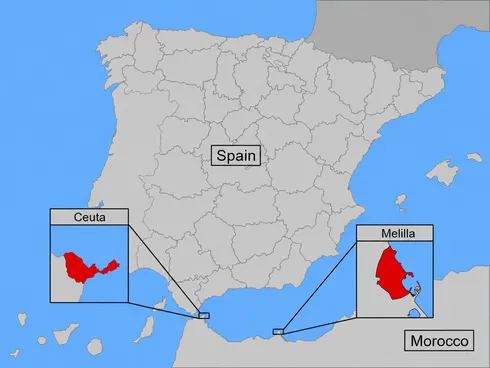
The geographical significance of Ceuta and Melilla, the two Spanish enclaves on the African continent, cannot be overlooked. Their borders with Morocco are the only land frontiers the European Union shares with Africa, rendering them critical entry points for migrants seeking to reach Europe. Despite security measures like fencing and surveillance, large-scale breaches occur, highlighting the persistent challenges faced in managing migration flows. The recent events echo past incidents, such as the 2021 surge of over 8,000 migrants into Ceuta in just two days, raising questions about the underlying causes of such mass movements and the broader implications for European immigration policy.
As reported by ynetnews.com.