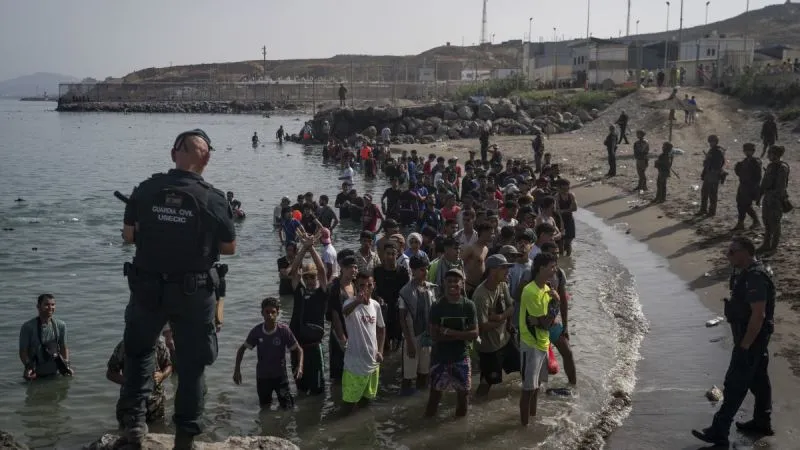

Ceuta, a small Spanish enclave nestled in North Africa, appeared to recover over the weekend from the brink of collapse, yet its inhabitants remained deeply shaken by the tumultuous events of the past week. A significant number of the approximately 60,000 migrants who had surged into the city during the week made their way back to Morocco by Sunday. However, some individuals chose to stay in the hills surrounding Ceuta, while Spanish Civil Guard boats continued their search for bodies in the waters near the urban beach that had been crossed by tens of thousands just days earlier.
Local businesses reopened, and the usual blend of residents and tourists returned to fill outdoor terraces, restaurants, and cafés in the city, which boasts a population of around 84,000. Despite this semblance of normalcy, the city, known for its rich tapestry of four cultures, still grappled with the ramifications of the mass arrival at its borders. Residents engaged in heated discussions about the origins of the crisis and who bore the true responsibility for the situation.
According to Spanish authorities, at least 72 migrants lost their lives during this crisis, with some drowning and others succumbing to injuries sustained while attempting to breach a breakwater barrier. The sudden influx of thousands of individuals reignited debates surrounding migration policy in Europe and beyond. "It is not the young people's fault," stated Mohamad Abdelkader Driss, a 44-year-old waiter at a local fried fish restaurant. "If you open the border, of course, everyone will come in, but the youth should not be blamed. The authorities are responsible for this situation."
Related Article: Sánchez Criticizes EU's 'Selfish' Response as Death Toll Rises in Crossings to Ceuta
Some migrants who returned to Morocco recounted that the border was virtually open, with authorities seemingly doing little to prevent the mass crossings. The Moroccan Ministry of the Interior reported that around 40,000 people attempted to cross into Ceuta last week, attributing the influx to misinformation circulating online, human trafficking networks, and misinterpretations of legal and administrative information, among other factors. The unauthorized arrival of between 50,000 and 60,000 individuals on Thursday and Friday, primarily young men, surged Ceuta's population by more than half. Abdelkader lamented the tragic events but noted that the behavior of those who crossed the border was relatively calm. "It could have been much worse," he remarked.
Over the weekend, far-right Spanish politicians and prominent right-wing influencers descended upon the city, provoking counter-protests that involved many members of Ceuta's diverse Muslim community, most of whom are of Moroccan descent. Alvise Pérez, a far-right politician and Member of the European Parliament, called for the expulsion of migrants while facing a crowd of opposing demonstrators. The situation escalated to the point where Pérez had to seek refuge in a bar as residents pounded on the windows until police escorted him away.
Among the protesters opposing Pérez's presence was Noor Ahmed, a 20-year-old student from Ceuta. She condemned the protest and the involvement of figures like Pérez in her city, asserting that they were attempting to exploit the humanitarian crisis currently unfolding in Ceuta. "They only want to profit from the humanitarian crisis that Ceuta is experiencing right now," Ahmed stated.
On Sunday, Santiago Abascal, leader of the far-right Vox party, visited Ceuta and criticized the Spanish government for the mass influx of migrants, labeling it an 'invasion.' He asserted, "The borders of Ceuta and Melilla are the walls of our home and our homeland, and they are not being protected by a corrupt and treacherous government." While some residents acknowledged that Ceuta's identity is enriched by its harmonious coexistence of Christians, Muslims, Jews, and Hindus, they expressed concerns about what this week's events revealed about their society.
Eva Barrientos, a logistics worker and Ceuta resident, attended the Saturday night protest to hear what Pérez and other right-wing figures had to say. She voiced her belief that a similar crisis could occur again and questioned the loyalty of some foreign-born residents towards Spain. "In Ceuta, we have always coexisted. We have four cultures that live together very well, without any problems," she commented. "But what we are discovering now is that there is an enemy within." She also accused some foreign-born residents of having greater loyalty to Morocco than to the country in which they reside.
Pope Leo XIV expressed his concern over the 'alarming situation in Ceuta' on Sunday and prayed for peaceful, stable, and just solutions to emerge. Migration has been a priority for Pope Leo XIV, a topic he highlighted during his recent visit to the Canary Islands, a major entry point for migrants into Europe.
As reported by cnnespanol.cnn.com.