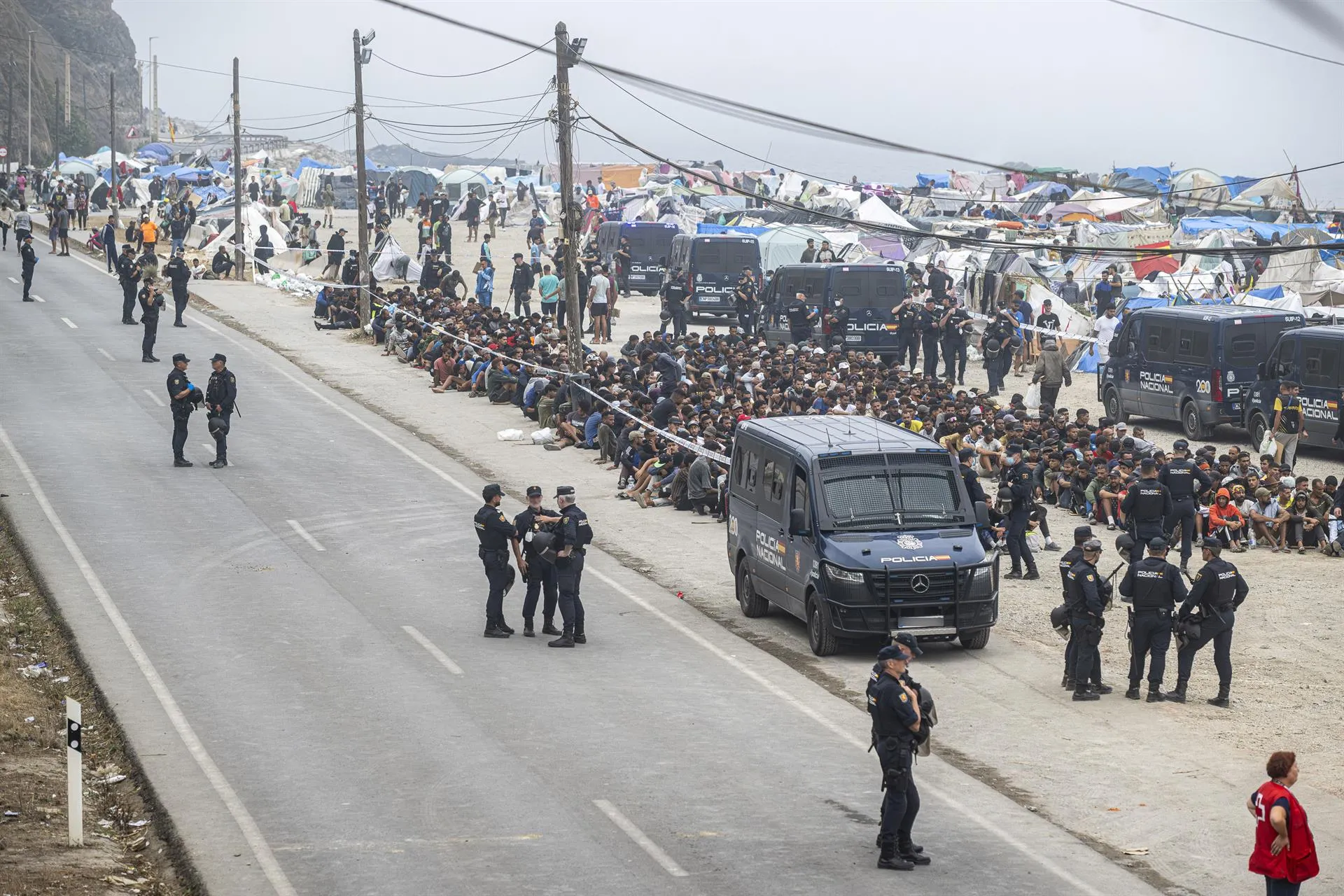

The Spanish authorities have completed the evacuation of a major migrant camp located in the North African exclave of Ceuta. This operation, which began in late July, saw more than 3,000 individuals living in makeshift shelters at the Trampolín beach removed by police and military forces. As reported by the Spanish government, all these migrants have now been taken away from the beach, yet the situation remains complex and fraught with tension.
According to RTVE, the migrants were transported in buses to the Tarajal border crossing, where they faced a difficult decision: to either return immediately to Morocco or register to receive emergency accommodations in a tent camp. A spokesperson from the Ministry of the Interior stated that the migrants could voluntarily choose to return to Morocco or opt for registration. However, many are apprehensive about the registration process, fearing that it might facilitate their deportation back to Morocco, which is designated as a safe country of origin. This fear is compounded by the possibility that their biometric data could lead to easier identification and subsequent deportation if they manage to reach mainland Spain or other EU countries.
Reports indicate that on the first day of the evacuation, approximately 600 people opted to return to Morocco. By the second day, many of those who had been living in plastic-sheet huts for months fled into nearby forests to avoid registration. Humanitarian organization Mission Lifeline criticized the Spanish authorities for their approach, arguing that the presence of heavily armed police and armored vehicles undermines any claim of voluntariness or adherence to legal processes. The head of the NGO, Nolte Bauer, emphasized the need for individual assessments for each person involved.
In a related development, the Spanish royal family is scheduled to visit Ceuta and Melilla on October 13 and 14, as tensions with Morocco have heightened following the large influx of migrants that began at the end of July. The visit, coordinated between the government and the royal household, marks the first time since 2007 that a Spanish monarch has visited these enclaves, a trip that previously triggered a diplomatic crisis with Morocco.
In late July alone, it is estimated that up to 80,000 migrants crossed from Morocco to Ceuta, although most returned shortly thereafter. Nonetheless, thousands continue to remain in this Spanish exclave, highlighting the ongoing challenges surrounding migration and border control in the region.
As reported by zeit.de.