
The Humanitarian Crisis Unfolding in Ceuta
As soon as you disembark from the ferry at the terminal in Ceuta, a Spanish enclave on the North African coast, you are immediately approached by migrants from all directions. Rather than asking for money, they convey their desperation through gestures, pointing at their mouths or rubbing their stomachs—signs of hunger. In the first 20 minutes of your arrival in this city of just 84,000 residents, you are likely to encounter hundreds of individuals seeking help.
In late July, a staggering influx of between 80,000 and 100,000 undocumented migrants surged into Ceuta, overwhelming the local population. The majority of these newcomers were men, predominantly from Morocco, with a notable number hailing from sub-Saharan Africa. Although many left within a day, between 8,000 and 12,000 remained, including at least a quarter who were unaccompanied minors. As the situation escalated, the scenes became increasingly chaotic, with groups of migrants scattering throughout the city—on benches, in parks, and along streets—often appearing lost and hopeless with smartphones in hand.
The atmosphere in Ceuta has taken on a dystopian quality, underscored by sirens and the presence of police and military personnel. Spanish troops have been deployed, and armored vehicles patrol the streets, trying to maintain order amid the chaos. Local law enforcement frequently intervene in disputes that seem to erupt at any moment. The city's only reception center, initially designed to accommodate 500 individuals, has become a desperate shelter for around 800 migrants, including numerous women and children. Those who are unable to gain entry are left to fend for themselves in a city that has rapidly transformed from a tranquil locale into a humanitarian crisis zone.
The Struggles of Migrants in Ceuta
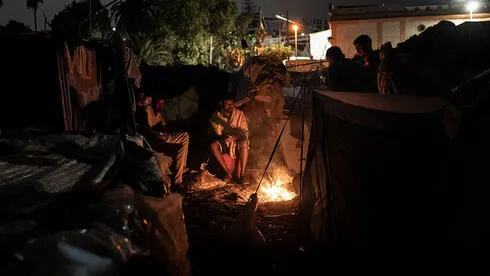
Many migrants have congregated at Playa del Trampolín, a beach that symbolizes their hopes of using Ceuta as a launchpad into Europe. Despite its status as a part of Spain and the European Union, Ceuta does not allow for easy passage into the Schengen Area, which complicates the dreams of those who have risked everything to reach its shores. A sprawling makeshift settlement has emerged, inhabited by at least 5,000 people, where the air is thick with the stench of human waste and neglect. Here, stalls sell basic necessities, while drug dealers operate openly, taking advantage of the lawlessness that characterizes the area. The makeshift community is marked by signs of desperation, with many men sleeping in shallow depressions in the ground, resembling communal graves.
Behind the tents designated for women and families, a fenced-off area houses survivors of sexual violence, highlighting the pervasive dangers that lurk in the camp, particularly after dark. Violence and competition for resources fuel tensions among the migrants, while police and humanitarian volunteers make their exits as night falls, leaving many vulnerable. Daytime efforts by aid workers—who distribute food and basic supplies—stand in stark contrast to the lawlessness that descends at night, when the camp becomes a battleground for survival.
The recent surge in migrant numbers has provoked a range of reactions from the local populace. Many residents, who have historically been sympathetic to migrants, are now grappling with fear and resentment as their city feels overwhelmed. The situation has spiraled into a crisis that extends beyond Ceuta's borders, with residents voicing their frustrations and anger towards the Spanish government for its handling of the influx. The complex interplay between migration, economic disparity, and local social dynamics has set the stage for a long and arduous struggle for both migrants seeking asylum and the residents of Ceuta trying to navigate an uncertain future. The crisis has left many questioning the motivations behind the mass crossings and the broader implications for Spain and Europe as a whole.
As reported by ynetnews.com.