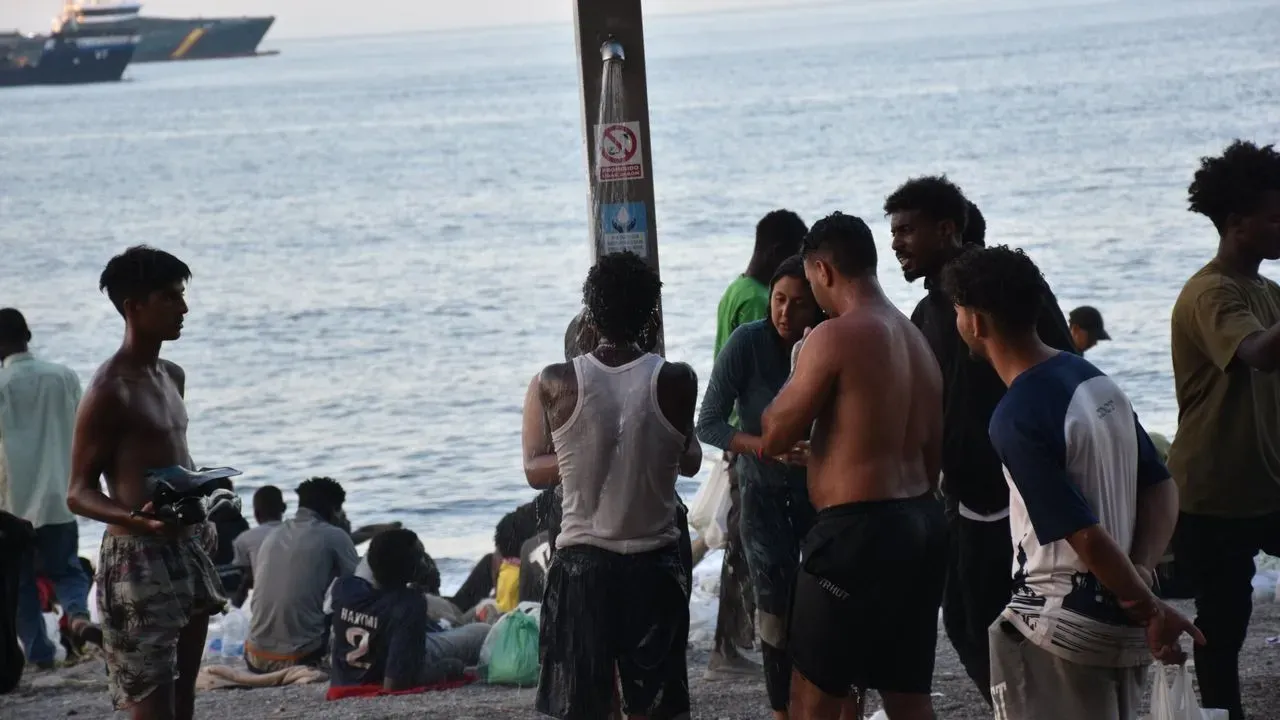

The President of Ceuta, Juan Jesús Vivas, described the events of July 30 and 31 as not merely a typical migration crisis. He emphasized that this situation has jeopardized Spain's territorial integrity and raised serious concerns regarding national security, particularly as it relates to Morocco, a third country that does not recognize Spain's sovereignty. During an extraordinary session of the European Parliament's Interior Affairs Committee, Vivas asserted that the recent influx of over 72,000 individuals into the autonomous city is part of a larger strategy of 'hybrid warfare' and 'premeditated occupation' orchestrated by the Moroccan kingdom, which seeks to manipulate migration pressures to counteract the Spanish government's attempts to frame the situation solely as a humanitarian crisis.
While the government led by Pedro Sánchez acknowledges that the events in Ceuta constitute a violation of Spain's territorial integrity, it has refrained from directly blaming Morocco, instead pointing to the human trafficking mafias that took advantage of the situation. Vivas highlighted that these groups have made an 'interested reading' of a recent Supreme Court ruling that restricts the practice of 'hot returns' for migrants arriving by sea. Although the Popular Party (PP) does not deny that the Supreme Court's ruling from July 16 could have acted as a trigger, they are focused on the alarming fact that tens of thousands managed to breach one of the most tightly monitored borders in the Maghreb, without a state boasting significant police and intelligence capabilities being able to stop them.
Recent images from those days depict the passivity of Moroccan authorities, drawing parallels to a similar incident in 2021, where nearly 10,000 individuals entered Ceuta within a mere 48 hours amid diplomatic tensions stemming from the reception of Brahim Gali, the leader of the Polisario Front, for COVID-19 treatment in a hospital in Logroño. Although the context in 2026 is different, it includes elements that could also be uncomfortable for Rabat, such as Sánchez's recent visit to Algiers and the proposal to grant nationality to Sahrawis born under Spanish administration, which is still pending approval in Congress.
So far, the government has opted for caution in its statements to protect the delicate bilateral relationship between Spain and Morocco, a critical axis of Sánchez's foreign policy. The PP has also avoided direct confrontation with King Mohammed VI's regime, focusing instead on criticizing the central government for its perceived inaction and 'lamentable' management of the crisis. 'We need to oppose the government,' they justify at the upper echelons to sidestep direct conflict with Rabat.
This crisis has further widened the rift between Moncloa and Génova, as the PP has utilized its influence in the Senate to pressure the government. They have called for a session this week in the respective committees involving the ministers directly implicated in the Ceuta crisis. The PP insists that Interior Minister Fernando Grande-Marlaska and Defense Minister Margarita Robles must clarify what information was available to the Interior Ministry and the National Intelligence Center prior to the mass entry of migrants.
As reported by lavozdegalicia.es.