

Colombia's Corporate Tax Burden: An Alarming Comparison
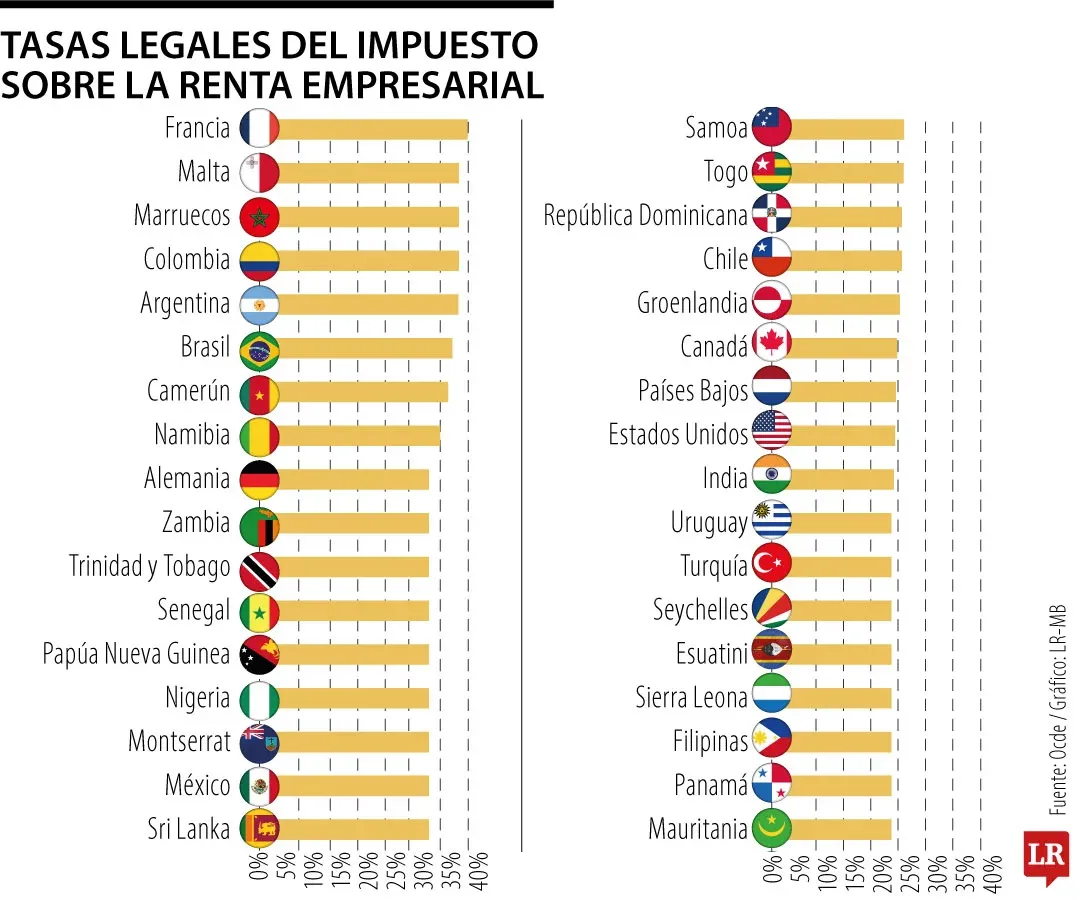
In a recent analysis conducted by the OECD, it was found that only 25 out of 146 jurisdictions have a corporate tax rate of 30% or higher. Colombia is among these countries, alongside France, Malta, and Morocco. For a business generating $100 in profits, the Colombian government can claim $35 in corporate income tax. This rate places Colombia among the highest globally, comparable to Malta and Morocco, and only slightly lower than France, as highlighted in the OECD's Corporate Tax Statistics 2026 report. Such comparisons illustrate the substantial tax burden that companies face within the country.
While the average corporate income tax rate across the 146 jurisdictions examined stands at 21.2%, Colombia enforces a general rate of 35%. France leads the pack with a rate of 36.1%, while both Malta and Morocco also maintain a rate of 35%. This stark disparity indicates that Colombian businesses are grappling with a corporate tax rate that is nearly 14 percentage points above the global average. Furthermore, the rates are significantly higher when contrasted with those in Latin America and the Caribbean, which average around 21.1%. The question arises: how did Colombia arrive at such a high taxation rate?
The Roots of Increased Corporate Taxation in Colombia
The surge in the corporate tax rate occurred in the aftermath of the pandemic. In 2021, the government increased the corporate income tax from 30% to 35%, driven by the urgent need to enhance revenue and rectify the deteriorating public finances. Andrés Langebaek, a former vice president of ANIF, noted that this increase was a desperate measure following the failure of the government's initial tax reform proposal. 'The rise from 30% to 35% could be viewed as a necessary step to boost revenue amidst the financial turmoil caused by the pandemic,' Langebaek pointed out.
The tax burden may be even more pronounced for certain sectors. According to Langebaek, industries such as mining and finance could face an additional 5 percentage points in taxation, pushing their rates to as high as 40%. 'This positions Colombia's tax rates among the highest globally,' he added.
The ramifications of this high tax rate are concerning. Langebaek argued that such elevated taxation could render Colombia less appealing for investment. Companies evaluating where to establish a factory, launch an operation, or expand their business often compare the tax obligations in Colombia against those in other countries. If the costs in Colombia appear prohibitive, potential investments may shift to more favorable economies.
For instance, a business owner contemplating relocation to Peru would find that the tax burden there is significantly lower, creating a compelling incentive to exit Colombia. The effect of high taxation can also influence competitiveness against imported products, where Colombian production struggles to maintain its market position due to the lower tax rates applicable on imports.
The OECD report underscores that Colombia's situation is not unique. France has the highest corporate tax rate among the highlighted countries at 36.1%, while Colombia, Malta, and Morocco each maintain a rate of 35%. However, it is essential to approach these comparisons with caution. A nominal tax rate does not necessarily equate to the actual tax burden faced by all companies, as nations typically offer deductions, tax benefits, special regimes, and varying rates for specific sectors.
Despite these nuances, the statutory rate serves as a crucial indicator for assessing the level of taxation that businesses, in principle, encounter and for evaluating the tax attractiveness of different countries.
The global trend regarding corporate taxation is also shifting. Over the past two decades, many countries have reduced their corporate tax rates to attract investment, with the average rate dropping from 28% in 2000 to 21.5% in 2019. However, this downward trend has largely stalled since then, with the average global rate remaining at 21.2% in 2026. Among the 146 jurisdictions analyzed by the OECD, 25 maintain a tax rate of 30% or higher, while on the opposite end, 11 have either no corporate income tax or apply a rate of 0%. The majority, totaling 74 jurisdictions, impose rates ranging between 20% and 30%.
As reported by larepublica.co.

