
In an atmosphere brimming with national enthusiasm and ongoing comprehensive mobilization, the Moroccan people, alongside the families of the resistance and the Liberation Army, will commemorate the 47th anniversary of the recovery of the Tindouf region. This event marks a significant milestone in the journey toward completing national independence and achieving the sacred territorial unity of Morocco.
The High Commission for Former Resistance Members and Liberation Army Members stated in a release that delegations of scholars, dignitaries, and elders from all tribes of the Tindouf region gathered in the capital, Rabat, on August 14, 1979, to reaffirm their allegiance to the Commander of the Faithful and protector of the faith, the late King Hassan II. They expressed their deep attachment to the glorious Alaouite throne and their loyalty and dedication to the monarch, following in the footsteps of their ancestors. This gathering linked the past with the present, emphasizing their commitment to Moroccan identity and national unity from Tangier to Lagouira, thwarting and undermining the schemes of adversaries of territorial unity and those plotting against Morocco’s legitimate rights.
During this historical moment, they presented the text of allegiance, the allegiance of acceptance and goodwill, declaring their strong bond and unity with their homeland, Morocco. The text of the allegiance emphasized the agreement among the esteemed scholars and dignitaries, men and women, young and old, to renew their pledge to the Commander of the Faithful, King Hassan II, invoking the same oath taken by their forebears. They committed to his authority, promising to support and heed his guidance at all times, declaring themselves his allies and defenders.
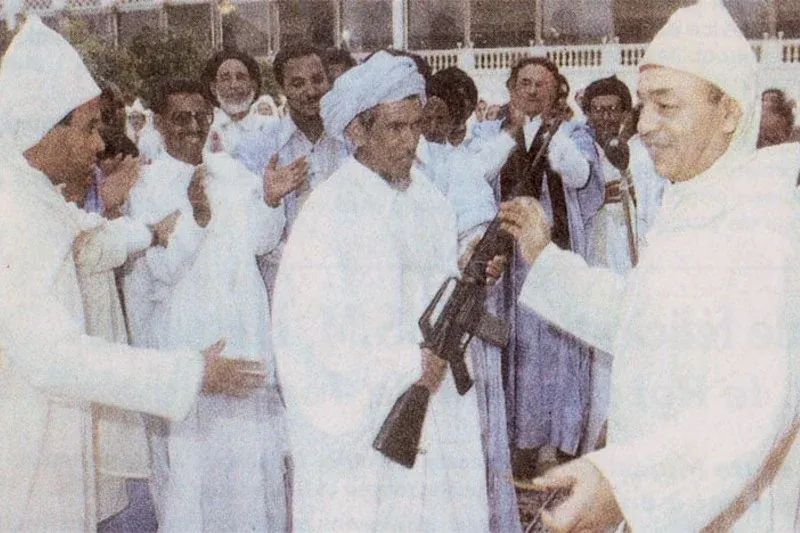
This occasion was a monumental moment in the epic of unity, championed with unwavering faith and foresight by the architect of the Green March, who addressed the sons of the Saharan tribes, affirming the importance of their allegiance and pledging to safeguard their safety and happiness. The late monarch symbolically distributed weapons to the delegations of the Saharan tribes, indicating the ongoing struggle to defend territorial integrity and ensure security and stability in the recovered southern regions.
Only a few months later, the meeting was rekindled when the initiator of the Green March visited the Tindouf region during the Throne Day celebrations. This reaffirmed the strong bond between the Alaouite throne and the inhabitants of these resilient regions, successfully countering the schemes of those opposed to unity. Morocco has since progressed on the path of development, integrating its southern regions into the national effort for sustainable and comprehensive development, defending its territorial integrity and showcasing to the world the legitimacy of its rights and the Moroccan people's consensus to uphold them.
The commission highlighted that August 14, 1979, stands as a historic day in the series of struggles and achievements aimed at achieving territorial unity and completing national sovereignty. It marks the culmination of a long and arduous path of struggle filled with lessons, following decades of Spanish colonial presence in the southern regions. The liberation efforts began with the city of Tarfaya on April 15, 1958, followed by Sidi Ifni on June 30, 1969, culminating in the recovery of the southern regions after the Green March on November 6, 1975, thanks to the genius of the late King Hassan II and the struggles of the resilient inhabitants, ultimately leading to the recovery of the Tindouf region on August 14, 1979.
Continuing the legacy, King Mohammed VI has taken up the mantle of defending national unity, dedicating utmost attention to the recovered southern regions and caring for their inhabitants, reinforcing the bonds of unity and continuous national mobilization to protect the sacred territorial integrity.
As the 47th anniversary of the return of this region to the homeland approaches, efforts to develop this cherished part of the nation continue with the same determination and resolve. Since the recovery of this region and other southern territories, major projects and initiatives have been launched across various economic, social, cultural, and infrastructural domains, establishing a robust regional economy that creates job opportunities.
The commission noted that the vision for inclusive and sustainable development prioritizing citizens has paved the way for profound transformation in the Dakhla-Oued Ed-Dahab region and the three southern regions, which had not seen any economic or social development during the occupation. Today, they thrive on an ongoing dynamic of comprehensive and integrated development within the national economy.
The commemoration of the 47th anniversary of the recovery of the Tindouf region, as in previous years, invites reflection on its values, lessons, and significance. It urges contemplation on this pivotal period in the history of independence, marked by development projects that reinforce territorial unity and the national economy, fostering a new society rooted in the principles of volunteerism, solidarity, and social justice.
The messages conveyed by the High Commission aim to instill these values in the hearts of future generations, nurturing a strong sense of national identity and pride. The families of resistance and the Liberation Army seize this occasion to reaffirm their continuous mobilization and vigilance alongside all segments of Moroccan society to safeguard territorial integrity and uphold national achievements. They highly value the speech delivered by King Mohammed VI on October 31, 2025, following the issuance of UN Resolution 2797, endorsing the initiative for autonomy of the recovered southern regions under Moroccan sovereignty as the sole basis for all negotiations regarding their future.
On this significant occasion, the High Commission for Former Resistance Members and Liberation Army Members will organize a speech festival tomorrow at 12:00 PM in the Agricultural Chamber of Dakhla, featuring speeches and testimonies celebrating the heroic struggle of the Alaouite throne and the Moroccan people in their tight-knit unity for the freedom and independence of the homeland and the defense of its sacred values.
Moreover, outstanding members of the resistance and Liberation Army will be honored for their notable contributions to religion, the homeland, and the throne. Financial aid and social support will also be distributed to several members of this esteemed family deserving of care and attention.
In conjunction with the festival and honoring ceremony, the foundation stone will be laid for the construction of a historical memory space for resistance and liberation in Dakhla. The regional and local offices of the High Commission for Former Resistance Members and Liberation Army Members, alongside the network of historical memory spaces across the nation, currently numbering 109, have prepared programs featuring educational, intellectual, cultural, and communicative activities that connect with national and local historical memory, in coordination with governmental and public institutions, elected bodies, and civil society organizations.
As reported by hespress.com.