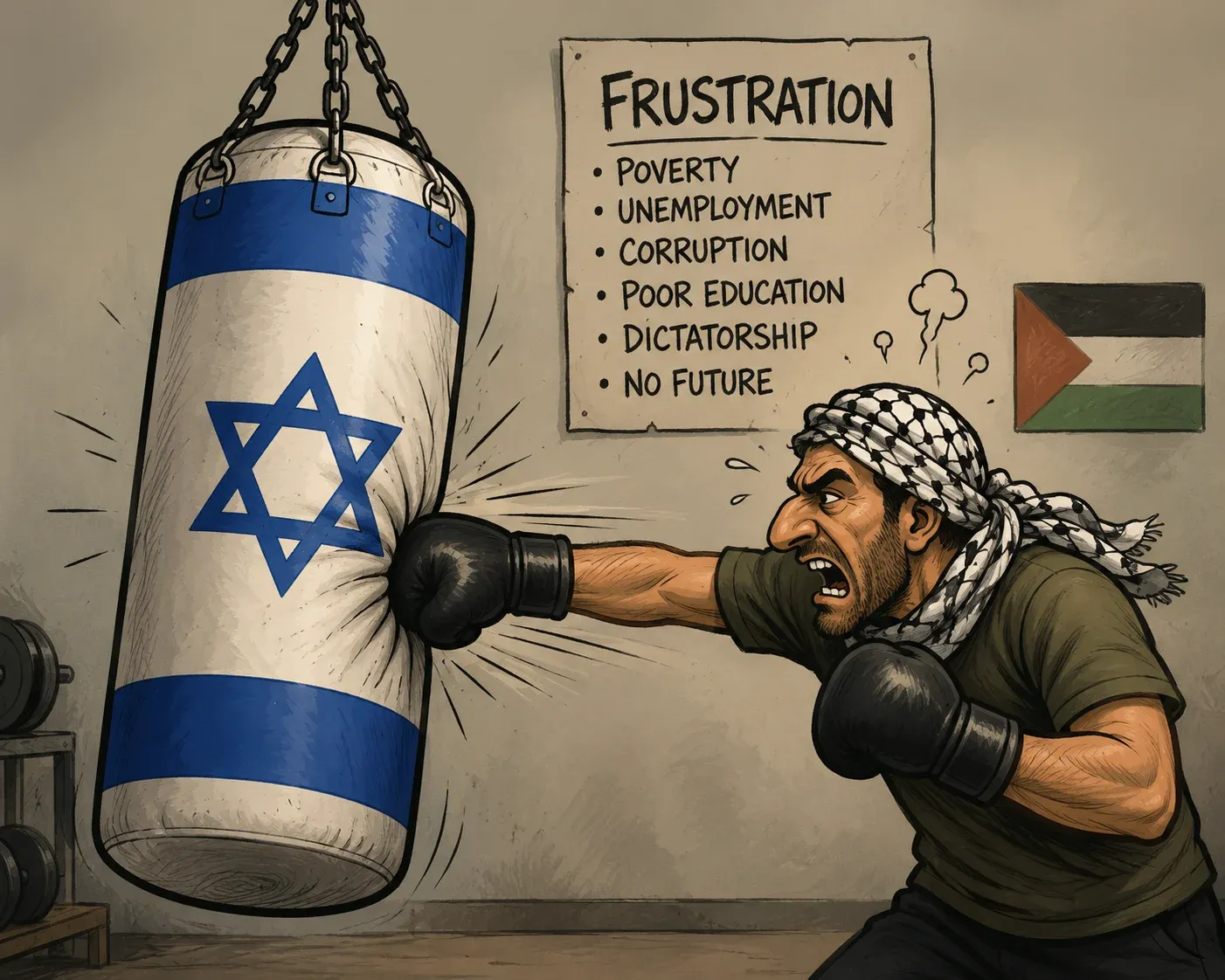

Redirecting Anger: The Myth of Israel as the Scapegoat
In every society, individuals seek ways to alleviate their frustrations, whether through exercise, music, meditation, therapy, or engaging in physical activities like boxing. Anger inherently requires an outlet, and it is a fundamental aspect of human nature. However, the tragedy faced by many in the Middle East over the decades is that this outlet has not been a healthy activity or object but rather has been directed towards Israel and, by extension, the Jewish people. Instead of addressing the genuine sources of our political, economic, and social inadequacies, we have been conditioned to believe that our suffering is a consequence of external forces. This notion has become one of the most enduring political myths within the modern Arab world.
Throughout the Middle East and North Africa, millions of young people grapple with legitimate frustrations. From Morocco to Iraq, Yemen to Lebanon, high unemployment rates persist, educational systems often fail to equip students for meaningful careers, rampant corruption undermines public institutions, and economic opportunities are severely limited. Political freedoms remain stifled in many nations, leading countless young Arabs to envision a future not in their homeland but elsewhere. These grievances are valid and should not be dismissed by any honest observer. However, the narrative provided to explain these issues warrants scrutiny.
The Dangers of a Simplified Narrative
For generations, many Arabs have been led to believe that Israel is the root cause of nearly every disappointment in the region. We have been told that Zionism is to blame for our poverty, that Israel is responsible for our political instability, and that Jewish influence is the explanation for our failures. This narrative has effectively diverted public anger away from those in power. Instead of questioning why corruption continues, why economies stagnate, or why educational systems underperform, we have taken to the streets demanding Israel's destruction, convinced that eliminating this external enemy will somehow resolve the issues that have arisen from within our own borders.
In reality, the truth is both simpler and more uncomfortable: Israel did not create corrupt institutions in Arab capitals, nor did it establish dysfunctional educational systems or embezzle public funds. The responsibility for these failures lies with those who have wielded power for decades without accountability. Blaming Israel often proves to be a politically expedient choice, as a society consumed by animosity towards an external enemy is less likely to demand answers from its own leaders.
This culture of scapegoating has far-reaching consequences, extending beyond the political realm. It has fostered an environment where hostility towards Israel often translates into animosity towards Jews as individuals. Although many insist on making this distinction in theory, it frequently collapses in practice. An illustrative example of this occurred after Morocco's World Cup defeat to France, where some individuals took to chanting against Jews and calling for Israel's destruction, despite Israel having no involvement in the match. This incident revealed how deeply anti-Israel propaganda has influenced the reactions of many who have been conditioned to blame Israel for events entirely disconnected from it.
The same disturbing pattern emerged soon after within Morocco itself, where activists publicly insulted Jacky Kadoch, the respected leader of the Jewish community in Marrakech. He was labeled a Zionist and subjected to a barrage of public abuse. Regardless of differing political opinions, targeting identifiable members of a small religious minority carries consequences that extend far beyond the individual. Jacky Kadoch, a devoted patriot who has spent decades serving his country, should not be a target for his Jewish identity. Such attacks send a chilling message to every remaining Moroccan Jew, implying that they too could become victims of public intimidation.
This reality should alarm every Moroccan, regardless of their political affiliations. Morocco's Jewish community, once one of the largest and oldest in the Arab world, has drastically declined over the past century. Those who remain are not outsiders; they are an integral part of Morocco’s rich history and culture. Jewish civilization has been intricately woven into the Moroccan narrative for over two millennia. Creating a climate where Moroccan Jews are publicly vilified is not just an attack on a single community; it is an assault on Morocco itself and the pluralistic identity that has historically set the kingdom apart from much of the region.
If the Arab world genuinely aspires for progress, it must first discard the comforting illusion that Israel is responsible for its internal failures. No nation has ever achieved prosperity by blaming external entities for issues created by its own political system. Reform cannot be attained through conspiracy theories; it requires accountability. The path to a stronger future begins with the courage to acknowledge that corruption, authoritarianism, economic stagnation, and institutional failure cannot be rectified by chanting against Israel or directing hatred towards Jews. They can only be addressed through honest self-reflection, political responsibility, and a commitment to hold our leaders accountable.
As a proud Moroccan Muslim, I reject the notion that antisemitism is a part of my identity or heritage. Morocco’s greatness has always been rooted in the coexistence of Arabs, Amazigh, Jews, Muslims, and various other communities whose histories are interwoven. When one segment of this heritage is under attack, the entire nation suffers. The future of the Arab world will not hinge on how vehemently we condemn Israel; it will depend on our willingness to confront ourselves and our own shortcomings.
As reported by blogs.timesofisrael.com.