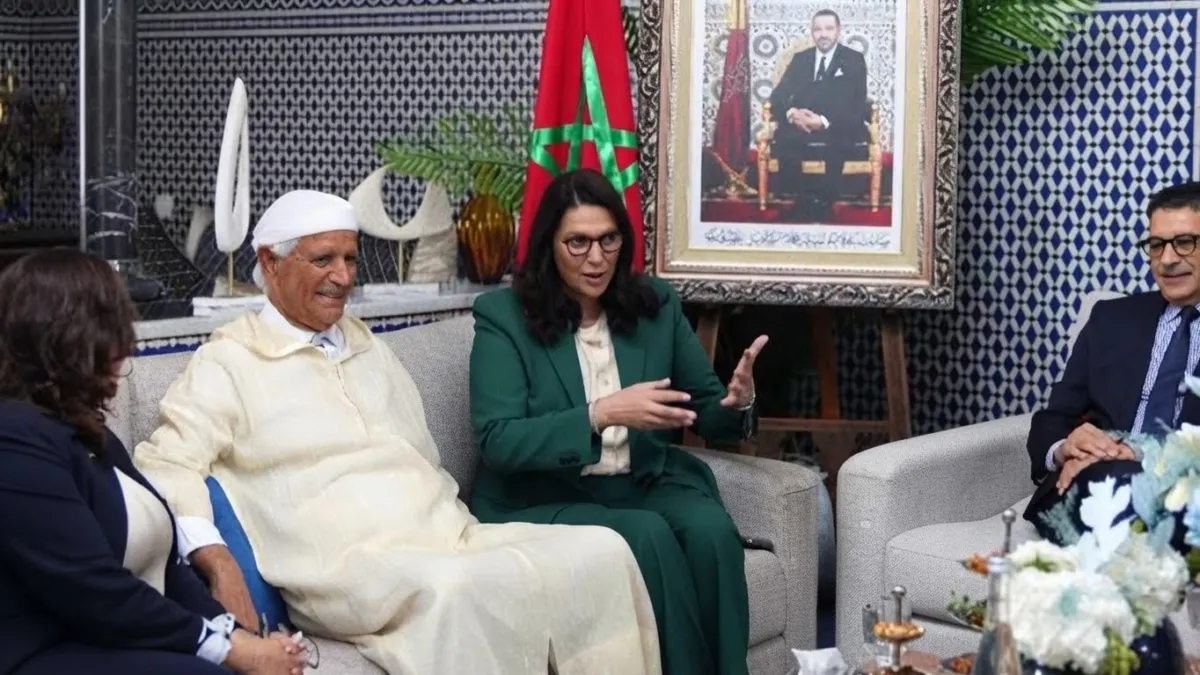

The newly appointed Prime Minister of Morocco, Fatima Zahra Mansouri, is already under scrutiny for her early decisions, even before the formation of her government cabinet. Currently engaged in a series of consultations with parliamentary party representatives to explore options for the formation of the Moroccan executive, one particular meeting has sparked discontent among the citizens. Shortly after her appointment became public, Mansouri met with Mahmoud Archane, the leader of the Democratic and Social Movement, a minor party with merely eight deputies that emerged in 1996 from the Popular Movement. Despite its small parliamentary presence, Archane's name resonates widely among Moroccans.
Archane, known as the "Executioner" during the repressive years under King Hassan II, has drawn considerable criticism. The Moroccan Association for Human Rights (AMDH) issued a robust denunciation following his meeting with the Prime Minister. During his tenure with the General Directorate of National Security (DGSN), he was responsible for a police station that operated as a secret detention and torture center, symbolizing state repression in Morocco.
Derb Moulay Cherif: A Symbol of Terror in Morocco
Even decades after retiring from the police force, Archane remains a contentious figure in Moroccan politics, though the public has not forgotten his past affiliations with the DGSN. The AMDH asserts that his name appeared on lists of torturers it had previously published, documenting human rights violations from that era. In an open letter to his torturer, activist Salah El Ouadie articulated the horrors that occurred in the basements of Derb Moulay Cherif during his imprisonment. This detention center epitomized the brutality with which Hassan II pursued dissenters and opponents for almost two decades following two failed coup attempts in the early 1970s.
As the head of this notorious police station, Archane has frequently been identified as a key figure associated with the grave human rights violations known as the "years of lead," according to the AMDH. The organization emphasizes that Derb Moulay Cherif and other secret detention centers were not merely transient locations in history; rather, they formed part of a broader system of political repression. This repression extended to members of the Authenticity and Modernity Party (PAM), led by Prime Minister Mansouri, who is now choosing to engage with one of the individuals responsible for the violations affecting her party colleagues. El Ouadie was initially part of this political formation but later distanced himself from it.
The Commission for Equality and Reconciliation
Shortly after ascending the throne, King Mohamed VI established the Equity and Reconciliation Commission (IER), a truth commission aimed at investigating the human rights violations committed during his father’s reign. In its final report, the IER recognized Derb Moulay Cherif as an illegal detention center, stating that 173 individuals had died during arbitrary detention or disappearance between 1956 and 1999 in locations like Derb Moulay Cherif. The report recommended several measures to ensure "non-repetition" of such serious human rights violations, including constitutional reforms, a national strategy against impunity, access to national archives for historical transparency, and compensation for victims.
However, four years after the report’s publication, Amnesty International criticized the "lack of political will" to implement these recommendations. The organization noted that only partial truths had been revealed regarding past abuses, the issue of justice remained unaddressed, and essential legal and institutional reforms necessary to prevent future abuses had not been implemented. Sixteen years later, the situation in Morocco has not improved. The AMDH views the meeting between Fatima Zahra Mansouri and Mahmoud Archane as an explicit culmination of the state's systematic rejection of the recommendations made by the Equity and Reconciliation Commission.
Despite the infamy surrounding Mahmoud Archane’s name, he has never faced repercussions for his actions. For the past thirty years, he has been actively participating in elections and has served as an advisor in the Moroccan Senate. In December 2018, he attended a tribute for the anniversary of Hassan II's death, where he was photographed smiling alongside then-Prime Minister Aziz Akhannouch. Just months prior, the president of the France-Morocco friendship group and the Senate's Committee on Foreign Affairs and Defense awarded Archane the institution's gold medal, prompting protests from Moroccan human rights associations. The senator defended his actions, claiming he was not a judge of Morocco's past, history, or disputes.
Nonetheless, the AMDH believes that this meeting during the official consultations for government formation transcends a mere protocol act. The organization asserts that the Prime Minister’s decision confirms the reintegration of symbols from the period of political repression into the public and institutional spheres. This can only be interpreted as a political maneuver that strengthens the position of perpetrators and grants them "symbolic immunity." According to the AMDH, "true reconciliation cannot be based on forgetfulness, nor on the political rehabilitation of those whose names are linked to serious violations, nor on turning the page on the past without a complete revelation of the truth and identification of individual and institutional responsibilities."
As reported by elindependiente.com.