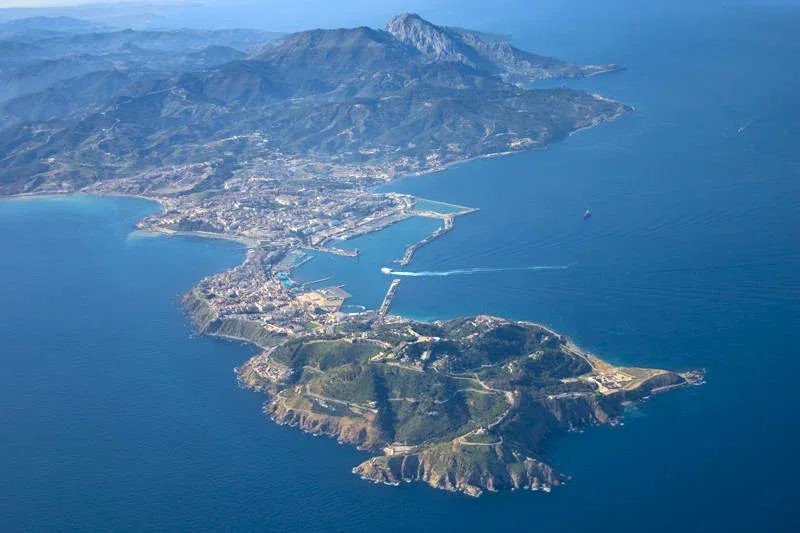

Ceuta: A Historical Examination of Sovereignty and Identity
Recent statements from Spanish commentators and intellectuals have suggested that when Portugal captured Ceuta in 1415, "Morocco did not exist." This assertion attempts to recast a military conquest as the occupation of a void, devoid of political claims or historical context. Such a narrative seeks to diminish Morocco's historical entitlement to its northern cities by effectively erasing its presence from history. However, this claim falters under basic historical scrutiny. Between the years 788 and 1415, the city now known as Sebta was under the administration of various Moroccan dynasties for over six centuries, affirming its significance and continuity within the Moroccan realm.
The Idrissids, who established the first Muslim state in Morocco, initially brought Sebta under their control. Subsequently, the Almoravids transformed it into a vital naval base, launching military campaigns from its shores, such as the notable crossing of Yusuf ibn Tashfin in 1086 to defeat Alfonso VI of Castile at the Battle of Zallaqa. The Almohad dynasty continued this legacy, maintaining Sebta as an important military and commercial port. Under the Marinids, the city flourished, marked by impressive urban and defensive growth, with robust fortifications, including the notable “Gate of Fez,” named after the Marinid capital. This historical backdrop illustrates that Sebta was far from a tribal hinterland devoid of governance; it was a thriving city characterized by a sovereign authority, a currency system, religious practices, military assets, libraries, mosques, and vibrant commerce.
Furthermore, Portuguese historical records corroborate the notion of Ceuta as a well-defended urban center, necessitating a major expeditionary force—comprising tens of thousands of troops and nearly two hundred ships—for its capture. Such a formidable mobilization of resources is hardly indicative of a political vacuum. The assertion that “Morocco did not exist” in 1415 is rooted in an anachronistic and hypocritical double standard. If the absence of contemporary borders and institutions can invalidate a state’s historical existence, then this logic must equally apply to Europe in the same era. In 1415, the Iberian Peninsula was divided among several entities, including Castile, Aragon, Navarre, Portugal, and the Nasrid Emirate of Granada, with no cohesive Spanish monarchy yet established due to the absence of the dynastic marriage that would later unify these territories.
Political landscapes were in flux across the continent, with shifting borders and evolving dynasties. While such historical complexities are acknowledged in Europe, they are often disregarded when discussing Morocco. It is crucial to note that the expedition of 1415 was initiated by the Portuguese, not the Spanish, with Spain acquiring Ceuta much later. Nevertheless, some Spanish narratives continue to frame the Portuguese conquest as the foundational moment for a Spanish city while simultaneously denying any historical connection between pre-1415 Sebta and the Moroccan state. Today, the Gate of Fez stands as a testament to the Marinid governance of the city, with contemporary Arabic accounts portraying Sebta as a prosperous urban center on the eve of its conquest. These historical records are not mere nationalist narratives fabricated in the modern era; they are authentic reflections of the city’s past.
As reported by northafricapost.com.