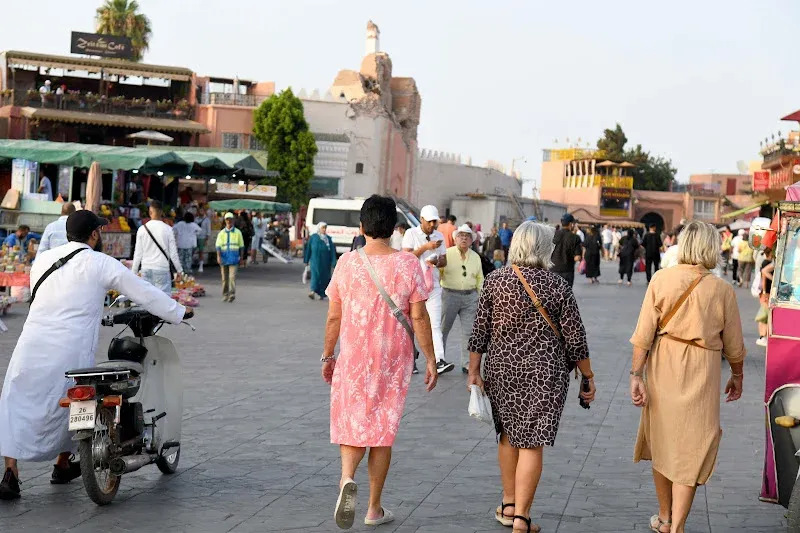

A recent academic study has unveiled significant demographic and urban transformations occurring in Marrakech, particularly within the historical medina. Over the past three decades, there has been a notable decline in the resident population, coinciding with the expansion of tourism and real estate activities, as well as the urban sprawl into new areas beyond the historical core. This analysis, published in the journal "Cities" in August 2026, employs a historical and morphological assessment of the city, utilizing urban maps, demographic data, and a review of urban planning documents associated with Marrakech.
The study's data reveals a dramatic decrease in the population of the medina, dropping from 192,323 residents in 1994 to 166,711 in 2004, then further down to 120,222 in 2014, and ultimately reaching 81,103 in 2024. This represents an alarming decline of nearly 58% over thirty years. In stark contrast, the total population of Marrakech has surged from 861,205 in 1994 to 1,560,103 in 2024. Similarly, the population in the Menara district has experienced growth from 148,403 inhabitants to over 519,000 during the same period, emphasizing a significant shift of population growth away from the historic center.
Declining Residents Within the Walls
The study connects the drop in residents within the medina to a myriad of compounding factors, including changes in family structures and housing preferences, a pursuit of modern residences with more amenities, the condition of traditional homes, and the rising economic value of real estate as historic riads and buildings are converted into tourist-centric activities. While the medina has not completely lost its residential function, the prominence of tourism within its confines has escalated, especially with the increase in guesthouses and the heightened interest in purchasing properties in heritage-rich neighborhoods.
The study notes that the number of properties owned by foreigners in the medina has surged from approximately 150 in 1999 to over 900 in 2003, particularly concentrated in the most attractive areas of the historical fabric. Additionally, the registered guesthouses have reached 1,424 units by 2024, according to the data referenced in the research. The maps included in the study indicate that this transformation is not confined to within the walls; the population decrease in the old city has coincided with rapid expansion in areas such as Al-Mahamid, Al-Massira, and Sidi Youssef Ben Ali, which have absorbed a substantial portion of the demographic and urban growth over the decades.
Urban Expansion Outpacing Planning Documents
The study also highlights a temporal discrepancy between the pace of urban expansion and the dates of updates to various urban planning documents, relying on data from the Marrakech Urban Agency, official maps, and building permit statistics. According to the collected data, the last comprehensive planning document for the city, prior to the recent wave of updates, dates back to 1996, while revisions have been made gradually across different regions. The planning document for Al-Mahamid was approved in 2014, for Sidi Youssef Ben Ali in 2021, for the medina and Mechouar Kasbah in 2023, for eastern Gueliz in 2024, and finally for western Marrakech in 2026, with a document from 2000 applicable to the Palm Grove area.
The building permit data presented in the research indicates a continuous issuance of permits between 2003 and 2020, during which parts of the city were experiencing rapid expansion. This highlights the importance of timing between the growth of built-up areas and the arrival of updated planning documents to various districts. The figures show that the number of permits issued rose from 1,530 in 2003 to 2,319 in 2004, reached 2,233 in 2007, before gradually declining to 606 permits in 2016, then rebounding to 1,461 in 2019, and concluding the period with 397 permits in 2020.
Using this series, the research illustrates that Marrakech has not expanded geographically at a uniform pace, and parts of its current urban form have emerged during phases where the coverage of planning documents varied from one area to another.
The study places the medina at the center of an intricate relationship between heritage preservation, housing, and the tourism economy. The rising appeal of traditional buildings among investors and visitors has led to increased property values, while resident families require housing and services that meet their daily living needs. The research draws attention to the transformation of residential buildings into riads and guesthouses or tourism-related activities, altering the character of specific streets and neighborhoods. Homes that once served as permanent residences are now receiving units for visitors, and surrounding commercial activities gradually adapt to meet the demands of tourism.
Furthermore, the study examines the impact of these shifts on traditional markets, hotels, and craft spaces, as elements previously associated with production and daily life become part of the city’s image presented to visitors. The research advocates for linking the preservation of heritage value with the stability of residents and the continued use of historical buildings for housing, integrating social and economic aspects into the management of the historical area, rather than focusing solely on architectural value. The data indicate that the ongoing transformation in Marrakech is moving in two parallel directions: the historic city is witnessing a decline in its resident population while its tourism and real estate values rise, while the broader city is increasing in population density and expanding into areas that were previously outside the built urban scope.
As reported by hespress.com.