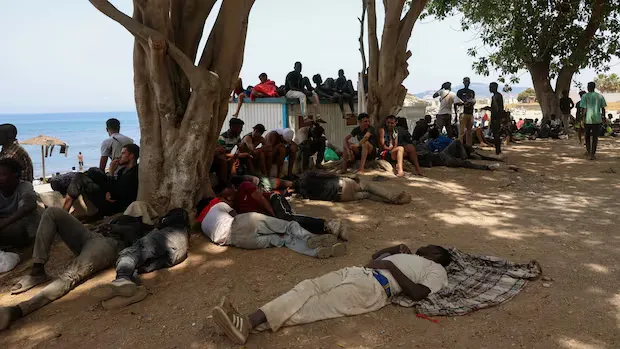

This week, a wave of migrants who had bravely swum or jumped over fences into Spain's North African enclave of Ceuta found themselves returning home on Saturday. Many of these individuals expressed their disappointment, citing hunger, exhaustion, and a hostile environment created by local residents as significant factors that dashed their aspirations for a new life in Europe. Reports indicate that the situation escalated dramatically when Spain announced the construction of a 500-meter-long containment barrier at its maritime border with Morocco. This decision followed a staggering breach of the frontier by more than 50,000 migrants within just a few days, leading to tragic fatalities, with at least 67 lives lost in the chaos.
Upon their return, some migrants recounted how they had been lured by viral social media posts and messages from friends claiming that the heavily fortified border was vulnerable. However, upon reaching Ceuta, many realized that their dreams of continuing to mainland Spain were unattainable. A bakery worker from Fez, named Brahim, shared, 'We came to make progress, not to be fooled. I thought I'd build a better future there. But I was surprised in Ceuta,' reflecting the disillusionment felt by many who undertook the perilous journey.
In the aftermath of the mass crossings, Spain and Morocco took measures to reinforce the border fence, which appeared to deter further attempts to breach the boundary. Reports from officials suggested that around 48,300 of the individuals who entered Ceuta had already returned to Morocco. The stark contrast between the once-bustling streets of Fnideq, the Moroccan city adjacent to Ceuta, and the current near-desertion of the border region was evident. Young men were seen departing along the highway, while shops remained shuttered, a scene far removed from the crowded gatherings just days earlier.
Numerous returnees expressed their frustrations regarding the lack of available food and water, compounded by the closure of supermarkets and shops, which left them in a desperate search for sustenance. One individual, who wished to remain unnamed, described Ceuta as a 'prison,' stating, 'There was nothing to do there. Everything was closed.' Another returnee, Yassine Ichou, recounted a harrowing experience where he was chased away and struck while attempting to gather supplies, highlighting the oppressive environment that many faced during their stay in the enclave.
Amid the turmoil, Spain's Interior Ministry reported that a couple of individuals sustained minor injuries due to separate knife attacks, underscoring the tension that had arisen from the mass influx of migrants. The government had to react swiftly, with Spanish Prime Minister Pedro Sánchez condemning the responses of certain European leaders who suggested suspending Spain from the Schengen area. He attributed these calls to prejudice and misinformation.
While the majority of migrants who had made the perilous journey back to Morocco have left, the future remains uncertain for those who still linger in the enclave. Mohamed Ahmed, a 43-year-old Sudanese man, voiced his determination to remain in Spain despite the challenges, indicating a resilience that many others share. 'I'm not going back. I'd rather die trying here,' he proclaimed, encapsulating the enduring hope and desperation that defines the migrant experience.
As reported by cbc.ca.