
The Humanitarian Crisis in Ceuta
In the Spanish exclave of Ceuta, a simmering anger has erupted against the government as numerous stranded refugees find themselves subsisting on meager rations of bread, bananas, and water, all while facing an uncertain future. The scene is poignant, with locals dressed elegantly, contrasting sharply with the chaotic backdrop of their protests. A woman in a tailored suit stepped out from the crowd to confront Spain's Interior Minister Fernando Grande-Marlaska, hurling insults as his convoy passed by, demonstrating the deep frustration felt by the residents. This outpouring of anger continued, even after the minister had retreated behind the walls of the government office, shielded by the Guardia Civil.
Inside, Grande-Marlaska provided journalists with statistical reassurances about EU financial aid aimed at managing the refugee crisis, claiming a decrease in crime rates in Ceuta as an indication of safety. However, the local sentiment tells a different story, as the explosive tension fills the air during his visit, the 41st day since a significant border breach occurred, which saw an influx of approximately 72,000 individuals, with over 5,000 still remaining in the city. Humanitarian organizations estimate that the true number could be as high as 10,000, predominantly young Moroccan males seeking a better life.
The Dire Living Conditions
The streets of Ceuta are heavily guarded by the military and police, who are stationed to keep migrants away from the city center and supermarkets. The local population demands immediate changes to immigration laws, hoping for expedited deportations without proper screening. In stark contrast, the government insists on following the legal process of assessing potential asylum claims, a procedure that is sure to take time, leaving many refugees in limbo.
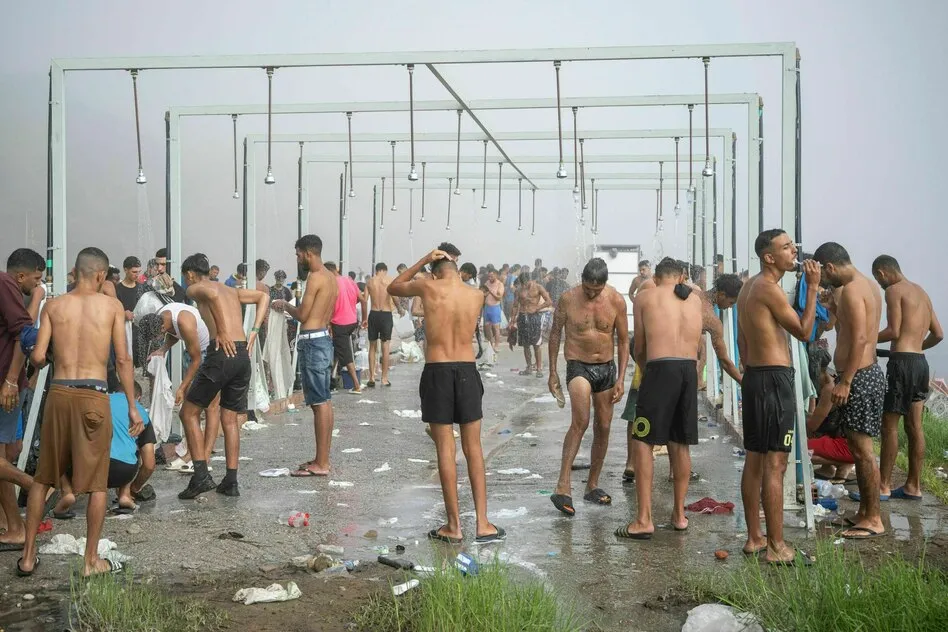
Along the so-called 'Trampolin Beach' west of the city center, many migrants have established makeshift shelters between the road and the sea. Among them is Karim, a thirty-something man from Algeria who recounts the harrowing journey he undertook to reach Spain. He recalls the tragic scene of children who drowned during the border crossing, their cries still haunting him. For the past 41 days, he has lived on the beach, relying solely on the evening distributions of food and water by the Red Cross, enduring long lines for a few essentials. With no means to charge his phone, which serves as a vital connection to the outside world, his survival has become increasingly precarious.
Karim's perspective sheds light on the broader issue, as he describes the indifference of local authorities, who he claims alternate between ignoring and attacking them at will. The deteriorating conditions have led many men to fall ill, with a makeshift refugee camp set up in a dilapidated industrial area failing to offer any significant improvement. The government’s actions seem to betray a reluctance to address the humanitarian crisis adequately, as local residents express fears about the impact of migrants on public services and safety.
Moreover, the political rhetoric surrounding the crisis has intensified, with officials framing the situation as an 'invasion,' further fueling divisions within the community. T-shirts proclaiming 'Una caballa no se rinde'—a message of resilience—have become a symbol of local defiance, while the specter of right-wing extremism looms larger, exacerbating tensions and fostering an atmosphere of hostility towards migrants.
In the coming days, a new tent camp is to be established behind a local car dealership, intended to house migrants during the asylum application process. However, the local government remains staunchly opposed to this solution, and there are widespread fears that the migrants will be denied the opportunity for a better life on the mainland. Amidst all this, Karim’s story of resilience and hope stands out as he dreams of a future in Spain, where he could work and rebuild his life if only he could secure the legal documentation necessary to do so.
As reported by taz.de.