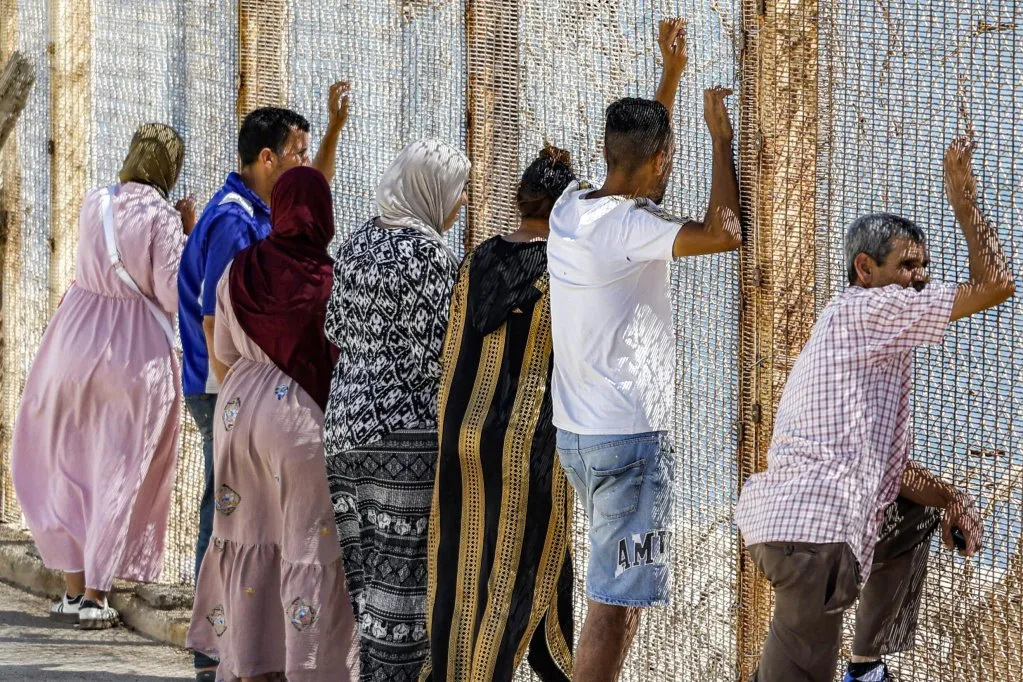

Moroccan Families Seek Missing Loved Ones Amid Crisis in Ceuta
In Ceuta, Spain, a profound humanitarian crisis unfolds as Moroccan families desperately search for their loved ones who embarked on a perilous journey to the Spanish enclave last month. These families have set up makeshift camps outside the Tarajal border post on the Moroccan side, hoping to receive any news regarding their missing relatives. In response to the distressing situation, Spanish authorities have established a dedicated office for missing persons, aiming to facilitate the search for those who have vanished during this wave of migration.
As reported by infomigrants.net.
More than two weeks after a significant influx of migrants into Ceuta, families continue to grapple with uncertainty as they await news of their loved ones. According to reports, over 70,000 individuals crossed the border between Morocco and the Spanish enclave during the events of July 30 and 31. While the majority have since left, estimates suggest that between 2,000 and 5,000 migrants remain stranded in Ceuta. The tragedy has claimed at least 91 lives, with the Moroccan Association for Human Rights estimating the toll could be as high as 141. Spanish authorities have recovered numerous bodies from the sea, yet the identification process is fraught with challenges, leaving many families in anguish.
Challenges in Identifying Victims and Organizing Burials
Despite the ongoing search for missing individuals, the process of organizing burials has commenced. As reported by Saïd Mohammed Mohammed, the manager of the Sidi Mbarek Muslim cemetery in Ceuta, a court order was issued to begin the burial of unidentified bodies. Unfortunately, due to resource constraints, not all bodies can be buried in a single day. Mohammed expressed the cemetery's responsibility to provide burials, regardless of whether the deceased are identified. Each body is assigned a number and documented in court records, ensuring that if a family comes forward later, their loved one can be identified and their remains returned.
The heart-wrenching stories of families searching for their missing relatives are numerous. Take, for instance, the plight of Rahali from Fnideq, a town in northern Morocco. His son, Zakaria, set out with a friend on July 30, drawn by rumors of an open border. The journey took a tragic turn when they attempted to swim across the sea, leading to their separation. Rahali has since scoured hospitals and police stations for news, but to no avail. His despair is palpable as he recounts the haunting uncertainty of not knowing his son's fate.
As families continue to employ social media as a tool to locate their missing loved ones, heart-wrenching posts featuring photos and pleas for information are shared across platforms like Facebook and Instagram. In this digital age, these platforms have become crucial in uniting families and providing glimpses of hope amidst the despair.
In response to the overwhelming need for assistance, Spanish authorities have increased their efforts by creating a specialized office for missing persons. This office allows families to report their missing relatives and submit photos and distinctive information. Moreover, biological samples are collected from family members to aid in the identification of unidentified bodies through DNA analysis. Since the establishment of this office, 32 cases of missing persons have been recorded, with promising matches already identified.
For many Moroccan families, the nightmare of uncertainty continues as they await any semblance of closure regarding their loved ones. The ongoing crisis exemplifies the profound human cost of migration and the desperate lengths families will go to in search of answers.