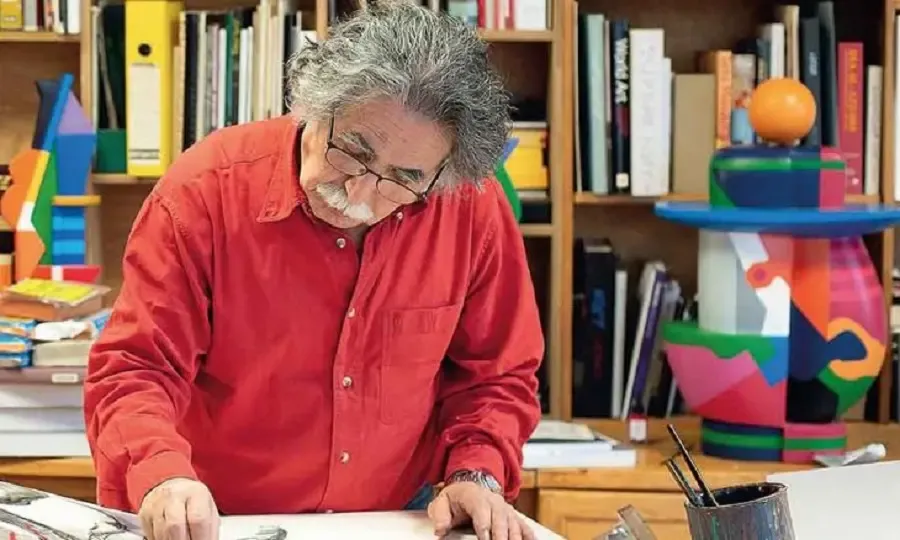

Celebrating Nature and Memory Through Art
At the age of eighty-seven, Diaa Al-Azzawi, one of the most prominent contemporary artists in the Arab world, continues his creative journey, finding inspiration in Morocco for a series of unprecedented works that illustrate the transformation of a place into a pictorial memory. His exhibition, titled "Inner Worlds, Under Open Skies," presented by La Galerie 38 during the Geneva Art Week, draws inspiration from locations that have left a mark on Al-Azzawi, particularly Beirut and Marrakech, with the famous blue of the Majorelle Garden radiating beyond the canvases dedicated to the red city, evolving into a recurring theme throughout the collection.
In a statement to the Moroccan News Agency during the exhibition's opening, Al-Azzawi noted, "I completed these works over the past two years, focusing mainly on my interest in nature." This approach reflects the increasing importance he places on contemplating nature and how lived experiences can extend and evolve within creative works. The displayed pieces reveal a more contemplative dimension of the artist's practice, where color becomes a language that celebrates the beauty of nature, aesthetic wonder, and nostalgia for a shared Arab heritage. Between inner worlds and open horizons, the artworks invite a sensory experience where memory, poetry, and the natural landscape resonate with one another.
The Influence of Moroccan Landscapes
Al-Azzawi's stays in Morocco have fueled a collection of impressions that he translates onto canvas. He shared, "During my visits to Morocco over the past two years, I created works linked to the impressions I retained from my stay, particularly in Marrakech." Among the places that captivated him was the Majorelle Garden, whose visual world seems to have left a profound impact on his imagination. He remarked, "I was particularly influenced by the Majorelle Garden, which is one of the most beautiful examples one can find in the country." In these works, whether abstract or figurative, the forms do not merely seek to present a descriptive image of Marrakech; rather, the city transforms into an experience of light, contrast, and color. The natural scenes, plants, and architecture appear to gradually fade away, making room for a more internal vision where perception merges with memory.
Additionally, Al-Azzawi highlighted the significance of constructing something from memory in these works, which is directly related to his visits to the city. Beyond the visual aspect emphasized by the exhibition, Al-Azzawi's relationship with Morocco is also deeply human, rooted in long-standing connections with Moroccan artists such as the late Farid Belkahia, Mohamed Mlih, and Mohamed Kassimi. He stated, "I have a long-standing relationship with Morocco. I held my first exhibition there in the 1970s in Casablanca, followed by other exhibitions in various cities across the country." He noted that this new exhibition stems from a desire to maintain a connection with Morocco, both geographically and through a sense of belonging to Arab culture.
While part of these works is directly related to the city, another part falls within experiences that have long intrigued the artist, particularly the "transformation of landscapes into abstract forms focused on color and shape." When asked if this renewed relationship with Morocco could extend to the idea of holding a major exhibition in the kingdom, Al-Azzawi confirmed that the project is under consideration, although he did not provide further details regarding the date or location.
In his view of Morocco, Al-Azzawi sees the kingdom as a place developing potential in various fields, highlighting its role in preserving and valuing Arab culture in all its forms. The artist, who considers Morocco a "model of success in the Arab world," stated, "Morocco is one of the most linked countries to Arab culture and is committed to preserving it." He closely follows the evolution of the Moroccan art scene and, while he is familiar with the first generation of prominent Moroccan artists, he believes that new generations still deserve more exploration.
Born in Baghdad in 1939 before settling in London in 1976, Diaa Al-Azzawi is a multidisciplinary artist whose extensive works span painting, sculpture, drawing, engraving, publishing, and design. He is notably one of the co-founders of the "New Vision" art movement established in 1969. His works are part of numerous prestigious museum collections, including the Bibliothèque Nationale de France, the British Museum, the Arab World Institute, the Library of Congress, the Victoria and Albert Museum, and the World Bank.
By showcasing the artist in Geneva, La Galerie 38 reaffirms its commitment to supporting prominent figures in modern and contemporary Arab art and the multiplicity of narratives that shape the history of this art. La Galerie 38, located in both Casablanca and Marrakech, is the first Moroccan gallery to expand its activities internationally. With its establishment in the Swiss city planned for 2025, it continues its endeavors outside Morocco and strengthens its presence in the international art scene.
As reported by febrayer.com.