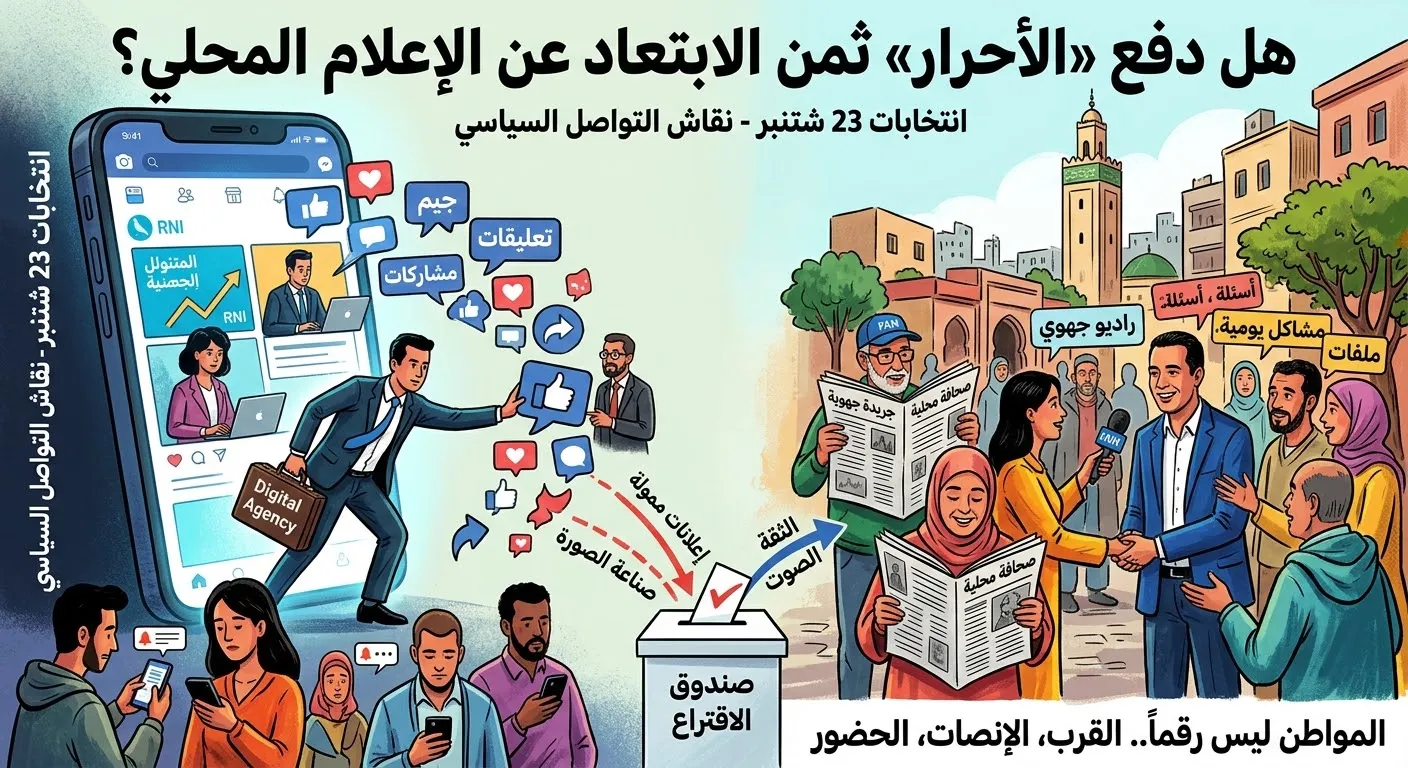

Did the 'Liberals' Pay the Price for an Outdated Media Strategy?
The results of the legislative elections held on September 23, 2026, have reignited discussions surrounding the intricate relationship between political finance, media, electoral communication, and the proximity to citizens. This discourse has become particularly pertinent following the contrasting outcomes observed between the Authenticity and Modernity Party (PAM) and the National Rally of Independents (RNI), especially in key regions like Marrakech. Nationally, PAM emerged as a frontrunner with 97 seats compared to RNI's 66, while overall voter participation stood at 38.08%. However, beyond the mere numbers, a critical question arises: did the electoral communication strategy contribute to the disparity between these two parties? This inquiry extends beyond the scale of expenditure on communication to encompass the effectiveness of its deployment and the perceived distance between the image projected through digital mediums and the real experiences of voters at the ballot box.
When Image Crafting Replaces Genuine Engagement
In recent years, digital communication has become an integral component of political and electoral strategies. The presence of robust social media pages, professional videos, sponsored advertisements, and meticulously designed visuals, all facilitated by specialized agencies, can create a substantial digital footprint. Nevertheless, the recent elections raise a more profound question: is a strong online presence sufficient to achieve a similar level of resonance with voters? In the case of the RNI, this aspect merits serious consideration, particularly given the reported substantial resources allocated to digital communication and image crafting during the electoral phase. Even if we assume that around 100 million dirhams were spent on this facet, the core issue lies not merely in the expenditure amount but rather in the return on this political and media investment. Money can certainly purchase advertising space, yet it does not automatically translate into trust. Advertisements may disseminate a candidate's image to thousands of devices, but they do not ensure that the voter perceives this candidate as relatable or capable of addressing their concerns.
Another significant question to ponder is the nature of the RNI's relationship with local and regional media throughout their campaign. In various regions, it appeared that the party heavily relied on communication and media production agencies, leading to a diminished presence of local media that intimately interacts with the citizenry on a daily basis. It is crucial to note that local media serves as more than just a conduit for disseminating statements and images; it possesses an intricate understanding of neighborhoods, communities, persistent issues, and the names that resonate with the populace as well as the questions they wish to pose to candidates. When this local media is overlooked or treated as less significant than larger communication agencies, the party risks losing something that digital campaigns cannot provide: a sense of closeness and connection.
Additionally, a more critical political and media analysis emerges: did the RNI approach local and regional media with a sense of superiority or disdain, favoring specialized communication agencies instead? If this interpretation holds validity, the issue lies not in utilizing agencies—which is a common practice in modern campaigns—but in allowing these agencies to substitute for local journalism. While agencies operate under a specific communication strategy focusing on messages, images, videos, reach, and content management, local journalism thrives in a different arena: inquiry, critique, follow-up, amplifying the citizen's voice, and holding candidates accountable. This distinction is essential; an agency might produce a striking video about a candidate, but a local journalist is more likely to question them about pressing issues such as local hospitals, transportation, overcrowded schools, stalled projects, and previous electoral promises.
This is where local media becomes not just an inconvenience but an invaluable asset for political life. In contrast, PAM's campaign demonstrated a more pronounced engagement with local and regional media alongside field and digital communication. However, this should not suggest that PAM's success can solely be attributed to media strategies, nor that local communication alone dictated the results. Elections are complex systems influenced by organizational strength, candidate networks, individual candidate charisma, grassroots mobilization, party presence, political messaging, and, of course, media and communication efforts. Nonetheless, the difference in how each party reached voters warrants attention, as local and regional media succeeded in contextualizing candidates and their programs within specific geographical and social frameworks, thus facilitating a more meaningful dialogue with citizens rather than presenting an abstract image of the party.
Ultimately, one of the most crucial takeaways from this experience is the recognition that citizens are not mere statistics on Facebook or views on a digital platform. In the realm of digital communication, it is all too easy to conflate reach with impact. A post may reach hundreds of thousands, a video may garner thousands of views, and sponsored advertisements may dominate Facebook and Instagram. However, a voter does not enter the polling station armed with a tally of the ads they have seen; instead, they carry their perceptions of the party and candidates, their sense of closeness, the credibility of their platforms, and their understanding of regional issues. This highlights the fundamental difference between crafting an image and fostering genuine relationships.
In conclusion, if the circulated figures regarding the expenditure are accurate, the more pertinent question post-elections should not be how much RNI spent, but rather what that expenditure contributed to the party's image and effectiveness in connecting with citizens. Did this investment bring candidates closer to the electorate? Did it enhance voters' understanding of the party's programs? Did it spark genuine discussions about urban and rural issues? Did it improve the local image of candidates? And did the agencies that assumed part of the communication role provide meaningful contributions that extended beyond merely creating content and beautifying images? The electoral outcomes alone do not confirm that these agencies were responsible for the losses nor imply that local media was the sole reason behind PAM's success. However, these results do raise crucial questions about the effectiveness of communication strategies and their alignment with the nature of Moroccan voters, who prioritize finding someone who listens and responds rather than merely enjoying an attractive image.
As reported by klamkom.com.