
Morocco is a land of remarkable diversity, offering experiences that span from the surf of the Atlantic coast to the vast dunes of the Sahara, and from a French-influenced capital to ancient medinas that predate the Crusades. Travelers can navigate from the snow-capped peaks of the Atlas Mountains to fortified coastal towns that were pivotal in 18th-century trade. This rich variety is precisely why the best destinations in Morocco are contingent upon the traveler's specific interests, be it culture, coastlines, deserts, or a blend of all three. Thus, evaluating these places involves more than just scenic beauty.
As of 2026, Morocco has garnered unprecedented international attention, having hosted the Africa Cup of Nations in 2025, a tournament that spanned from December 2025 to January 2026. This event has led to the development of new stadiums and improved transportation infrastructure in key cities like Marrakech, Fes, Rabat, and Tangier. Moreover, Morocco is one of the three co-hosts, alongside Spain and Portugal, for the FIFA World Cup in 2030, prompting significant investments in infrastructure that are already transforming airports and railway systems. While these developments do not alter the intrinsic appeal of each destination, they do facilitate easier logistics for travelers planning a visit this year.
This article presents a ranking of nine destinations across Morocco, from the imperial cities that define most first-time visits to less-traveled gems. Locations such as the Dades Valley and Rabat reward those willing to venture beyond Marrakech and Fes. The ranking takes into account historical significance, accessibility, and the actual experiences available on-site, rather than merely how photogenic a place may be. Each entry stands on its own merit, whether representing a four-day immersion in the Marrakech medina or a longer itinerary stretching from the Rif Mountains to the edge of the Sahara. Practical details, including how to reach each location, what they are renowned for, and the best times to visit, are integrated into each entry, making the ranking not just informative but also functional as a travel guide.
The Marrakech Medina Remains Morocco's Main Attraction in 2026
Marrakech is Morocco’s most visited city, and its medina, a UNESCO World Heritage Site since 1985, serves as the premier introduction to the country’s history and daily life. At its heart lies Jemaa el-Fnaa, a vibrant square that functions as a market, food stall, and open-air performance venue. The square has also been recognized by UNESCO as a masterpiece of the oral and intangible heritage of humanity.
The medina was established in the 11th century by the Almoravid dynasty, and much of its layout has remained unchanged over the centuries. Narrow alleyways radiate from central souks, each organized by trade. Leather goods cluster in one quarter, while metalwork and lanterns can be found in another, and spices and textiles occupy yet others. Bargaining is not just common; it is expected, with prices seldom fixed.
The Koutoubia Mosque, with its minaret soaring approximately 77 meters high, dominates the skyline and dates back to the 12th century under the Almohad dynasty. Its design influenced both the Giralda in Seville and the Hassan Tower in Rabat, marking it as one of the most architecturally significant structures in the western Islamic world. While non-Muslim visitors cannot enter the mosque itself, the surrounding gardens and plaza are open to all.
Outside the medina walls, the Majorelle Garden offers a contrasting stop. Created by French painter Jacques Majorelle in the 1920s and 1930s, it later came under the ownership of fashion designer Yves Saint Laurent and his partner Pierre Bergé. The cobalt-blue buildings within, now known as Majorelle Blue, have become one of the city's most photographed features.
Marrakech serves as both a base for day trips and as a destination in its own right. The Atlas Mountains are visible on clear days from parts of the city, and several villages in the foothills can be reached within one to two hours by car. Riads, traditional homes built around courtyards, have largely replaced hotels as the preferred type of accommodation in the medina, providing a quieter alternative to the bustle of the main square after dark.
Chefchaouen: Morocco's Blue City in the Rif Mountains
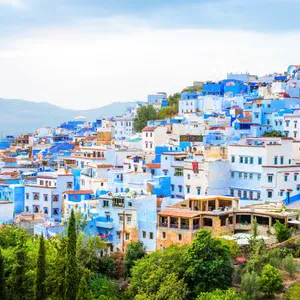
Chefchaouen, nestled in the Rif Mountains of northern Morocco, is almost exclusively known for its blue-painted walls and doors that adorn most of the old town. This distinctive color has been gradually applied over decades, with its exact origins being somewhat disputed. The hue is often associated with Jewish refugees who settled in the city during the 1930s, linking blue to the sky and religious tradition.
The city was founded in 1471 by Moulay Ali ibn Rashid as a fortress against the Portuguese expansion along the northern coast. For centuries, it remained largely closed to outsiders, opening up more to travelers only in the 20th century. This history contributes to the sensation that its medina feels smaller and less commercial than those of Marrakech or Fes.
Located approximately two hours by car from both Tangier and Tetouan, Chefchaouen is a popular day trip destination. An overnight stay allows for the town's narrow streets to empty out after day-trippers depart. The Ras El Maa waterfall on the outskirts of the medina is where locals still wash wool and marks the source of the town's water supply.
The kasbah in the main square houses a small ethnographic museum and a garden that offers views over the surrounding rooftops. Beyond photography, the city serves as a gateway for hikes in the Talassemtane National Park, home to Barbary macaques and a mix of cedar and fir forests that see far fewer visitors than the Atlas Mountains further south.
Due to its compact size, Chefchaouen can largely be explored on foot in a single day. The lighting changes noticeably from morning to late afternoon, affecting how the shades of blue appear in photographs. Shops within the medina sell wool blankets, goat cheese, and leather goods that are typical of the surrounding Rif region, differing from what is found in markets further south in Morocco.
As reported by de.qz.com.