
The Rise of EBRO and the S900 SUV
The revitalized EBRO brand has achieved remarkable milestones in an impressively short timeframe. In just two years since its reintroduction, the Spanish manufacturer has expanded its lineup to include a significant variety of models, with the S900 standing out as the largest and most sophisticated among them. The European automotive landscape has undergone considerable changes recently, with the emergence of numerous new brands complicating purchasing decisions for consumers. Amidst this competitive environment, EBRO has made strides to establish its presence in Spain, currently offering four different models and soon to introduce its first electric vehicle. Supported by the extensive Chery empire, the S900 is the flagship vehicle that aims to project the brand's image and position its hybrids as the 'people's hybrids.'
EBRO began its journey by selling gasoline SUVs, quickly transitioned to plug-in hybrids, and is now moving toward hybrid models, with electric vehicles on the horizon—all within a span of just over 24 months. The rapid pace of development is reminiscent of the hardworking culture of China, where there is a relentless push to launch new vehicles and update existing ones. A prime example of this is the EBRO S400 hybrid, which underwent a significant and necessary mechanical upgrade just months after its official launch.
A Thrilling Drive Through Morocco
At the beginning of the year, I had the opportunity to share my initial impressions of the S900, which I first encountered in Málaga. This time, I returned to test it for an extended period in the more southern regions of Morocco. EBRO graciously invited us on an extraordinary journey through the country, covering over 1,000 kilometers in three intense days aboard the S900. The initial question on everyone’s mind is: what insights have I gathered from this experience? Let me share my findings.
Morocco, for those who haven’t visited, is an incredible country. In just a couple of hours of flight from Madrid, one finds themselves in the bustling and vibrant city of Marrakech, home to over a million people and nearly as many motorcycles. This city served as our starting point for a journey that would take us southward, just a few kilometers from the Algerian border. While it is relatively easy to cover 1,000 kilometers in nearly any car today, the comfort of Spanish highways is a stark contrast to Morocco’s road network.
The first day of driving promised to be the longest, spanning 464 kilometers, a distance less than that between two major Spanish cities like Madrid and Seville. Under normal conditions, this journey can be completed in about four hours at a relaxed pace. However, in Morocco, that estimate doubles. Without highways, we faced over eight hours of driving on what could be classified in Spain as second and third-tier national or regional roads.
As we set off, Morocco made it clear that this would not be a peaceful journey. The traffic and road conditions—when they exist—made progress challenging. Through the windshield, the snow-capped peaks of the High Atlas emerged, marking our first stop at Col du Tichka, which rises to an altitude of 2,260 meters. This historic caravan route, opened by the French in the early 20th century, is now a winding, well-paved road teeming with buses and tourist vehicles, among which we found ourselves.
Time was of the essence, and after a brief pit stop, we reignited the S900’s four engines (one thermal and three electric). During this initial leg, it proved to be an exceptional plug-in hybrid SUV: comfortable, quiet, and well-rooted on the road. As we continued southward, we veered away from the typical tourist route and began to discover the authentic Morocco, passing by various kasbahs and ksars, including the renowned Ait Ben Haddou, a backdrop for movies and series such as Gladiator and Game of Thrones.
Although we made few stops, progress was slow, especially when navigating bustling local markets. In Morocco, markets are a daily affair, as the lack of freezers makes traditional weekly grocery shopping impractical. We crossed through Ouarzazate, perhaps the most significant urban center in the region, before encountering the Draa River, the longest river in the country and home to one of the largest palm groves in the world. Hundreds of kilometers of palm trees lined the almost dry banks of the river. Night fell before we reached our destination, Mhamid, the last village before the Algerian border.
After more than 12 hours of travel the previous day, including the customary tourist and food breaks, today promised a shorter but no less intense day. As we left the hotel, we were greeted by more palm trees and the first sand dunes that were invisible the night before. Despite the exhausting journey, the S900's ride comfort stood out, including the front seats with massage features. Today, the air conditioning would need to perform at full capacity.
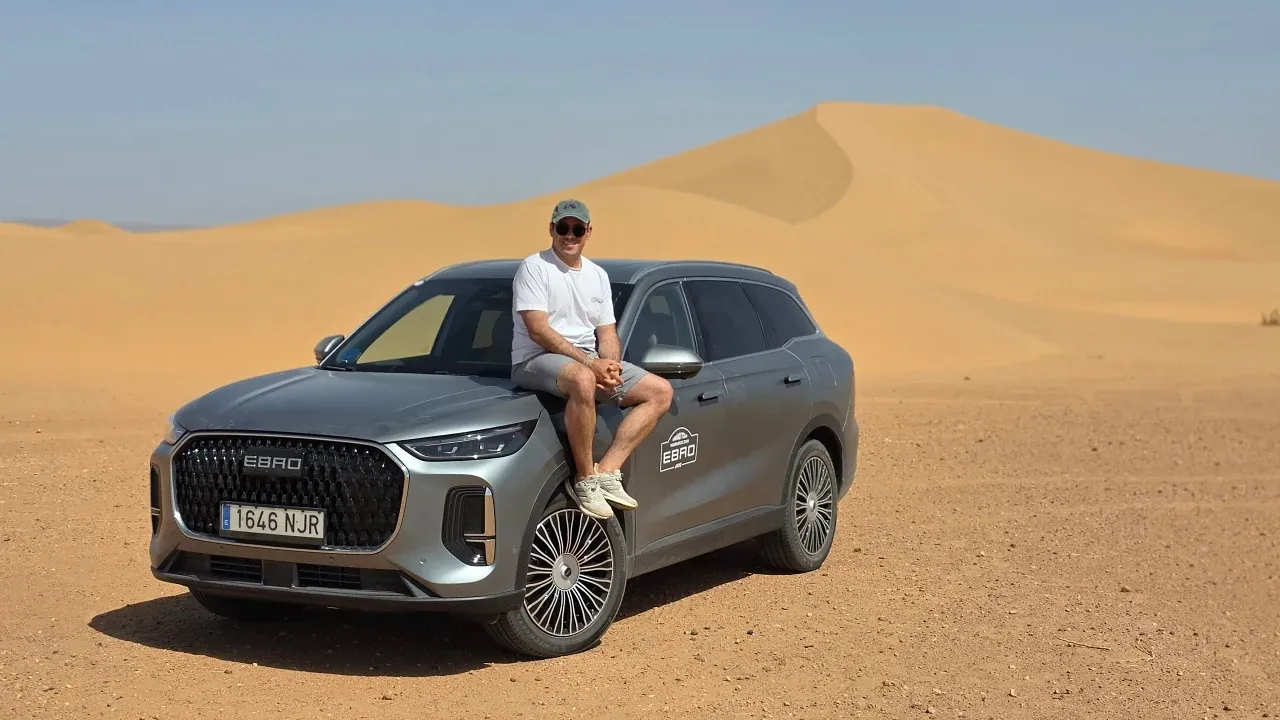
With no paved roads leading to the dunes, we ventured onto the first dirt and rocky paths in the EBRO. In the distance, the dunes of El Hnite awaited us. Sahara sand began to accumulate on the vehicle's exterior and inside, but it didn’t matter. The scenery was breathtaking, and nothing hindered the S900’s progress. We activated 'Sand Mode,' and at no point did we feel that the vehicle would get stuck. We took obligatory photos and enjoyed a quick coffee brewed with the V2L charger that comes standard with the S900, powering a Nespresso machine that became a powerful ally.
Our next stop was Tamegroute, a village famous for its pottery craftsmanship. Its impressive Ksar, still home to dozens of families, showcases some of the most remarkable clay creations we've ever seen. All handmade with local materials, including dried palm leaves that fuel the kilns. Items range from basic pieces like tiles and roof slates to vases, plates, and various decorative objects. Some of these treasures were loaded into the S900's spacious trunk, which boasts 448 liters of capacity when the two additional seats are folded down.
As we continued north, we traversed stunning landscapes and captivating mountain roads, such as the N'Tazazert pass, where each curve revealed a different side of Morocco. We transitioned from desert sand to the red earth of mountain passes, including the lush scenery of crops and palms hugging the Draa River. Today, with fewer kilometers behind us, approximately 300, we reached our destination. The next day awaited the queen stage, where the S900 would need to continue demonstrating its full range of capabilities. To date, after nearly 800 kilometers, there had been no issues, and we still had over 120 kilometers of range left.
The final day of this grand experience through Morocco would involve just over 300 kilometers, but it would take nearly eight hours of driving. The S900 would need to earn its keep, as ahead lay several hours over unpaved mountain paths. The EBRO and its Michelin tires were about to face a true test. The comfort of the asphalt was short-lived. Soon, the S900's front end began to lift as we ascended twisting roads, remnants of an old caravan route that remain closed during much of the year due to accumulated snow in the Atlas Mountains. In fact, we still encountered frozen remnants at altitudes exceeding 2,000 meters.
Gradually, turn by turn, we climbed what was once a mountain road. Today, only remnants remained—small vestiges of civilization washed away by rains and low temperatures. We reached the highest point of the day and the entire journey, the N'Ait Hmed pass, at an altitude of 3,005 meters. The thermometer read 18 degrees, the coldest temperature we would experience. Our only companions were the goats that roamed the peaks and a couple of Bedouins on horseback—the only ones we saw in a Morocco where donkeys reign as the primary work animal.
In a constant ascent and descent, we moved with surprising ease through paths that seemed untouched by human hands. The S900 remained unfazed by any obstacle, whether it was rough terrain, stones, or fords. It was earning its keep, kilometer after kilometer, without showing any signs of fatigue. Nothing creaked; it maintained its comfort, aided by its seats, climate control, and sound system. The breathtaking landscapes left us speechless. It is easy to recognize other regions of the world, such as the United States, Nepal, and Colombia—Morocco is indeed the land of a thousand landscapes for a reason. I continuously find myself in awe.
After over five hours on rocky, dusty roads, passing through villages where we unquestionably became the center of attention, we finally returned to the asphalt. The GPS indicated there were still two hours to reach Marrakech, but that didn’t mean challenges lay behind us. We faced the chaotic traffic surrounding the city once again. Overtaking became child's play, thanks to the S900's 426 horsepower. As you might have guessed, the battery had long since depleted, yet it never fell below 16%, allowing for some reserve power when needed for those critical overtakes on the busy roads leading to Marrakech. Trucks, cars, donkeys, motorcycles, bicycles—all fell behind with a simple tap of the accelerator. The same went for navigating through the city. Few urban areas endure such mobility chaos as Marrakech, where rules seem virtually non-existent. The S900's size made maneuvering effortless, with its imposing front end commanding respect from other road users. We arrived safe and sound.
After covering over 1,000 kilometers and spending more than 24 hours driving, we disembarked with a feeling of immense satisfaction. First and foremost, it must be acknowledged that this was due to Morocco itself—its people, landscapes, and cuisine. This is a country worth exploring beyond its major cities. It is entirely safe to traverse from north to south and east to west. The variety of settings is absolute, ranging from deserts to the High Atlas mountains, the Draa Valley, and countless passes and landscapes that have completely enamored us. I yearn to return and discover something new and even better.
Moreover, the EBRO S900 deserves recognition for taking on the brunt of this journey without a single complaint. Seven vehicles were utilized in this modern caravan, and none experienced even the slightest mishap or failure—not even a flat tire, which everyone had anticipated given the route. Excellent. It made our experience incredibly easy and surprisingly comfortable. The tuning of the vehicle is commendable; I was particularly impressed with its suspension. While not pneumatic, it strikes an excellent balance between comfort and dynamism.
Having initially been intrigued by the EBRO S900 during my first encounter earlier this year, after covering 1,000 kilometers across Morocco, I can only sing its praises. Yes, there are aspects that could use improvement, such as the software and certain driving assistance and safety features, which can be resolved with a simple remote update, but it is a sensational product. If you are in search of a family car with seven seats, comfortable, spacious, balanced, and reasonably priced—under 50,000 euros—there are few alternatives that surpass it in today’s market. Moreover, as I have demonstrated, it is reliable.
As reported by motor.es.