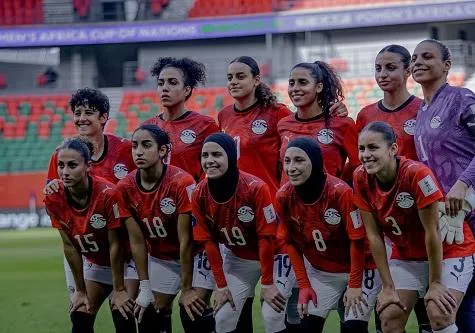

After the Egyptian national football team celebrated a historic World Cup journey with nationwide acclaim last month, the country’s women's team, known as the Cleopatras, traveled to Morocco to compete in the Women's Africa Cup of Nations (Wafcon). The hope was to extend the celebratory atmosphere, but the reality was starkly different. While the men's team made headlines by reaching the last 16, the women suffered a disheartening exit, marked by three heavy losses, during which they conceded a staggering 15 goals and managed to score only three, leading to their elimination in the group stage.
This marked Egypt's third appearance in the Wafcon, and notably their first since 2016. Despite their participation, the Cleopatras did not qualify through conventional means; instead, their entry was enabled by the expansion of the tournament from 12 to 16 teams, allowing Egypt to participate as one of the four highest-ranked teams eliminated in the qualifying rounds.
In a nation passionate about football, with a population of 120 million, the women’s team often struggles to garner the same level of attention and support as the men's squad. Over the past two decades, the women's team has experienced multiple formations and dissolutions, suffering from a lack of structured development and strategic planning. However, recent years have seen an increase in investment in women's football, driven by the Confederation of African Football (CAF), which now requires major men's clubs in Africa to establish women's teams in order to maintain their continental licenses.
In preparation for the upcoming 2026 Wafcon, the Egyptian Football Association (EFA) allocated resources for friendly matches and training camps, even reinstating former manager Mohamed Kamal to lead the team, alongside his role with the National Bank of Egypt women's team. Unfortunately, despite a six-month training period, the team's performance in Morocco fell short of expectations, leading to significant criticism directed at Kamal from current and former players. They accused him of favoritism, unprofessionalism, and creating divisions among squad members.
Prominent player Sarah Essam, who made history as the first Egyptian female footballer to play professionally in England and Spain, emerged as a vocal critic of Kamal. Upon the team's return from Morocco, she expressed her discontent through social media, apologizing to the Egyptian public for the dismal results, which included a 6-0 defeat to Zambia, a 3-1 loss to Malawi, and a 6-2 setback against Nigeria. Essam emphasized the need for a professional environment founded on fairness and equality in player treatment, arguing that the national team deserves better than what has been provided.
Essam, who participated minimally during the tournament, described the training camps and overall experience at Wafcon as “a disaster.” She asserted that the EFA had made significant efforts to prepare the team, setting up eight friendly matches and multiple training camps. However, she criticized the lack of consistency in team line-ups and the apparent disregard for effective game management during crucial matches. The players’ grievances extended to accusations of unqualified individuals being included in the squad based on favoritism, undermining the spirit of meritocracy within the team.
Adding to the controversy, Essam revealed instances of alleged favoritism and unprofessional conduct from Kamal, highlighting that he would grant playing time based on personal connections rather than merit. This situation was exacerbated by the fact that while fellow Arab nations like Morocco and Algeria advanced to the next World Cup, the Egyptian women's team fell short, underscoring a significant gap in development and performance.
Essam’s sentiments were echoed by teammate Eman Hassan, who also shared her experiences and frustrations regarding the treatment of players within the national team setup. The accusations against Kamal have led to a broader conversation about the need for reform and a more structured approach to player selection and coaching. Supporters of the women's team hope for a future where fairness and professionalism take precedence, allowing the Cleopatras to thrive on the international stage.
As reported by thenationalnews.com.