In the wake of the 20th edition of the Al Moutmir Open Innovation Lab, a focus on the Casablanca-Settat and Marrakech-Safi regions sheds light on the impact of Al Moutmir demonstration platforms (PFDs) on hectare yields, soil health, and crop performance. The findings underscore the critical role of research and innovation in the sustainable development of cereal and legume sectors in both regions.
Seven years ago, the OCP Group initiated the Al Moutmir initiative, aiming to foster a more resilient agricultural sector in the face of climate change. This initiative is fundamentally based on a technical pathway and a scientific protocol that equips farmers, particularly those cultivating olives, cereals, and legumes, with best agricultural practices. These practices include rational fertilization, efficient irrigation techniques, the development of climate-resilient seeds, and crop rotation strategies. Moreover, it encompasses a comparative analysis of the results achieved against those obtained through conventional farming methods as conducted by the farmers themselves. Over the years, Al Moutmir has directly assisted more than 40,000 farmers and reached over 560,000 through digital solutions deployed during this period.
The 2025-2026 agricultural campaign further emphasizes the relevance of the Al Moutmir initiative for crops such as olives, cereals, and legumes, as evidenced by the results presented during the recent Open Innovation Lab. On July 17, Al Moutmir hosted a webinar focusing on the Casablanca-Settat and Marrakech-Safi regions, providing a platform for sharing experiences in supporting cereal and legume producers through both conventional cultivation systems and direct seeding practices during this agricultural cycle. The event featured insights from Al Moutmir engineers, partners including INRA and ONCA, and testimonials from beneficiary farmers in the two regions.
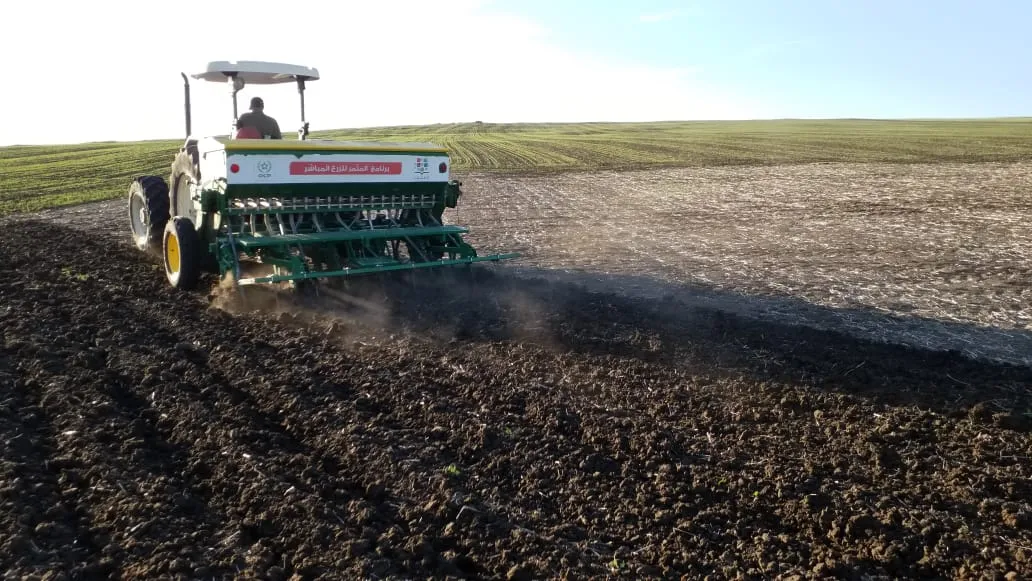
In the Casablanca-Settat region, often regarded as Morocco's agricultural heartland, approximately 392 Al Moutmir PFDs were established during the 2025-2026 campaign, benefiting 98 farmers focusing on cereal and legume crops. Notable deployments include 104 PFDs for soft wheat and 8 for chickpeas in Berrechid, 72 PFDs for durum wheat and 12 for peas in Settat, and additional platforms in El Jadida and Sidi Bennour. The results have been promising, particularly in the Benslimane province, where durum wheat PFDs recorded total yields of up to 84.6 quintals per hectare, significantly outperforming the conventional plots, which yielded only 72.5 quintals. Additionally, grain production also improved, reaching 26.1 to 28 quintals per hectare compared to 21.1 quintals in control plots.
Similar upward trends were observed in Berrechid and Sidi Bennour, with Al Moutmir’s initiatives yielding notable increases. In the Marrakech-Safi region, Al Moutmir deployed 56 durum wheat PFDs and 12 pea PFDs in Safi, 24 barley PFDs in Youssoufia, and 12 fava bean PFDs in Essaouira. In Safi, durum wheat yields reached an impressive 135 quintals per hectare in PFDs, compared to 96 quintals in control plots, while pea production soared to 140.6 quintals per hectare for the sulfur-enriched formula, a stark contrast to 81 quintals in conventional setups. Youssoufia’s barley PFDs achieved unprecedented results in this semi-desert region, yielding around 66 quintals per hectare, representing a yield increase of 40% to 60%. Essaouira also reported PFD yields exceeding 50% compared to control plots.
Nationally, during the 2025/2026 campaign, a total of 1,152 PFDs dedicated to cereals and legumes were installed across 25 provinces, benefiting over 288 direct farmers. It’s important to highlight that Al Moutmir is not a one-size-fits-all approach; it is a tailored technical pathway and scientific protocol that considers the specific characteristics of each covered region, including its climate, crop types, rainfall patterns, crop disease prevalence, and early pest control measures.
Furthermore, the initiative leverages digital tools to capitalize on data collected from farmers, a key strength of this program aimed at enriching Morocco's agronomic database and equipping the ecosystem with localized data to facilitate informed agricultural decision-making.
As reported by ecoactu.ma.