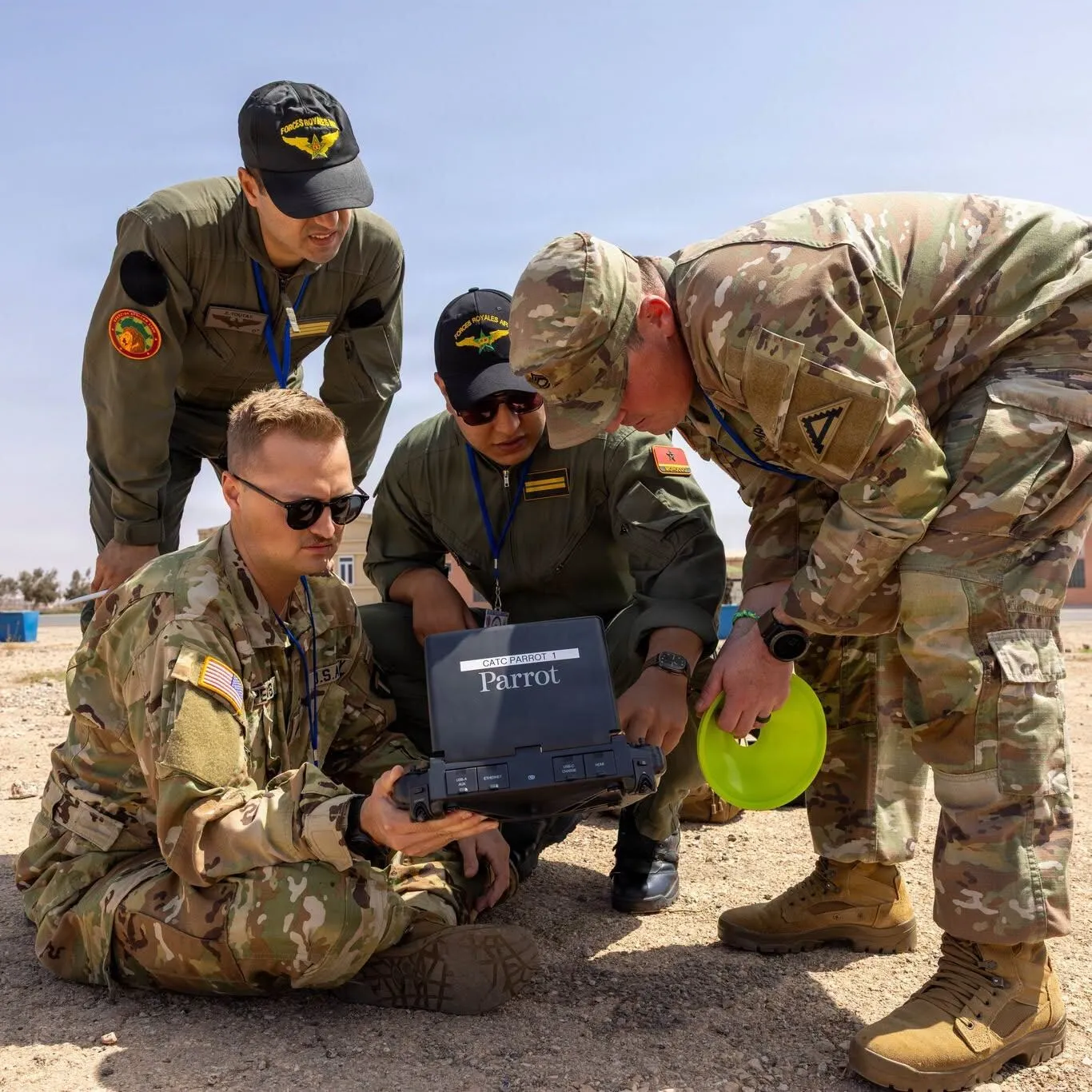

Joint Tactical Drone Training in Agadir
The collaboration between the Moroccan Royal Armed Forces and the United States has recently taken a significant step forward with a specialized training program focused on small Unmanned Aircraft Systems (SUAS) in Agadir. This training initiative is the result of a partnership involving the U.S. Africa Command (AFRICOM), the Royal Armed Forces (FAR) of Morocco, and the Utah National Guard. The primary objective of this program is to equip both Moroccan and American operators and instructors with the necessary skills while enhancing interoperability between the two military forces. Support for the training was provided by the Combined Arms Training Center and the 7th Army Training Command, both of which are part of the U.S. garrison in Vilseck, Germany.
Strengthening Strategic Alliances and Tactical Proficiency
This training program is part of a broader strategic alliance that has existed between Utah and Morocco for the past 23 years. As Morocco and the United States approach the milestone of 250 years of diplomatic relations in 2027, events like this training are more critical than ever. Lieutenant Colonel Corbett Baxter of the Southern European Task Force Africa emphasized the importance of such training, stating that it allows the two forces to take emerging capabilities and convert them into effective tools for military operation. By training alongside Moroccan partners, U.S. forces not only develop interoperability but also learn how to integrate unmanned systems into larger operations, thereby enhancing both capability and lethality.
Leading the initiative for drone program development in Utah is First Lieutenant Jake Sorenson. Recently transitioning from operational planning to a logistical management position at the Utah training center, he is focused on identifying the necessary capabilities for the state and exploring industrial partnerships. Sorenson noted that they are in the initial phases of this joint drone program, aiming to create a comprehensive, multi-level roadmap in Utah to be shared with allied forces. He asserted the importance of early integration of drones, stating, "The sooner we integrate these systems, the greater advantage we will gain."
Technical Sergeant Michael Bennion, a drone specialist from the 151st Air Security Wing of the Utah National Guard, shared his firsthand experience from the training. Having never piloted an aircraft before, Bennion acknowledged his initial unfamiliarity with drone operation. He underwent training alongside Moroccan students, learning about stabilized and non-stabilized flight, control sensitivity, and various operational modes of the devices. He remarked, "This is the future of warfare. We must stay ahead and learn how to use these systems." Bennion plans to relay this training to his unit, emphasizing its potential application in supporting security forces during crowd control operations and in identifying and tracking individuals involved in violent acts.
Additionally, Second Lieutenant Kenton Hemsley, an unmanned systems manager at Camp Williams and a member of the 65th Field Artillery Brigade in Utah, is advocating for each military specialty to develop its own drone integration procedures. He stated, "We designed the program so that each specialty in every unit can define their standard operating procedures and determine how to integrate unmanned systems. Every soldier must understand this challenge, not just on the operational front, but also in defense."
Sergeant Major Mohammed Idamr, representing the FAR, provided a positive reflection on the experience. He noted that the SUAS training has imparted essential knowledge and practical skills, particularly in drone piloting, mission planning, meteorology, safety, and instruction. He concluded, "This training has reinforced our understanding of the role that unmanned systems play in supporting military missions and enhancing situational awareness, while also helping us train qualified personnel and optimize the tactical use of drones within our Armed Forces."
As reported by es.le360.ma.