
Migration Crisis Sparks Tensions Within the EU
The recent influx of up to 60,000 migrants into the Spanish exclave of Ceuta has ignited significant tensions within the European Union. In response to this crisis, EU interior ministers convened for an emergency meeting to discuss the developments in Ceuta, as announced by the Irish EU presidency on the social media platform X. The call for this meeting came from Spanish Prime Minister Pedro Sánchez and the leaders of 22 out of 27 EU member states. While a majority of European governments are advocating for a stronger collective response, Sánchez has criticized certain partner nations for adopting a "selfish" and "illegal" approach to the crisis.
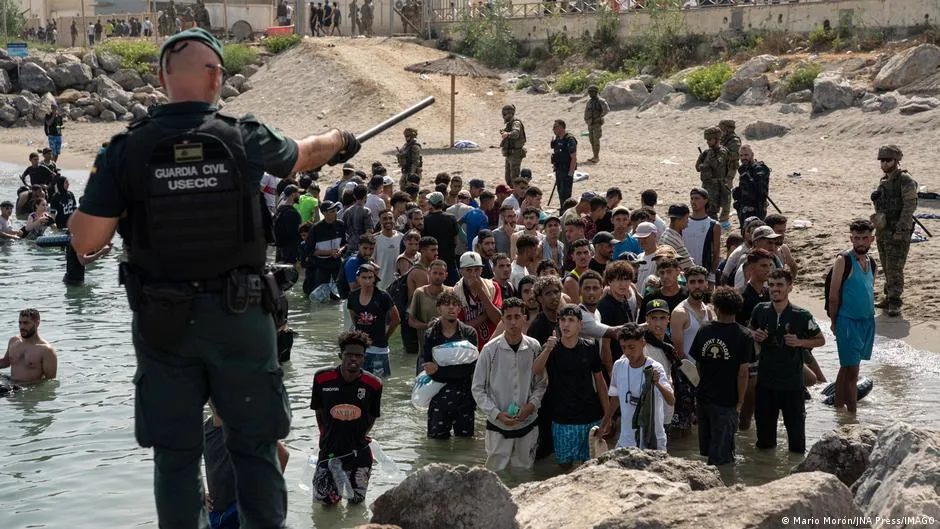
The tumultuous events began with the arrival of tens of thousands of migrants in Ceuta, with Spanish Interior Minister Fernando Grande-Marlaska reporting that as many as 60,000 individuals crossed into the exclave from Morocco within a week. The scenes at the borders and beaches were chaotic, and tragically, at least 72 migrants lost their lives attempting to reach Ceuta. However, it has been reported that "almost all" of the arriving migrants have since returned to Morocco, as confirmed by Spain's Interior Ministry. Journalists from the AFP news agency observed that additional young migrants were seen crossing back into Morocco under the supervision of security forces.
The Complexity of the Situation and Political Responses
In a further effort to manage the situation, Spanish authorities deployed a floating barrier approximately 500 meters long in the waters off Ceuta. Both European Commission President Ursula von der Leyen and the Spanish government stated that "not a single person reached the Spanish mainland or any other part of the EU." The sudden surge in migrants remains largely unexplained, with Moroccan authorities yet to issue an official statement. Sánchez pointed to rumors spread by a "smuggling mafia" that falsely suggested the border to Ceuta was open. In response, the Moroccan human rights organization AMDH has called for a "serious and independent investigation" into these events.
German Vice Chancellor Lars Klingbeil described the situation as seemingly orchestrated, asserting that Ceuta has become a target of a manipulated migration movement aimed at dividing Europe. He emphasized that the unity of Europe and solidarity with Spain must now take precedence. In a joint letter, the leaders of 22 EU countries demanded an "immediate and coordinated European response," stressing that uncontrolled border crossings should not create the impression that illegal entry into the EU is feasible. This letter, which included signatures from Chancellor Friedrich Merz, was perceived as a critique of the Spanish government's relatively liberal migration policies, which have seen it grant residency permits to hundreds of thousands of irregular migrants.
Initiated by Italy's right-wing Prime Minister Giorgia Meloni and her Danish counterpart Mette Frederiksen, the letter garnered support from Hungary, Sweden, and Poland, while neighboring countries France and Portugal did not participate. Von der Leyen welcomed this initiative, calling for a process to "strengthen our European resilience." Meloni stated on X that the stance represented by Italy is now shared by an increasing number of European nations. She had even suggested a suspension of Schengen rules concerning Spain, a proposal that received backing from Finland and Denmark.
Ultimately, Italy reinstated border checks on air and maritime traffic with Spain for an initial month, while Madrid condemned threats of exclusion from the Schengen area as "demagogic." Legal experts consulted by AFP indicated that such exclusion is not permissible under current EU law, and noted that Ceuta is subject to different freedom of movement regulations than the rest of the Schengen zone. Sánchez has since called for a special meeting of EU interior ministers, emphasizing that the EU cannot afford a "selfish, divisive, and illegal response" in the current international context.
Spain asserts that it has successfully prevented migrants from Ceuta from reaching the European mainland while also cooperating with Morocco on the repatriation of individuals. German Foreign Minister Johann Wadephul has urged the EU Commission to prioritize the protection of the EU's external borders. He stated, "The situation in Ceuta over the past few days has been an absolute stress test that we have passed." Wadephul also underscored the necessity of collaborating with non-EU countries to effectively manage migration, praising the swift resolution of the crisis in partnership with Morocco.
This crisis has highlighted the critical need for a united and rapid response to misinformation, which can drive individuals to perilous migration routes. The European Union stands at a crossroads, facing challenges that test its solidarity and commitment to a cohesive migration policy.
As reported by dw.com.