Transforming a Dream into Reality
In 2019, a Franco-Moroccan couple, Nadia and Pierre Jost, stumbled upon an unfinished edifice that would soon transform into a luxurious haven. Initially, Pierre confesses that their intent was to purchase the property for personal enjoyment, reminiscing about the whimsical notion of residing in such a majestic structure. However, as the couple delved deeper into their vision, they faced the stark reality of the building's design—a fortress-like structure, inherently closed off from the outside world, with no windows to let in the light of day. This prompted a significant shift in their ambition: instead of a private residence, why not aspire to create a five-star hotel? With Nadia already managing a renowned riad, the Josts set out on an ambitious journey to breathe life into this architectural marvel.
Pierre, taking the reins as the project's main architect alongside a friend, opted for a unique approach—excavating into the hillside rather than simply raising the structure. Over the course of six years, nearly 150 skilled artisans, known as "maâlems," dedicated their craft to this monumental project. An astonishing 1,900 truckloads of rock were removed from the depths of the earth to carve out a space for a luxurious spa, located twelve meters below the kasbah's level. "We spent three years just removing rock. Once we started, there was no turning back. This is a once-in-a-lifetime project; we invested all our savings into it, without ever cutting corners," Pierre shares with a smile.
A Harmony with Nature
As the excavation progressed, the workers uncovered a natural vein of rock that would become an integral feature of the spa's access tunnel. Despite initial hesitations from the architect, Pierre insisted on preserving this geological wonder. At the end of this stone passageway, light is artfully introduced through intricately sculpted Berber arches, symbolizing the lineage of grandmother, mother, and child. This motif is echoed throughout the suites, where three-dimensional marble cutouts project the same familial theme onto the walls. The marble, sourced from a quarry an hour's drive from Marrakech, was meticulously selected in full blocks—one for each bathroom, totaling forty-two blocks—to ensure a seamless flow of veining across spaces.
Walking through this impressive hallway, cool and shadowy, one is met with a breathtaking contrast at the tunnel's end: a soothing 37°C pool, where the gentle warmth envelops the body while a refreshing desert breeze brushes against the face, with the eternal snows of the Atlas Mountains looming in the distance.
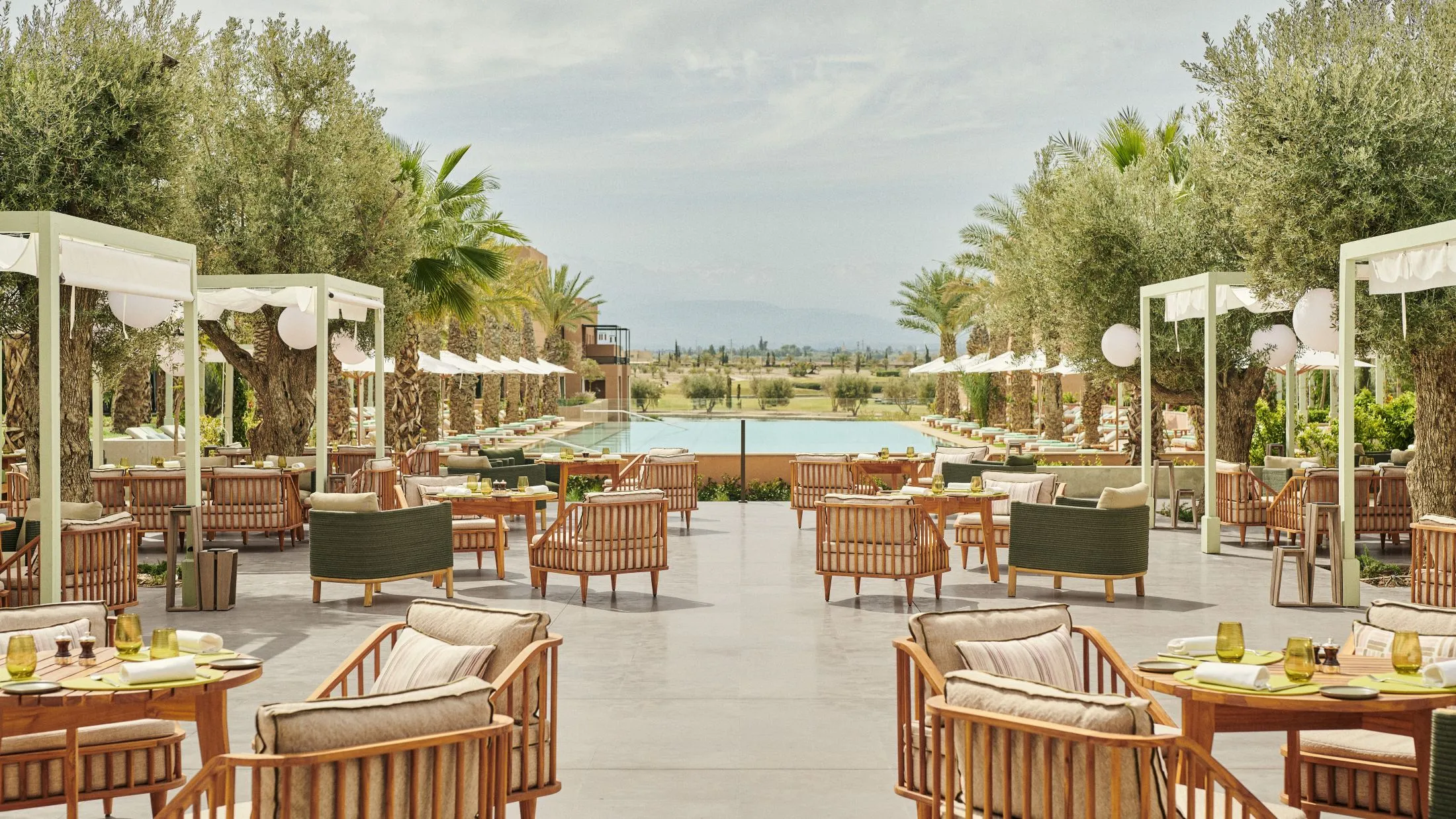
Beyond the kasbah, a lunar landscape has been transformed into a lush oasis, thanks to an eco-conscious approach that saw the planting of 190,000 indigenous trees and shrubs, selected for their low water consumption. The construction team ingeniously reused excavated rock to create terraced gardens and support structures, resulting in a vibrant environment filled with olive trees, lemon trees, and vibrant bougainvilleas, all serenaded by the sounds of crickets at dusk.
Inside the kasbah, the ambiance continues to reflect authenticity and tradition across its 37 rooms and suites. Each space is adorned with Tazenakht rugs, Skoura ceramics, Mauritanian leather and mats, and Amazigh jewelry from Taroudant. Pierre and Nadia set a strict rule: to procure only items that could have historically been traded by caravan travelers. The raw linen and weathered leathers beautifully complement the Volubilis marble, blending the old with the new.
The sensory journey extends to the culinary offerings at the Patio restaurant, Al Massaa, and the expansive rooftop terrace with its stunning pergola. Young chef Hassan Bensaïd artfully reinterprets traditional Moroccan cuisine, introducing Mediterranean influences and creating unexpected culinary bridges. Pierre encapsulates this philosophy: "Local cuisine is among the best in the world, but the balance of sweet and savory or the intensity of spices can be overwhelming. We aim to create a world cuisine infused with Moroccan spirit, ensuring every traveler feels at home." As time drifts away like sand in the wind, the visionary behind this project already gazes towards future ventures. On a nearby hill, plans are underway to design a unique kasbah—a troglodyte hotel nestled within the rock, invisible from the road, featuring a central courtyard reminiscent of an open crater. "I refuse to alter the purity of this landscape in any way," Pierre asserts.
The childhood dream of Mohamed Ifkiren is no longer merely a vision etched in clay; it is becoming a living legend.
As reported by lecho.be.