
Discovering the Enchantment of Marrakech
Marrakech pulsates with energy just outside the walls of the Royal Mansour, where the vibrant souks, or traditional markets, present a labyrinth of sights and sounds that can easily disorient any visitor. The narrow alleyways twist and turn, with motorcycles weaving through pedestrians in a display of skill that defies logic. Each store showcases an array of delightful products, from aromatic spices to intricate Berber carpets, exquisite ceramics, silverware, and handcrafted leather shoes, creating an atmosphere that is both chaotic and enchanting.
A mere minutes away from this bustling activity, the Royal Mansour stands as a sanctuary, protected by the historic walls of the imperial city, with the majestic Atlas Mountains serving as a stunning backdrop. Upon arrival, guests are welcomed with refreshing mint tea and cookies, making the check-in process feel seamless and almost unnoticed. The hotel’s interior is a feast for the eyes, with surfaces adorned by meticulous craftsmanship that exemplifies a carefully curated maximalism.
Commissioned by King Mohammed VI, the Royal Mansour opened its doors in 2010 after three years of extensive construction involving more than 1,200 local artisans, celebrating the true essence of Moroccan architecture and savoir-faire. Each guest is bestowed their own riad, a traditional Moroccan home designed around an open-air courtyard. With options ranging from one to four bedrooms, these riads are nestled within winding paths that mimic the layout of a historic medina, the heart of Arab cities.
/i.s3.glbimg.com/v1/AUTH_51f0194726ca4cae994c33379977582d/internal_photos/bs/2026/K/f/FTZZr0SxqlIRK2UKjlDg/grand-riad-1-.jpg)
The riads at Royal Mansour range from 140 to 1,800 square meters, including the exclusive Royal Suite.
Exploring the 175 square meters of my riad spread over three levels leads me to a private terrace complete with a swimming pool. The bedroom captivates me with its artisanal details, where the pristine white of the sculpted plaster contrasts beautifully with the dark, intricately carved wood and the hand-painted headboard. A tablet beside the bed allows me to control the lights, summon concierge services, and make reservations or order meals. To start the day, I recommend scheduling breakfast on the terrace, ideally featuring pain au chocolat and Moroccan crepes.
During the sweltering summer months, when temperatures in Marrakech can easily soar above 40 degrees Celsius, the gardens of the Royal Mansour transform into one of the property's most inviting retreats. Surrounded by palm and olive trees, the pool area provides shaded spots to escape the heat. Service begins with refreshing mango juice, and later, a chilled cucumber sorbet offers a delightful respite from the sun. For those seeking more privacy, one of the seven pavilions scattered throughout the grounds can be reserved, each equipped with its own lounge, bathroom, terrace, and sun loungers.
/i.s3.glbimg.com/v1/AUTH_51f0194726ca4cae994c33379977582d/internal_photos/bs/2026/b/l/ALdUTkT4Ac0yBXTVnEtQ/rmm-principle-rm-nov20162878-ok-topaz-gigapixel-escala-2x.jpg)
Indulging in Moroccan Luxury and Tradition
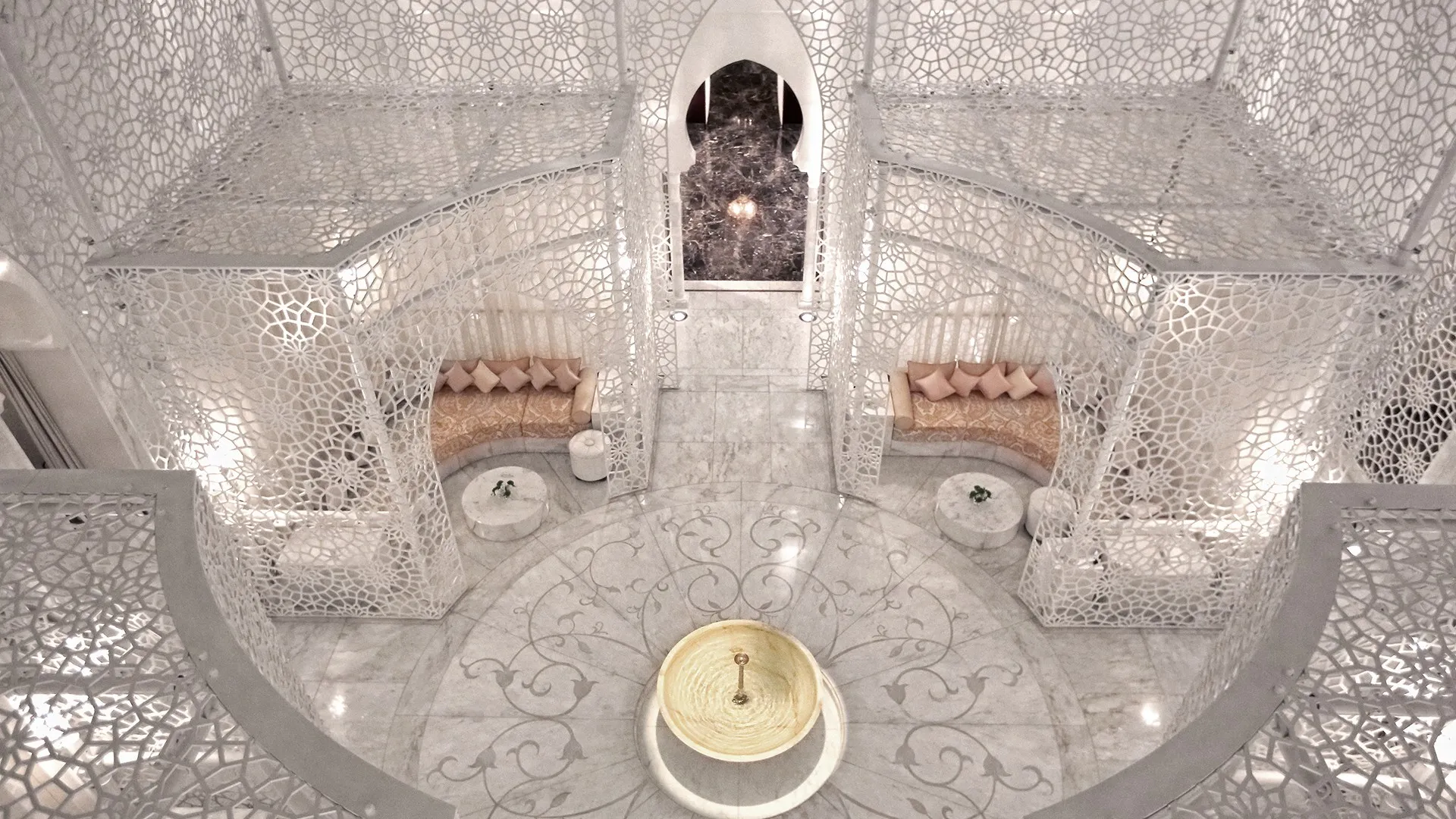
Stepping further into the Royal Mansour leads me to the entrance of the spa, a space that offers a stark contrast to the vibrant colors and intricate designs of the rest of the property. The nearly all-white atrium features a lattice structure that rises through multiple floors, allowing natural light to filter through the glass ceiling and create enchanting patterns on the marble floor.
/i.s3.glbimg.com/v1/AUTH_51f0194726ca4cae994c33379977582d/internal_photos/bs/2026/G/m/rBzkIvSfyorPq96JWuBw/spa-night.jpg)
Here, I embark on a ritual I had only known by name—the hammam, a quintessential Moroccan experience. Latifa, my therapist, kindly offers me lavender and apple tea before leading me to a heated marble room. As she instructs me to lie on the warm stone floor and explains that she will attend to my bath from start to finish, I take a moment to process what I have just heard.
/i.s3.glbimg.com/v1/AUTH_51f0194726ca4cae994c33379977582d/internal_photos/bs/2026/k/o/gzwMvdRvmUF7GLC3jnYQ/hammam-piscine-0117-2-hd.jpg)
Latifa notices my surprise and explains that for many Moroccans, visiting the hammam is a weekly ritual. Outside the luxury hotel sector, public versions continue to thrive in neighborhoods, serving as communal gathering spaces. The ritual commences with savon beldi, a black soap applied to the heated skin, followed by the kessa, a rough glove used for exfoliation. The experience flows seamlessly with hot water buckets, massages, rinses, and ghassoul, a Moroccan clay used for skin and hair. Gradually, I lose track of where one stage ends and another begins, surrendering to the warmth of the stone and drifting off to sleep. I awaken at the end of the session, just in time for two quick dips in a cold water bath before heading to a dimly lit relaxation area filled with the soothing sounds of birds. By the conclusion of the experience, my skin feels remarkably soft and radiant, with a glow that lasts for days.
/i.s3.glbimg.com/v1/AUTH_51f0194726ca4cae994c33379977582d/internal_photos/bs/2026/U/J/wnK610RfCgVTeF1ypbXw/fv3i0003-2-hd.jpg)
Returning to reality, it’s easy to allow the meals to dictate the rhythm of the day. The four restaurants, which are open to non-hotel guests as well, offer a gastronomic journey around the world without ever leaving the property. The Moroccan cuisine reaches its zenith at La Grande Table Marocaine, ranked 19th among the 50 Best Restaurants in the Middle East and North Africa for 2026 and awarded the Art of Hospitality Award. The meal begins with harira, a traditional Moroccan soup that reveals its complex layers of spices and flavors as one savors each spoonful. Following this, the 24-hour slow-cooked lamb shoulder practically falls apart at the touch of a fork.
/i.s3.glbimg.com/v1/AUTH_51f0194726ca4cae994c33379977582d/internal_photos/bs/2026/E/V/3jJQOFQRqjAY4jBRPfpA/la-grande-brasserie-4-.jpg)
The menu then shifts its accent. At Le Jardin, Asian-inspired dishes perfectly complement the lush landscaping designed by Luis Vallejo, creating a delightful atmosphere for midday dining. At Sesamo, ranked 24th in the same list, the Alajmo brothers bring Venetian influences to Marrakech, surrounded by Murano chandeliers and damask curtains. French flavors are showcased at La Grande Brasserie, led by Michelin-starred chef Hélène Darroze, where dishes like gougère with goat cheese and pavlova steal the spotlight.
Throughout the stay, luxury manifests in various forms, including exclusive access to unique experiences. The royal family's connection with Serge Lutens, the king's perfumer, allows select hotel guests to visit his foundation, with prior authorization. Our guide, Elmehdi, estimates that around 20 individuals per month are granted entry to the space, where photography and audio recordings are strictly prohibited. Surprisingly, one of the most beautiful experiences of the trip is one for which I have no photographic evidence.
The discreet facade adheres to a tradition in Islamic architecture, where the true wealth of a home is often revealed only inside. Nothing outside the Fondation Serge Lutens hints at the two hectares of rooms, courtyards, and corridors hidden behind its walls. Carved wood, mosaics, and softly lit spaces unfold along the journey, including a wood-paneled library and areas dedicated to African artworks curated by Lutens himself.
One door opens to the garden, where the dim light gives way to vibrant greenery. Palm trees, dense foliage, and a series of fountains create shaded corridors, evoking my new vision of Eden. In one of the rooms, we encounter men diligently working on maintenance. Lutens, our guide explains, insists that everything remains immaculate, and they listen to the Quran as they work, seeking inspiration. We move on, while they remain focused on the details of a place that few will ever see.
As reported by revistamarieclaire.globo.com.