
In the latest episode of Jack Souvant's adventures, he finds himself in the vibrant city of Casablanca, where he is humorously welcomed into the year 2976 according to the Amazigh calendar. True to form, Jack immerses himself in a series of encounters that range from informal chats to more structured discussions. From the director of a video art festival to an oyster vendor creatively pairing Oualidia oysters with Red Bull, and even a photographer who constructs hyperrealistic images, Jack's stay is driven by a singular inquiry: what is reality? The answer may lie in the metaverse, where his next destination awaits revelation.
Rick's Café: The Illusion of 'Casablanca'
To grasp the essence of Casablanca, Jack naturally heads towards the old Medina, where he meets Majid Seddati, the director of the [International Video Art Festival of Casablanca](https://fiav.ma/). Taking the opportunity to delve deeper, Jack queries this cultural pioneer about his perspective on digital arts, emphasizing that it transcends mere content creation for social media. Majid explains, "In digital arts, there is a process, a vision, and an artistic journey. Artists are utilizing digital tools not just as mediums but as integral components in creating bona fide works of art.” This democratization of access to art, he asserts, is evident in the rise of immersive installations, augmented reality, and virtual reality films that are now celebrated from Cannes to Venice.
Majid shares insight into Iranian filmmaker [Nader Homayoun](https://www.rfi.fr/emission/20160523-nader-homayoun-tapis), who, unable to shoot in Iran, discovered the streets of Casablanca to be the perfect backdrop for his next film largely envisioned with the aid of artificial intelligence. Casablanca is accustomed to blurring the lines between reality and fiction; the iconic Rick's Café, often mistaken for the film set of the classic movie 'Casablanca', was actually constructed based on its cinematic portrayal. “As filmmakers, we create lies that lead to truths,” Majid quotes the renowned Iranian director Abbas Kiarostami.
As Jack makes his way towards Christian Mamoun, he passes the breathtaking Hassan II Mosque, an architectural marvel that commands the coastline with its surreal presence. This mosque, emblematic of the city, serves as a stunning backdrop to his explorations.
Christian Mamoun: The Quest for Truth in Imagery
On a scooter, Jack navigates through a city that Hubert Lyautey transformed into a haven for architects during the French Protectorate. His destination is Mers-Sultan, a neighborhood of artists that Christian Mamoun likens to Kreuzberg in Berlin from forty years ago, a hub of rebellion and alternative culture. Christian, a German-French-Moroccan fashion photographer, reflects on how generative AI has been able to replicate his photographs in mere minutes, provoking him to question the authenticity of images, particularly through his 2024 series titled 'What Could Have Been?', which juxtaposes works he created against those generated by artificial intelligence.
“The veracity of the image is a pertinent issue from a political standpoint. AI is becoming increasingly capable and is being utilized by global leaders. What can we trust? What is real? What is false?” Christian muses. He supports his thoughts with a story about Alain Declercq's series 'Evidence', where fabricated documents related to terrorism are crafted to lend credibility to conspiratorial narratives, thereby questioning how evidence is constructed. Through this work, the artist aims not to validate these narratives but to expose the fragility of our relationship with information, imagery, and the frameworks that shape belief.
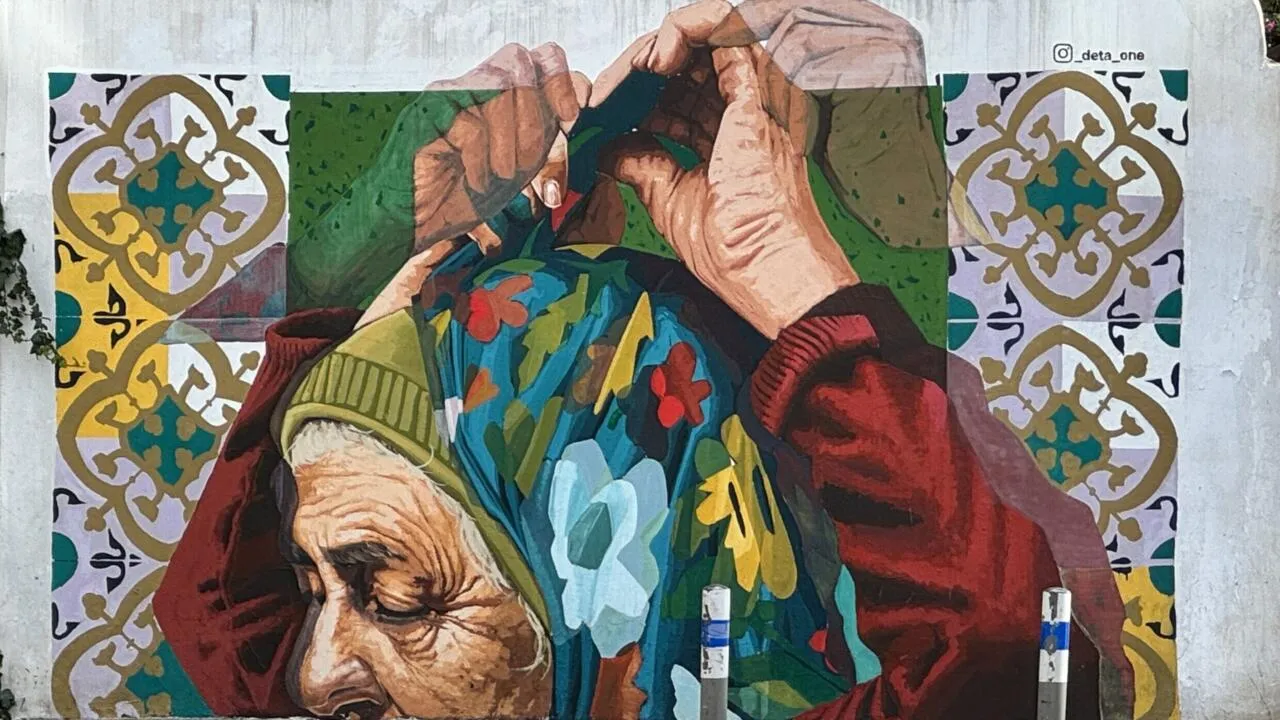
Continuing his conversation with Jack, Christian pays homage to the often-invisible figures in Moroccan society, whom he highlights through his various works. “I meet many elderly individuals; they may not be seen, yet they are the pillars of their communities. Morocco is also built by those we do not see, and they have taught me much about my Moroccan identity,” he shares.
Jack then hops back onto the photographer's scooter, eager to delve deeper into the essence of the white city...
At a local market, Jack encounters Aïcha Nour, who proudly claims the title of the best seafood vendor, as she offers him a taste of her Oualidia and Dakhla oysters paired with Red Bull, her latest culinary invention. After a delightful tasting session and a proposal for an Instagram collaboration, Jack continues his journey, driven by the quest for truth, guided by these diverse artists from around the globe.
It is here that Jack meets Louis Cacciuttolo, a pioneer in immersive art, who is adapting virtual creation to the African continent. He explains the continent's unique characteristics: a deep-rooted culture of social interaction and extensive mobile usage. “When you mention phones, you’re talking about augmented reality, not virtual reality. I’ve tailored my approach to this interface that allows us to reach a broad audience, raising awareness of these overlapping worlds without ever fully disconnecting from reality,” Louis states, as he introduces Jack to the concept of the metaverse, virtual worlds where individuals can project themselves as avatars, either through virtual reality headsets or directly via screens.
Jack, intrigued, decides to experience this for himself by donning a pair of virtual reality glasses, finding himself in a virtual venue known as the Totem Club, where he encounters another avatar who hands him a mysterious letter. In just two hours, Jack must depart Casablanca for **Montreal**, where he is set to explore the discipline of **design**.
As reported by rfi.fr.