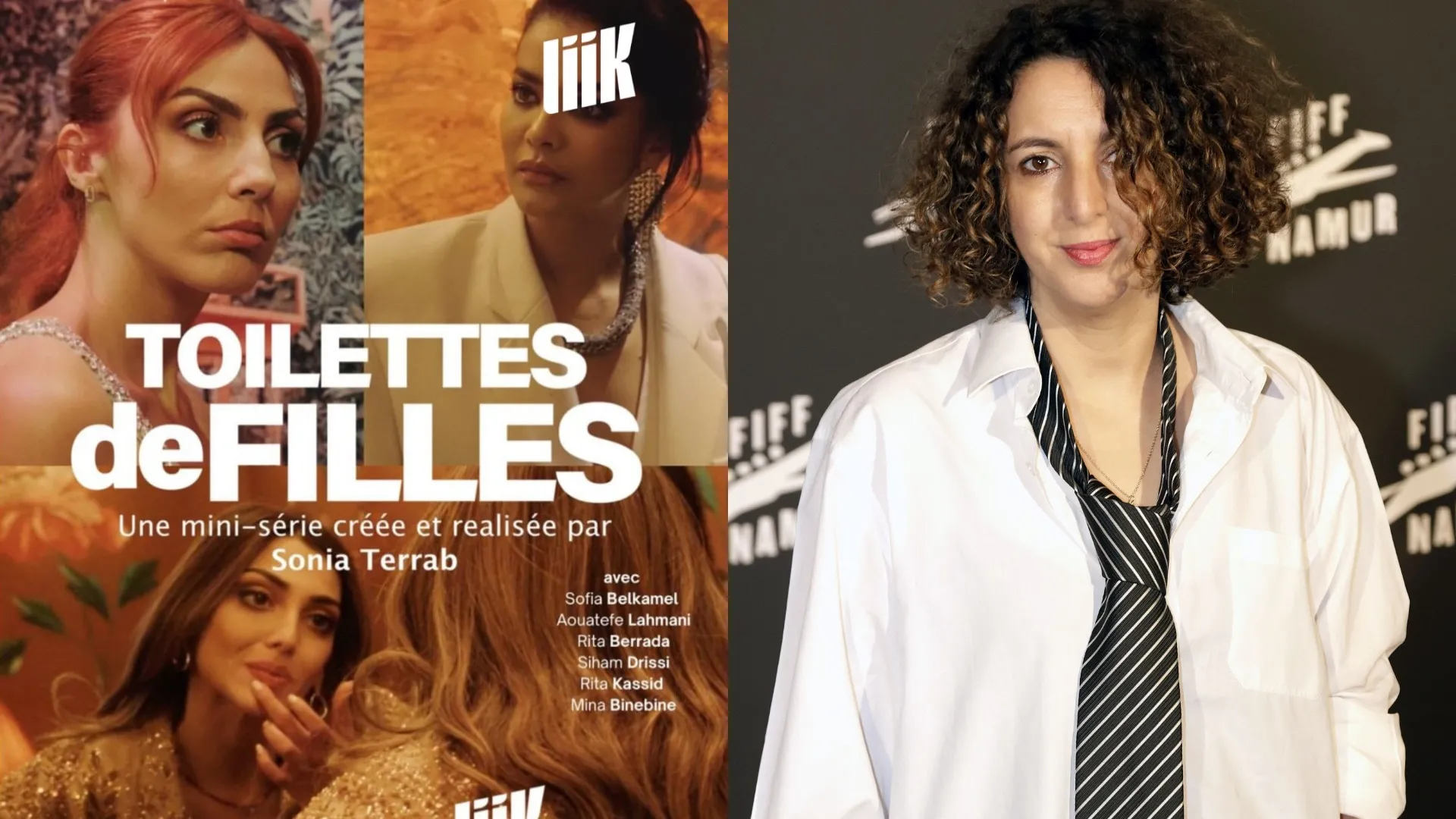

From her earlier work 'Marokkiat' to the new web series 'Toilettes de Filles', Sonia Terrab continues her exploration of spaces that narrate women's experiences in Morocco. In an insightful interview with 'L'Opinion', the director elaborates on the inception of this web series filmed in Marrakech, her choice of the micro-format, and the underlying social dynamics, friendship, and harassment that her setting reveals.
'Toilettes de Filles' transforms a routine venue of Moroccan nightlife into an intimate theatrical stage, where in seven episodes, each less than three minutes long, a poignant investigation unfolds surrounding themes of harassment, friendship, and societal facades. Selected for the 16th edition of the Marseille Web Fest, a prominent French festival for web series, in October 2026, this series stands out as one of the most refined offerings in the burgeoning genre of micro-dramas in Morocco.
The premise is simple yet carries profound social and dramatic weight: Inès, Lina, and Kenza, three childhood friends portrayed by Sofia Belkamel, Rita Berrada, and Aouatefe Lahmani, find themselves night after night in the restrooms of iconic establishments in Marrakech's vibrant nightlife. There, they pursue an unknown assailant, whose identity and actions remain shrouded in mystery, including whether he has assaulted one of them. As they embark on this quest, they confront unexpected reunions, share intimate confessions between makeup touch-ups, and navigate tensions accumulated over years of separation. Co-produced by Fablabchannel and Meknech, with executive production by New Generation Production, the series is available on the Liik platform before a complete release on YouTube, benefiting from support by the French National Center for Cinema (CNC).
A Social Space Worth Exploring: From Casablanca Sidewalks to Marrakech Restrooms
To truly grasp the origins of 'Toilettes de Filles', we must trace back to 2017 and 'Marokkiat', Sonia Terrab's first project, which she discusses in her interview with 'L'Opinion'. In this earlier work, she engaged women on the streets of Casablanca to share, in one or two minutes, a significant moment from their lives as Moroccan women. This initiative aimed to denounce sexual harassment in public spaces, empowering women to reclaim a space that typically does not belong to them. Coinciding with the global rise of the MeToo movement, the series garnered international attention, showcasing testimonies of violence, harassment, and daily misogyny.
Nearly a decade later, Terrab sought to extend her exploration of spaces that subtly reflect the Moroccan female condition. She chose a location that is both banal and symbolically rich: the restrooms of bars, restaurants, and clubs at night. She describes this setting as one of the few places for social mixing in Morocco, where laughter, confessions, and advice can flow freely, creating a moment of pure sisterhood, innocence, and kindness.
Initially considering a documentary approach, the director ultimately decided against it, realizing that placing a camera in what she refers to as a 'safe place' for women would disrupt its essence and endanger those who frequent it. It was her producer, Claire Leproust—who had previously worked on the acclaimed Algerian web series 'El'Sardines'—who suggested pivoting to a fictional format. This shift allowed Terrab to explore a new narrative style, moving away from the dramatic realism of her short film 'Les Jardins du Paradis', which had been selected at the International Film Festival of Francophone Cinema in Namur and awarded at the African Cinema Festival in Milan. In this new work, she embraces a vibrant, colorful, and rhythmic tone, featuring continuous movement in filming to establish immediate intimacy with the characters.
The Challenge of Short Format: Balancing Distribution Constraints with Creative Choices
The project's writing, collaboratively developed with Sofia Belkamel, Rita Berrada, and Aouatefe Lahmani from the very first work session, underwent significant changes in its format. Originally conceived as thirteen-minute episodes, they were condensed to four minutes, and ultimately, the seven episodes were trimmed to between one and a half and three minutes each—this decision made just four months before release. This reduction aligns with a broader trend that Terrab observes: the rise of two-minute micro-dramas, a consumption format that emerged in China and is now expanding in Europe and Morocco. The director expresses her desire to be a pioneer in this sphere, acknowledging that she had to adapt during editing with Zoé Lienard, as she likely would have approached the openings of episodes differently had the short format been established from the outset.
The choice of distributor plays a crucial role in this strategy. Liik, a media platform founded by journalist Rachid Arhab, dedicated to pop culture in the Maghreb and Mediterranean, curated a comprehensive editorial framework around the summer launch of the series, featuring reports on the actresses, interviews with the director, and narrative accounts of the series' release. For this platform, it marked their inaugural venture into fiction, a step that Terrab describes as a shared gamble.
Through 'Toilettes de Filles', Terrab aims to present a portrayal of Marrakech nights that defies impoverished clichés, showcasing women who celebrate, dance, and laugh in carefully selected venues. After previously filming her short film in a slum, the director sought to represent luxurious restrooms—not to establish an aesthetic hierarchy, but to illustrate the diversity of Moroccan identities and the social fractures permeating the nation. She reveals her intention to show that there is no singular way to depict Morocco or to be Moroccan, and that joy, resilience, and self-affirmation can coexist without negating each other.
The filming was made possible thanks to Mohamed Kaghat, the executive producer in Marrakech, whose trust in this sensitive project was invaluable. The series has received a warm reception from audiences, with many female viewers recognizing the filming locations or relating their experiences in similar restrooms. This confirms that a format born from distribution constraints can evolve into a space of collective recognition. Its selection for the Marseille Web Fest, the premier French event dedicated to web series, culminates a journey that, from Casablanca to Marrakech, aims to provide Moroccan women with platforms where their voices can finally be expressed unreservedly.
As reported by lopinion.ma.