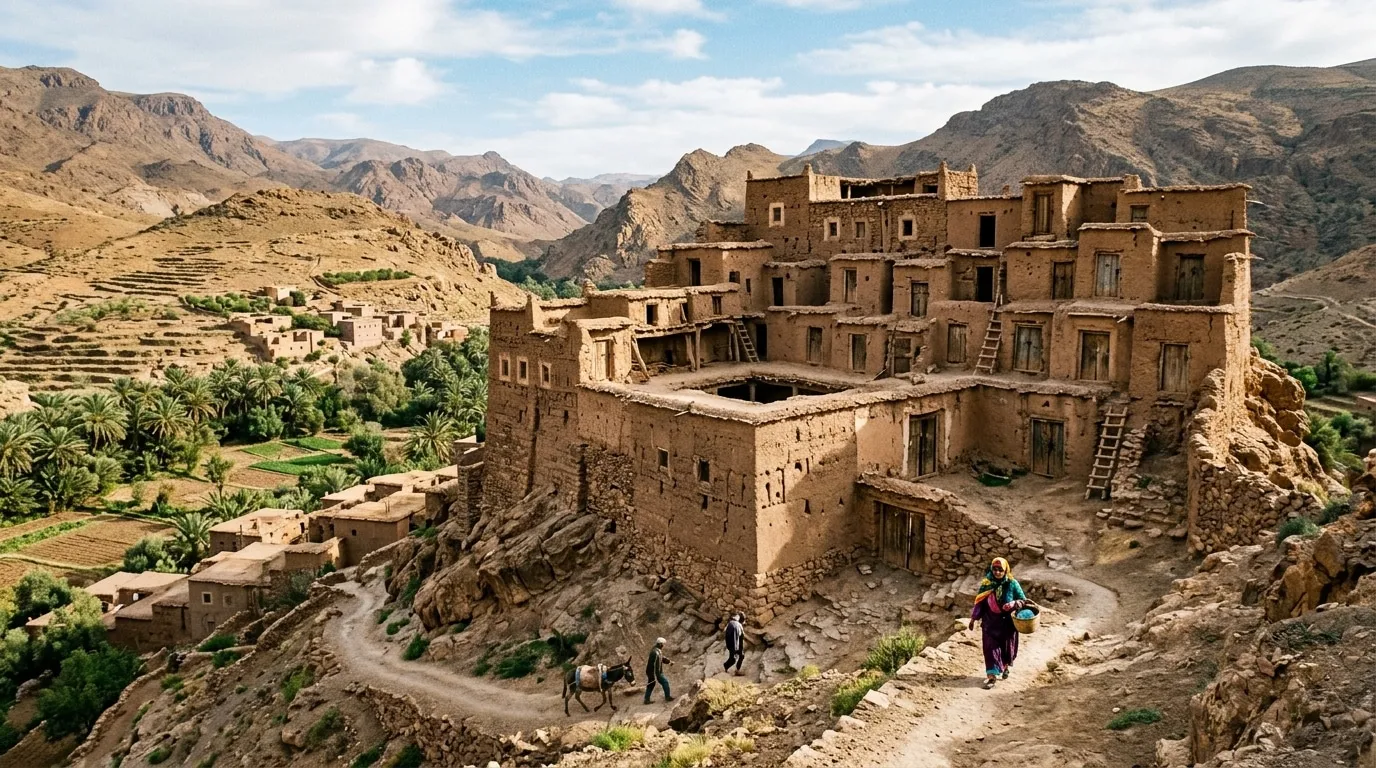

Nestled at the southern tip of the Anti-Atlas, the village oasis of Aït Kine boasts a remarkable agadir that continues to serve its community. Unlike mere relics confined to museum displays, this fortified granary remains a vibrant hub where local harvests, cherished family heirlooms, and important documents are stored, while also serving as a venue for weddings and communal gatherings. This agadir, a product of an ingenious system devised by the Amazigh people, demonstrates their resilience in a harsh environment prone to pillaging.
The Historical Significance of Grain Fortresses in the Anti-Atlas
The term 'agadir' originates from the Amazigh language, signifying a fortified wall or enclosure. These communal granaries can be found perched on rocky hills or nestled within the arid mountains of southern Morocco, particularly in the Anti-Atlas region and along the Sous Valley. Historically, these areas were vital routes for trans-Saharan trade caravans connecting sub-Saharan Africa to Marrakech. While this flourishing trade brought prosperity, it also invited greed and threats of theft. To safeguard their possessions, local inhabitants constructed these stone, rammed earth, or mud brick structures, often situated on hard-to-access rocky outcrops. Typically, these granaries follow a rectangular design featuring a single fortified entrance surrounded by rows of stacked small cells.
Each cell within the agadir was assigned to a family and secured with intricately carved wooden locking mechanisms, which varied by region. Among the most notable examples, Agadir Inoumar continues to dominate its rocky hill, while Agadir Tasguent impresses with its multi-level structure.
A Village Bank: An Ancestral System of Trust and Survival
Within the protective walls of these granaries, residents stored more than just grains. Almonds, dried figs, honey, oil, as well as carpets, jewelry, and important family documents found sanctuary in these individual cells. Some igoudar even included a small mosque or prayer space, highlighting their multifunctional role beyond mere storage. The operation of these granaries was governed by strict rules, overseen by a guardian appointed by the entire village. This individual managed access to the chambers and the withdrawal of goods, ensuring that no one could deplete the communal reserves without adhering to the established code of conduct.
This arrangement bears a striking resemblance to a rural banking system. During bountiful harvests, families would deposit their surplus, while in times of scarcity, they would withdraw what was necessary for survival. The entire system relied on mutual trust among neighbors, reinforcing community bonds.
Today, the majority of igoudar have lost their original purpose and stand at risk of decay and disappearance, despite ongoing preservation efforts. However, the agadir of Aït Kine stands out as a remarkable exception. This granary continues to be actively utilized for the storage of crops, jewelry, and family documents, just as it has been for generations. It even hosts wedding ceremonies, blending practical function with the social life of the village.
The enduring presence of Aït Kine offers invaluable insights into the lifestyles of rural societies in southern Morocco. These stone citadels deserve recognition beyond their architectural curiosity, embodying the collective intelligence born out of necessity, where the survival of a village depended on trust and adherence to a shared code. Even today, in Aït Kine, the memory of this tradition thrives within the thick walls of a granary that refuses to be relegated to the status of a museum.
As reported by journaldesseniors.20minutes.fr.