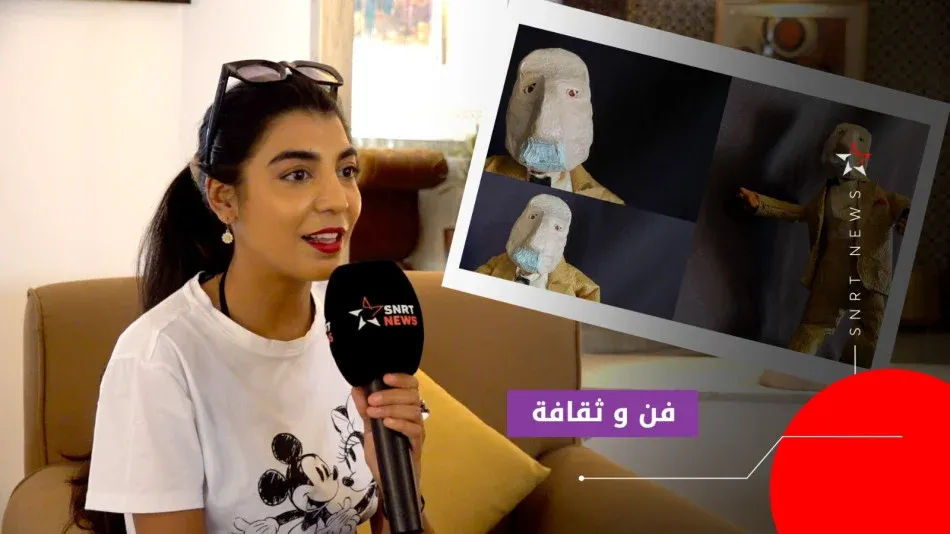

Since her teenage years, Jihan Jouiboul has chosen to embark on a distinctive artistic path centered around stop motion animation, a technique that transforms paper and simple materials into lively characters. This creative journey merges traditional craftsmanship with cinematic imagination, showcasing her innovative approach to storytelling.
In an insightful interview with SNRTnews, the young director and chair of the film selection committee for the International Stop Motion Film Festival in Meknes, known as "FICAM," discussed her artistic trajectory, her early beginnings in animation, and her current work on the short film "Haroun and Mamoun," which is featured in the projects in progress section of the festival.
Among her notable works are titles such as "Nuit Sanglante," "La Mort de Monsieur Tête d'Épingle," and "La Maison des Anges." Additionally, her film "Matryushka" was selected to compete in the Marrakech Short Film Festival, marking her presence in the competitive film landscape.
Jouiboul revealed that her relationship with stop motion technology began at an early stage, emphasizing that this technique has granted her the freedom to create her own worlds without the need for large productions or actors. Over time, this artistic choice has evolved into a cinematic language through which she expresses the fragility of human relationships, memory, and complex emotions. She noted that her diverse cultural background positively influences her artistic vision and creative choices.
Regarding her short film project "Haroun and Mamoun," Jouiboul shared that it is set to premiere at the end of 2027 and will be the first entirely Moroccan short film produced using stop motion, created by a Moroccan team. The film is rooted in a fantastical idea where time freezes in Casablanca following a meteor strike, compelling a father and son to confront their past and their fractured relationship.
Importantly, she clarified that the film does not primarily rely on science fiction as a goal in itself; rather, it uses the genre to pose profound human questions related to reconciliation, memory, and the transmission of emotions across generations. Jouiboul expressed her intention to utilize paper and handmade materials in designing the film's visual world, aiming to give the imagery a tangible texture. She highlighted that traditional Moroccan crafts, including wood engraving and handmade products, serve as a fundamental source of inspiration in the creation of her sets and characters, noting her collaboration with various Moroccan artisans.
Her participation in international workshops and residencies, including the Annecy Festival and "Animasyros," has helped her understand the industrial and economic aspects of the animation film industry. Jouiboul believes that Moroccan animation cinema is currently undergoing a significant transformation, thanks to its increasing presence in international markets and festivals, alongside the emergence of support programs from the Moroccan Cinematic Center and specialized workshops. She considers that the "FICAM" festival plays a crucial role in training a new generation of directors capable of transforming animation from mere entertainment into a legitimate cultural industry.
As reported by snrtnews.com.