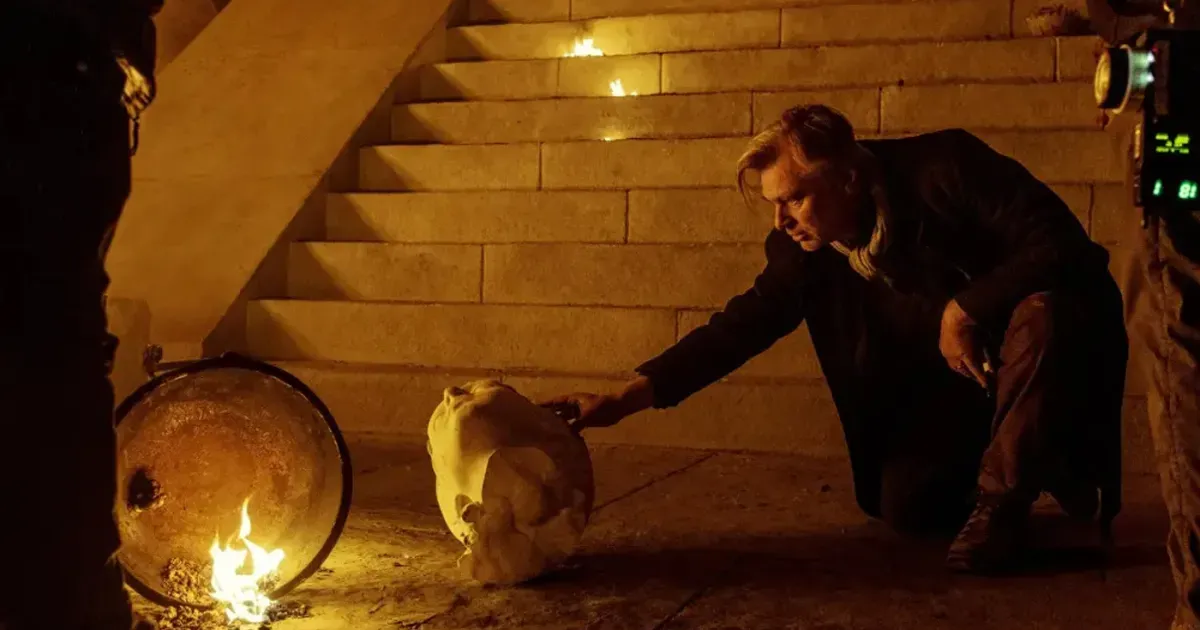

When renowned filmmaker Christopher Nolan decided to bring the timeless epic of Homer, 'The Odyssey', to the big screen, he went beyond merely retelling Odysseus's legendary journey; he sought to create a tangible visual world that reshapes its ancient geography. To achieve this, he chose filming locations spanning six countries, with Morocco and Greece at the forefront, to bring to life the cities, islands, and realms traversed by the hero during his lengthy odyssey.
This article follows the footsteps of Odysseus through some of the most prominent locations selected by Nolan to transform Homer's myth into cinematic reality.
Morocco: A Cinematic Gem
This isn't the first time Morocco has hosted the filming of iconic Hollywood epics. With its enchanting landscapes and distinctive architecture, the country has previously served as the backdrop for several important films, including the acclaimed 'Gladiator'. The filming locations in Morocco included:
1 – Aït Benhaddou: The Rebirth of Troy
Located about 30 kilometers from the city of Ouarzazate and along the ancient caravan route between the Sahara Desert and Marrakech, Aït Benhaddou, a UNESCO World Heritage site since 1987, stands as a prominent example of traditional earthen architecture. Nolan utilized this stunning location to depict the city of Troy, leveraging its ancient walls and fortifications to evoke the ambiance of ancient cities. The production team also constructed over 60 temporary buildings around the original kasbah, covering an area of approximately 110,000 square feet, which included temples, gates, towers, and staircases.
2 – Essaouira: The Trojan Horse
On the shores of Essaouira, Morocco, the scene of discovering the partially buried wooden horse was filmed in the wind-swept sands of the coast. The historical walls and old city also served as the backdrop for scenes depicting the celebrations preceding Odysseus's long voyage, where the stone walls of the city against the crashing Atlantic waves provided an ideal stage for the events. Essaouira, located 90 miles west of Marrakech, is famous for its historic ramparts and was once a commercial port connecting Morocco's desert depths with Europe and the world. It was designated a UNESCO World Heritage site in 2001.
3 – Dakhla and the White Dune: Calypso's Island
For the scenes set on the nymph Calypso's island—played by Charlize Theron—where Odysseus spent seven years, the team chose the breathtaking 'White Dune' area, located about 40 kilometers from the city of Dakhla.
4 – Marrakech: The Palace of Menelaus
The interior scenes of King Menelaus's palace were filmed in Marrakech, although sources did not explicitly mention the building's name. Marrakech serves as an excellent starting point for your journey in Morocco, from where you can head west to Essaouira or southeast to Aït Benhaddou and Ouarzazate.
Greece: The Heart of the Odyssey
After our exploration of Morocco, we transition to Greece, the homeland of Homer's original poem, where several key scenes of the film were shot. One of the prominent locations is Nestor's Cave, situated above Voidokilia Beach in Greece, which was used to film the scenes of Odysseus and his crew's siege against the one-eyed giant, requiring no additional interior sets, thus enhancing the realism of the scenes. The Greek castle of Methoni was also utilized for the exterior shots of Menelaus's palace.
In addition, instead of filming Odysseus's homeland on the Greek island of Ithaca, the team selected the island of Favignana off the western coast of Sicily, specifically the Santa Caterina Castle overlooking the sea, which was transformed into the exterior of Odysseus's palace. Some naval maneuvering scenes were filmed in the Aeolian Islands north of Sicily, known for their stunning landscapes and active volcanoes, and they are listed as a UNESCO World Heritage site.
The cave of Calypso is located on the western side of Ramla Bay, specifically on the island of Gozo in Malta, believed to be the cave referred to in the Odyssey, and it was used for filming the scenes of Calypso's cave.
Underwater scenes, including shipwrecks and close-range naval battles, were filmed at the Mediterranean Film Studios located in Kalkara. Although primarily a production facility, it also attracts significant interest from film tourism enthusiasts, with some tour companies offering special tours to explore it.
Finally, to capture the mystical atmosphere of the enchanting island of Circe, Nolan headed to the ruins of Findlater Castle overlooking Moray Bay in Scotland, while the Sandy Side Beach featured in the scenes of Odysseus and his crew's arrival on shore, and the Goblin Forest was used to film scenes involving the cannibals who ambushed Odysseus's crew.
Notably, Iceland has emerged as a recurring filming location in Nolan's cinema, marking the third time he returned after 'Batman Begins' and 'Interstellar'. Filming locations included Lindyjahofn and the Icelandic Highlands, where Nolan utilized the dramatic landscapes to depict scenes of Odysseus's descent into the underworld.
Among all these locations, Morocco remains the most alluring starting point for any journey tracing the path of 'The Odyssey'; in just one country, you can follow half the geography of Homer’s world that Nolan has artistically reimagined on screen.
As reported by aljazeera.net.