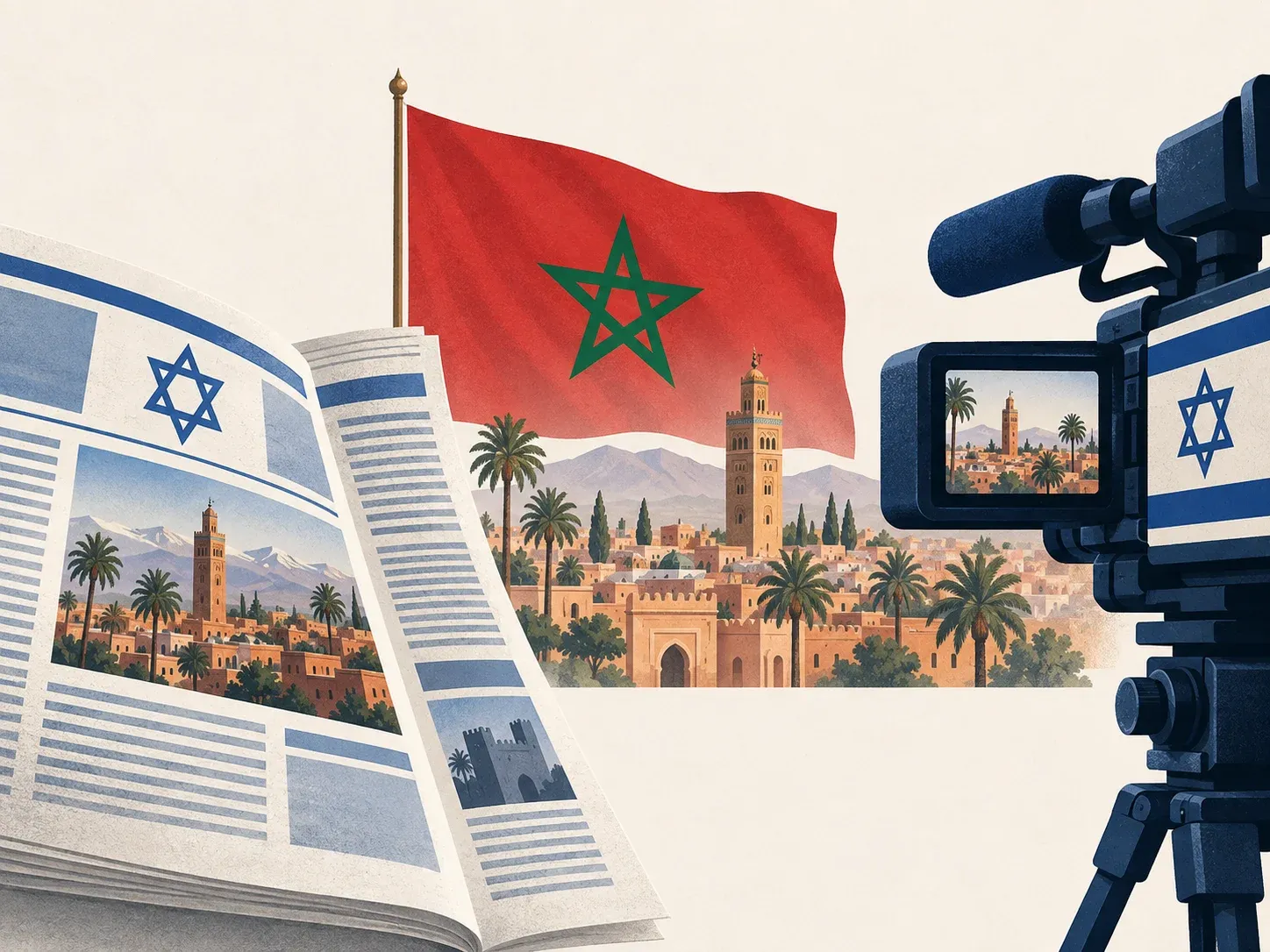

Understanding the Narrative of Morocco in Israel’s English-Language Press
Shalom to all, and Gmar Chatimah Tovah! I hope your Yom Kippur is filled with meaning and reflection. After extensive research and meticulous revisions, my paper titled “Adaptive Frames, Convergent Silences: Morocco in Israel’s English-Language Press across the Pre-Normalization, Normalization, and Post-October 7 Periods” has been accepted for publication by the Journal for Interdisciplinary Middle Eastern Studies (JIMES), a peer-reviewed, Scopus-indexed journal affiliated with Ariel University Press. This significant work will be featured in Volume 13, No. 1 (2027).
This research commenced as my master’s thesis at the Doha Institute for Graduate Studies in Qatar, evolving into a comprehensive 42-page analysis aimed at addressing a seemingly straightforward yet profound question: how is Morocco depicted in Israel’s English-language press? Rather than simply categorizing Morocco-Israel relations as either "good" or "bad," this study delves deeper into which aspects of Morocco’s identity are highlighted in Israeli media coverage, the authority of various voices, the histories that are invoked, and those that remain overlooked.
To provide a robust analysis, I scrutinized articles from prominent publications such as Haaretz, The Jerusalem Post, and Ynetnews during three critical periods: prior to formal normalization, from the December 2020 agreement to October 6, 2023, and from October 7 through March 18, 2025. Out of over a thousand eligible articles, I closely examined 45—five from each outlet for each time frame.
The results of my study defy simplistic left-right ideological boundaries. Each media outlet adapted its language in response to evolving events while maintaining its intrinsic editorial perspectives. For instance, Haaretz balanced a recognition of Morocco’s rich Jewish heritage with critical assessments of the monarchy and the transactional nature of normalization. Conversely, The Jerusalem Post wove cultural memory into a narrative of strategic partnership, emphasizing the resilience of official ties following October 7. Ynetnews framed normalization as a revival of historical kinship, attributing much of the Moroccan opposition to normalization to “media distortion” and misinformation.
I term these dynamics “adaptive framing ecosystems,” wherein media outlets navigate significant events while interpreting them through their longstanding commitments. Interestingly, the similarities across these outlets proved more informative than their differences. Across the political spectrum, the historical ties between Jews and Moroccans received extensive attention—highlighting mellahs, synagogues, cemeteries, Andalusian music, migration narratives, and the approximately one million Israelis of Moroccan descent. This shared heritage allowed normalization to be framed not as a controversial new beginning but rather as a revival of a previously interrupted relationship, a concept I refer to as “mnemonic bridging.”
In stark contrast, while the Jewish-Moroccan heritage was contextualized with centuries of history, the popular Moroccan opposition to normalization was often stripped of historical nuance. Protesters were depicted merely as crowds, Islamists, or victims of misinformation, rather than as active participants rooted in Morocco’s long-standing tradition of solidarity with Palestine. Outside of Haaretz, the monarchy generally received deference or was left unexamined, while Islamist factions were frequently portrayed as obstacles to an otherwise promising relationship.
As a Moroccan journalist and researcher, this experience was illuminating. I recognized facets of my country in the coverage, yet never in its entirety. Morocco was portrayed variously as a repository of Jewish memory, a diplomatic asset, a tourism hub, a strategic ally, and at times, a challenging Arab public. Each representation held a kernel of truth; however, none captured the full scope of Morocco’s reality.
This illustrates the essence of media framing, which does not necessarily fabricate facts but wields its power by determining which facts are given historical significance, whose grievances are explained, and which omissions become so habitual that they fade from the audience's awareness. The “convergent silences” identified in my study are not mere voids; they constitute integral parts of the narrative crafted by the coverage.
Furthermore, my paper includes an unexpected postscript. Its dataset concludes on March 18, 2025, meaning it does not encompass the significant development of September 16, 2026, when Morocco and Israel agreed to enhance diplomatic relations through the establishment of embassies and the appointment of ambassadors. This pivotal moment will undoubtedly serve as the foundation for my next research endeavor.
This evolving scenario presents a valuable test case: How will Israeli media frame this diplomatic upgrade? Will it be portrayed as evidence of institutional resilience post-October 7, a culmination of an age-old friendship, or simply as another strategic negotiation? Will Moroccan public dissent and the Palestinian issue be contextualized, or will they be depicted merely as challenges to an otherwise successful diplomatic narrative? Additionally, will the Hebrew and English editions relay the same events with similar interpretations?
Academic research progresses at a deliberate pace, in contrast to the rapidly changing landscape of diplomacy. A study must inevitably draw a line somewhere, even when the relationships it explores continue to evolve. I take pride in the publication of this paper, not because it resolves the debate, but because it provides a transparent corpus of research, complete with archived links and claims that readers can evaluate against the original texts.
As a Moroccan author examining Israeli media, my intent was neither to celebrate nor condemn but to engage in careful analysis. If this paper prompts Israeli readers to reflect on how Morocco is depicted and inspires Moroccan audiences to consider how we narrate Israel, it will have accomplished something far more significant than a personal achievement: it will facilitate a reciprocal scrutiny that honors a relationship too complex to be distilled into simplistic slogans.
As reported by blogs.timesofisrael.com.