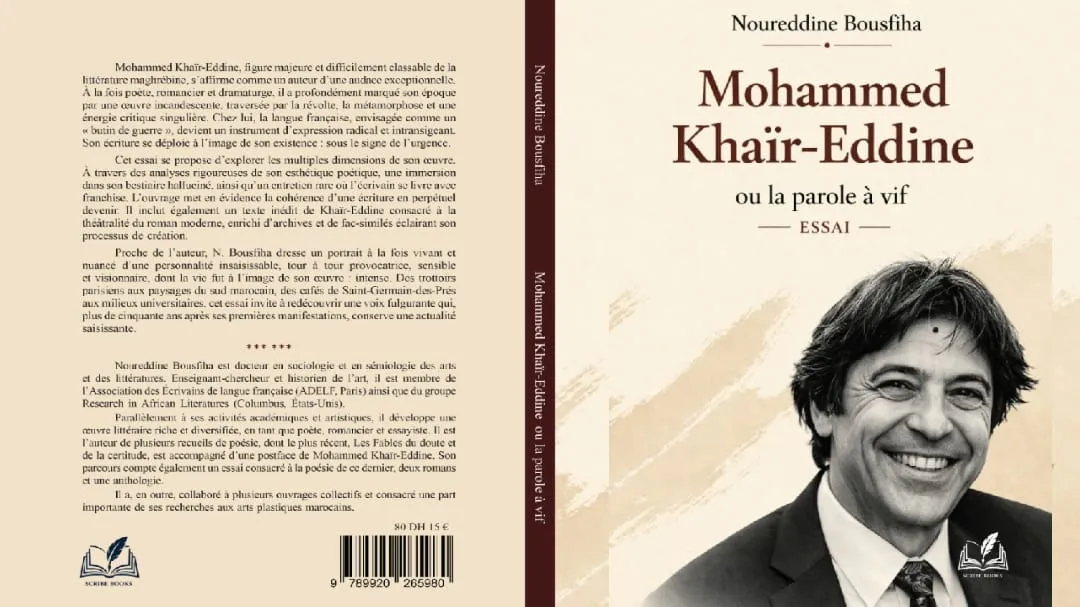

A Profound Exploration of Mohammed Khaïr-Eddine's Work
A new book titled "Mohammed Khaïr-Eddine ou la parole à vif" has been released by Scribe Books in Tétouan, authored by the sociologist, semiologist, and poet, Noureddine Bousfiha. This essential work offers a deep dive into the intricacies of Mohammed Khaïr-Eddine's oeuvre, a prominent figure in contemporary Moroccan literature known for his unique and subversive voice. Through its vibrant language, poetry, striking imagery, and previously unpublished texts, the book provides a fresh perspective on Khaïr-Eddine’s work, which has continuously challenged literary forms, conventions, and imaginations. It intertwines critical analysis with unpublished documents, correspondences, and testimonies, illuminating the multifaceted nature of Khaïr-Eddine's writing—a writing imbued with themes of rebellion, freedom, and transgression, while also being profoundly poetic, deeply rooted in memory, exile, violence, and an insatiable desire for expression.
More than just a tribute, this book serves as an invitation to rediscover Khaïr-Eddine, his incandescent voice, and his extraordinary literary universe. It represents a significant and necessary exploration that offers a rare glimpse into the khaïr-eddinien realm and aids in renewing the perception of a major literary work that remains vibrant, unsettling, and relevant today.
A Brief Biography of Mohammed Khaïr-Eddine
Born in Tafraout, a small town in the Souss-Massa-Drâa region of Morocco, Mohammed Khaïr-Eddine hailed from the Amazigh tribe of Aït Ammeln, located 180 kilometers south of Agadir. His life was profoundly shaped by the devastating earthquake of 1960, prompting his relocation to Agadir in 1961, where he lived until 1963. During this period, he was tasked by the social security agency to conduct investigations among the local population. A burgeoning writer, he soon became part of the literary and artistic circle in Casablanca. In 1964, along with Mostafa Nissaboury, he founded the movement "Poésie toute."
In 1965, Khaïr-Eddine voluntarily exiled himself to France, where he worked as a laborer in the Paris suburbs to support himself. From 1966 onwards, he contributed to the literary magazine "Encres vives" while collaborating with "Les Lettres nouvelles" and "Présence africaine." His 1967 novel "Agadir" marked a turning point in his career, earning him the prestigious Enfants terribles prize established by Jean Cocteau. After returning to Morocco in 1979, Khaïr-Eddine passed away in Rabat on November 18, 1995, coinciding with Morocco's Independence Day.
His literary works, predominantly published by Éditions du Seuil, include notable titles such as "Nausée noire," "Le Roi," "Agadir," "Corps négatif," and "Faune détériorée," among others. Each of these works contributes to the rich tapestry of Moroccan literature, showcasing Khaïr-Eddine's profound engagement with the complexities of identity, memory, and cultural expression.
As reported by lecollimateur.ma.