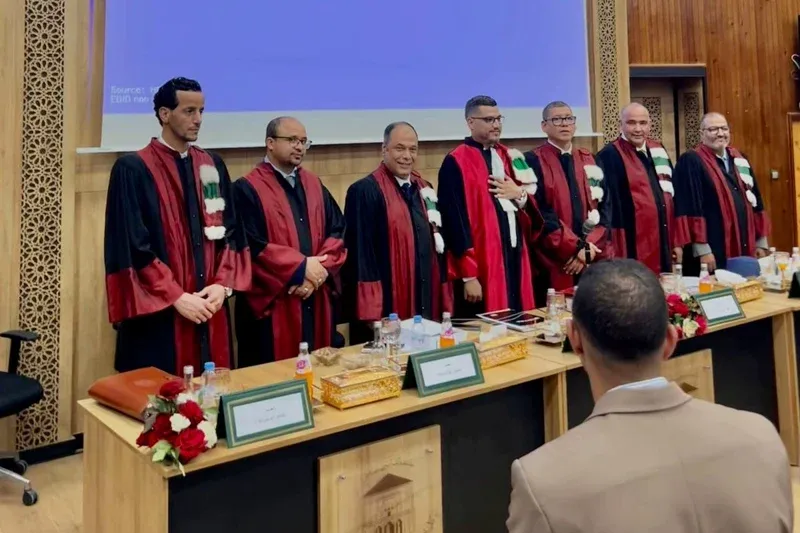

Insights from Osama Fawzi's PhD Thesis Discussion
The auditorium of Al-Mokhtar Soussi, part of the Faculty of Legal, Economic, and Social Sciences at Cadi Ayyad University in Marrakech, recently hosted an insightful discussion surrounding a doctoral thesis presented by researcher Osama Fawzi. The thesis, titled “Local Regulatory Authority in Morocco: Evolution and Outcomes,” delved into the complexities of local governance and regulatory frameworks in the Moroccan context.
Presided over by Professor Hussein Aboushi, a distinguished faculty member, the session also included esteemed academics such as Professor Mohamed Al-Abida, along with several other professors from various law faculties, showcasing the collaborative academic environment. The research focused on the degree of autonomy and freedom granted to local communities in exercising their regulatory power amidst the legal constraints imposed upon them. Fawzi posed a critical question regarding whether this autonomy is a primary factor driving Moroccan legislators to adopt a dual-function principle for the administrative oversight of local authorities.
Fawzi's study was structured around three hypotheses: first, that local authority is a subordinate and derivative power; second, that it is exercised broadly based on free administration; and third, that the dual-functionality of administrative oversight ensures the exercise of this authority. The findings of the research led to a significant conclusion that the territorial decision-making remains subject to national legislation established by Parliament and is influenced by the broader public policies of the state. Interestingly, the study disproved the second hypothesis, revealing that this authority is not as extensive as presumed but rather constrained by specific competencies and subjected to an important process of administrative oversight. The third hypothesis, however, remained in a state of ambiguity, oscillating between affirmation and refutation.
The conclusions drawn from the research indicated that the activation of local regulatory authority, recognized by the 2011 Constitution, faces challenges linked to the state’s apprehension regarding the implications of the principle of free administration at the local level. The study identified three primary reasons for these challenges: the state's commitment to safeguarding regulatory actions, a deficiency in the qualifications and skills among local elites and elected officials, and legislative concerns about the increasing scope of local autonomy compared to comparative systems of self-governance.
Moreover, the research offered numerous recommendations, emphasizing the need to revise candidacy requirements, reduce administrative oversight, and grant broader legislative space for local communities to establish original regulatory authority. Fawzi underscored the necessity for careful preparation of a new territorial model that considers the hybrid regional system in Morocco, aiming for a balance between advanced regionalization and autonomous governance regions.
Ultimately, the scientific committee accepted this research, awarding Osama Fawzi with a PhD with high honors, along with a recommendation for publication, highlighting the importance of his contributions to the discourse on local governance in Morocco.
As reported by hespress.com.