
Unveiling the Mysteries of Monte Tropic
Situated to the south of the Canary Islands, beneath the depths of the Atlantic Ocean, lie several submerged mountains that once aspired to become islands. These geological formations, referred to as the "abuelas de Canarias" or "grandmothers of the Canaries," not only reflect the ancient volcanic processes that shaped the Spanish archipelago but are also gaining prominence in the international geopolitical arena. This renewed interest is largely due to the discovery of vast quantities of rare earth minerals such as tellurium, cobalt, and nickel, which are highly sought after in the technology industry. Over the past few years, these underwater mountains have captured the attention of scientists and governments alike, presenting both opportunities and challenges.
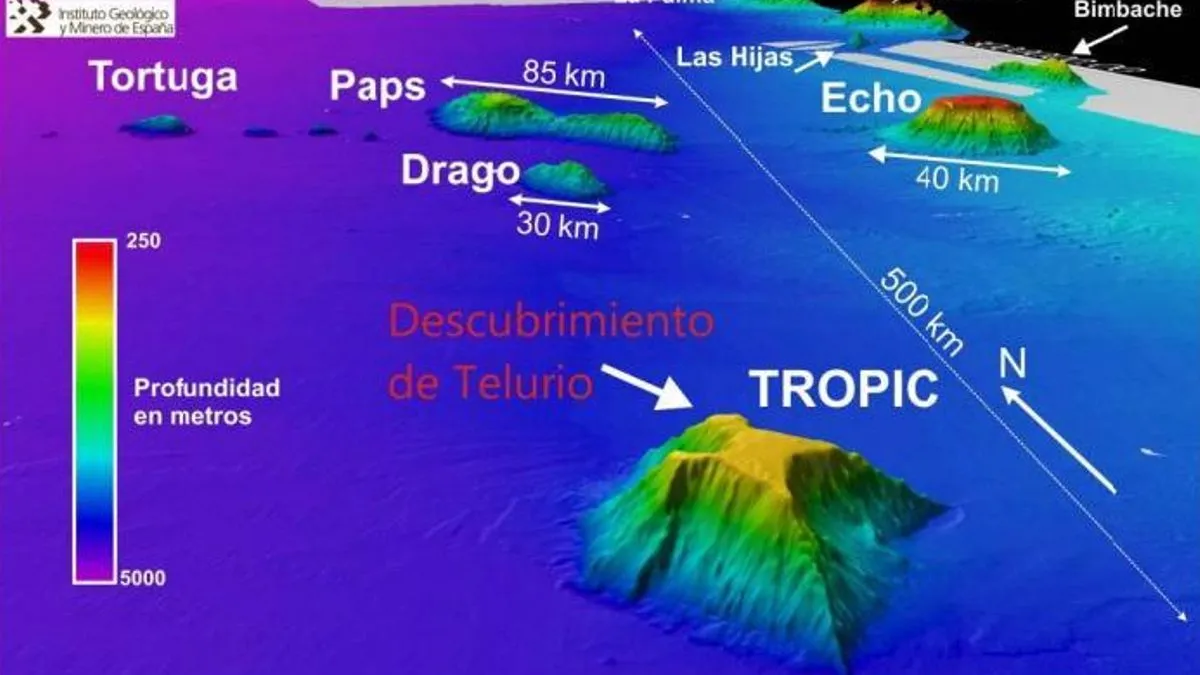
Initially, five submarine mountains were identified, including Las Hijas, Echo, The Paps, Drago, and Tropic, followed by another eight: Drago, Bimbache, Ico, Pelicar, Malpaso, Tortuga, Infinito, and Las Abuelas. Among these formations, Monte Tropic stands out as a focal point of interest. This ancient volcano, estimated to be 119 million years old, is significantly older than the geologically oldest Canary Island, Fuerteventura, by a factor of five. The summit of Monte Tropic rests approximately 1,000 meters below the ocean surface, with a diameter of about 50 kilometers. With a height of 3,200 meters, it is one of the oldest mountains within the volcanic province of the Canary Islands, though it officially lies beyond the 200 nautical miles that define Spanish waters.
The Geological Significance and Resource Wealth of Monte Tropic
Monte Tropic is located more than 250 nautical miles from the nearest point of the Canary Archipelago at coordinates 20.72 degrees West, 23.89 degrees North. According to Google Maps, it is precisely 499 kilometers (or 269 nautical miles) from the port of La Restinga on El Hierro, which marks the southernmost point of the Canary Islands, and 677 kilometers (360 miles) from Maspalomas on Gran Canaria. Within its geographical context, Tropic is the second highest underwater mountain after Echo, which rises to 3,400 meters from a depth of 3,700 meters, and ranks second in surface area, following The Paps, which is 44% larger at 1,363 km².
The mountain features a nearly circular shape, indicative of prolonged volcanic activity concentrated at a single point. Its slopes exhibit signs of significant ancient landslides akin to those observed on El Hierro today. Research teams from the Spanish Institute of Oceanography (IEO), the Geological and Mining Institute of Spain (IGME), and the Navy have studied this underwater wonder, uncovering that it is topped by a large flat plateau that shows evidence of having been above sea level until a certain point in the past, after which it submerged to its current depths.
Monte Tropic garnered international attention in 2017 when the UK's National Oceanography Centre, in collaboration with IGME and researchers from various universities, announced the discovery of substantial concentrations of tellurium within the ferromanganese crusts that coat the mountain. Reports indicated that Tropic could potentially host around 2,670 tons of tellurium, equating to one-twelfth of the global consumption of this metal. Scientists revealed that the plateau atop Monte Tropic is covered by a rocky crust about four centimeters thick, containing tellurium concentrations 50,000 times greater than those typically found in terrestrial deposits.
Bram Murton, the expedition leader, described the crust as "astonishingly rich," emphasizing the exceptional value of these rocks from a resource perspective. The findings were further highlighted by the journal Science, which noted that if the calculations from the James Cook research vessel were accurate, Monte Tropic could provide enough cobalt to manufacture 277 million electric cars—54 times the current global fleet—and sufficient tellurium to produce solar panels that would cover half of the electricity consumption for the United Kingdom, the seventh largest economy in the world.
However, prior to the British expedition's discoveries, Spain had already conducted multiple oceanographic campaigns in the region. In October 2016, IGME, IEO, and the Complutense University published preliminary findings in Ore Geology Reviews, revealing the mineral wealth of Monte Tropic and its neighboring mountains, although they did not specifically mention tellurium. These campaigns, dating back to 2011, aimed to understand not only the geological characteristics of these underwater mountains and their ecosystems but also to document Spain's request to the UN for an extension of its sovereignty over the maritime area surrounding the Canaries beyond 200 nautical miles.
In fact, in 2014, three years before the British expedition, the Spanish government submitted a formal request to the United Nations to extend the continental shelf of the Canaries westward across an ocean area ranging from 200 to 350 nautical miles, covering a total surface area of 296,000 square kilometers, which is nearly equivalent to the entire area of Italy. Monte Tropic falls within this requested zone. Following the global recognition of Tropic's resource wealth, Morocco enacted two legislative initiatives in July 2017 aimed at incorporating the waters of Western Sahara into its jurisdiction and defining its maritime border with the Canaries. In December 2019, the Moroccan parliament unilaterally approved two laws to extend its territorial waters towards the coast of Western Sahara, a territory still undergoing decolonization, thereby including the coveted underwater mountains.
This development sparked a dispute between Spain and Morocco within the UN regarding sovereignty over the waters and their underwater resources. Nevertheless, discussions about territorial waters and airspace over Western Sahara have remained secondary in the bilateral relations between the two nations. A joint declaration was signed in December 2025 to reopen customs in Ceuta and Melilla, yet the contentious issues surrounding territorial waters and airspace were notably absent from the agenda.
Meanwhile, in the Canary Islands, the Parliament voted in 2021, with opposition from the PP and Ciudadanos parties, to request the Spanish government to impose a moratorium on underwater mining at Monte Tropic until the environmental impacts on marine ecosystems could be thoroughly investigated. This proposal, drafted by Ecologistas en Acción Lanzarote, also sought to declare the area as an ecologically or biologically important marine site.
As reported by eldiario.es.