
Historical Roots and Political Implications of Greater Morocco
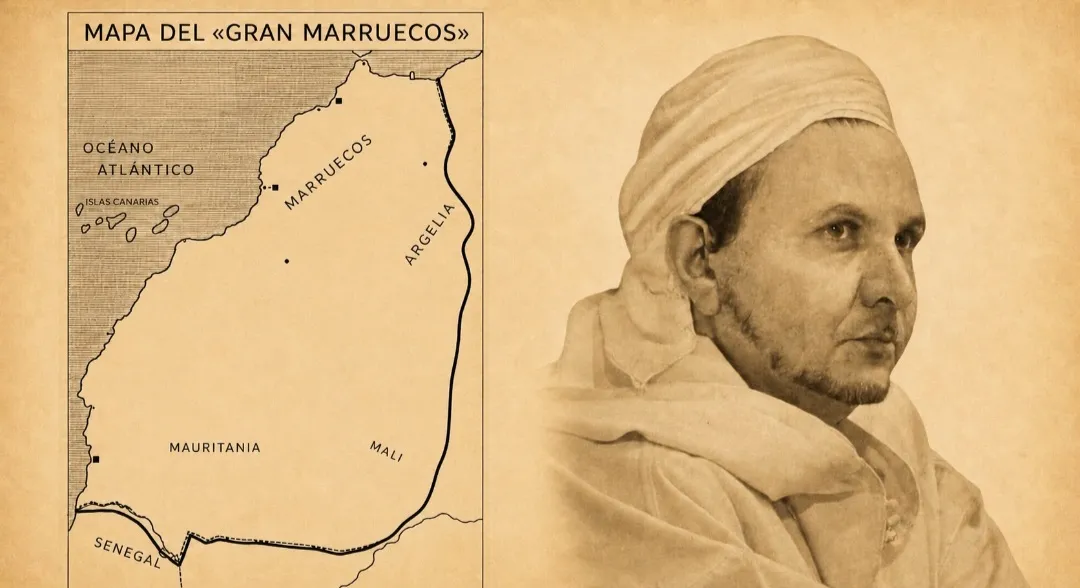
A recent Spanish report has shed light on the historical and political backgrounds surrounding the concept of "Greater Morocco," examining its evolution since the era of Moroccan nationalism. This discussion encompasses the territorial debates concerning the kingdom, including Ceuta, Melilla, and the Sahara, particularly as the issue of border relations between Morocco and Spain has resurfaced following recent developments in Ceuta. The report, published by the website "infobae," traces the roots of the "Greater Morocco" concept, which emerged in the first half of the 20th century. It highlights how this idea was associated with several figures from the Moroccan nationalist movement, who envisioned a historical narrative that connects contemporary Morocco with regions that were once under the rule of various dynasties and states throughout history in Morocco and broader North Africa.
One of the prominent advocates of this vision was Allal al-Fassi, a leading figure in the Moroccan nationalist movement and a co-founder of the Istiqlal Party. Al-Fassi linked modern Morocco to the political legacy of historical dynasties such as the Almoravids, Almohads, and Marinids, aiming to reclaim what he viewed as historically connected territories. According to the Spanish report, the concept of "Greater Morocco" historically encompassed present-day Morocco, the Sahara, Mauritania, parts of Algeria and Mali, as well as Ceuta, Melilla, and several Mediterranean coastal sites currently administered by Spain.
Modern Context and Current Diplomatic Relations
However, the report notes that the current official discourse in Morocco does not typically employ the term "Greater Morocco" in the same context as it was during the nationalist movement's era. Over recent decades, Morocco's focus has shifted more towards the Sahara issue, alongside regional and international relations. Regarding Ceuta and Melilla, the report references recent statements from Justice Minister Abdellatif Ouahbi, who indicated that the status of these cities remains a topic of discussion in Moroccan-Spanish dialogues, with Morocco continuously raising the issue during meetings between officials from both nations.
This emphasis comes at a time when Moroccan-Spanish relations are experiencing a different phase compared to previous tensions, as both countries have successfully developed a high level of coordination on various issues, including migration, security, trade, and investment. The report then transitions to the Sahara issue, which has significantly influenced Morocco's relations with Spain, Algeria, and the Polisario Front since the mid-1970s. It highlights that Morocco presented historical arguments regarding the Sahara at the International Court of Justice during its deliberations in 1975, emphasizing the political and religious ties that existed between various tribes in the region and the Moroccan sultans.
In its advisory opinion issued in 1975, the International Court of Justice acknowledged the existence of legal ties of allegiance between the Sultan of Morocco and the Sahrawi tribes. This period also marked a pivotal moment in the conflict between Morocco and the Polisario Front, particularly with the organization of the "Green March" by Morocco in November 1975. The report connects the developments regarding the Sahara issue with shifting positions of several countries, noting that Spain itself altered its stance in March 2022, when Prime Minister Pedro Sánchez's government expressed support for Morocco's autonomy initiative as a basis for a political solution to the dispute.
As reported by assahifa.com.