
Understanding the Historical Context of the Greater Morocco Concept
A recent Spanish report sheds light on the historical and political underpinnings of the concept of "Greater Morocco," tracing its evolution from the era of Moroccan nationalism and the ongoing discussions surrounding the territorial scope of the kingdom, including Ceuta, Melilla, and the Sahara. This analysis comes at a time when the issue of border relations between Morocco and Spain has resurfaced following recent developments concerning Ceuta.
The report, published by the website "infobae," delves into the origins of the concept of "Greater Morocco," which emerged in the first half of the 20th century. It underscores how this idea was linked to various figures within the Moroccan nationalist movement, who envisioned a historical narrative that emphasized the connections and extensions between present-day Morocco and territories that have been governed at different times by various dynasties and states throughout Moroccan history and much of North Africa.
The Role of Nationalist Leaders in Promoting Greater Morocco
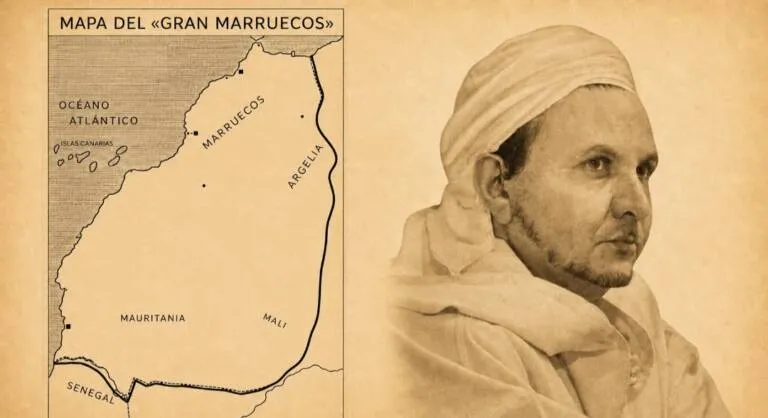
One of the most prominent advocates of this vision was Allal al-Fassi, a leading figure in the Moroccan nationalist movement and a co-founder of the Istiqlal Party. He linked modern Morocco to the political legacy of historical dynasties such as the Almoravids, Almohads, and Merinids, in a narrative aimed at reclaiming what he viewed as historically connected territories to Morocco. According to the Spanish report, the notion of "Greater Morocco" historically encompassed present-day Morocco, the Sahara, Mauritania, and parts of Algeria and Mali, along with Ceuta, Melilla, and several Mediterranean coastal sites currently administered by Spain.
However, the same report notes that contemporary Moroccan discourse does not typically employ the concept of "Greater Morocco" in the same way it was associated with the era of nationalist movements. Instead, in recent decades, Morocco's focus has shifted more towards the Sahara issue, alongside its regional and international diplomatic relations. Regarding Ceuta and Melilla, the report cites recent statements from Justice Minister Abdellatif Wahbi, who indicated that the question of these cities remains a topic of discussion in Moroccan-Spanish dialogues, with Rabat consistently raising the issue in meetings between officials from both countries.
This focus on Ceuta and Melilla comes at a time when Moroccan-Spanish relations are in a different phase compared to previous periods of tension. In recent years, both countries have managed to enhance their cooperation across several areas, including immigration, security, trade, and investment. The report further transitions to the Sahara issue, which has been a significant factor in Morocco's relations with Spain, Algeria, and the Polisario Front since the mid-1970s. It highlights that Morocco presented a series of historical arguments before the International Court of Justice concerning the Sahara in 1975, related to the bonds of allegiance and the political and religious ties that existed between several tribes in the region and the Moroccan sultans.
In its advisory opinion issued in 1975, the International Court of Justice acknowledged the existence of legal ties of allegiance between the Sultan of Morocco and the Sahrawi tribes. This period was pivotal, leading to the "Green March" organized by Morocco in November 1975, which marked a crucial point in the conflict between Morocco and the Polisario Front. The report connects developments in the Sahara issue with the changing stances of various countries, noting that Spain itself altered its position in March 2022 when Prime Minister Pedro Sánchez’s government expressed support for Morocco's autonomy initiative as a basis for a political resolution to the dispute.
As reported by ariffino.net.