
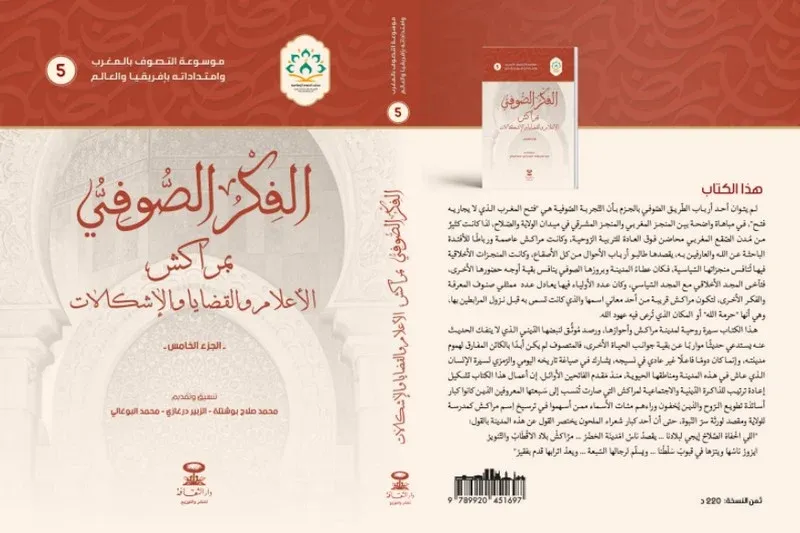
A significant milestone in the academic exploration of Sufi thought in Morocco is marked by the release of the fifth volume of the "Encyclopedia of Sufism in Morocco and Its Extensions in Africa and the World." This collective work, coordinated by a team of esteemed professors from the Philosophy Department, including Mohamed Salah Bouchtala, Zoubair Derghazi, and Mohamed Bougali, was published by the Laboratory of Islamic Sciences at the Faculty of Religious Sciences in Tetouan. Titled "Sufi Thought in Marrakech: Figures, Issues, and Challenges," this volume is described in its introductory paper as a novel qualitative addition to the research project focused on the Sufi memory of Morocco, aiming to shift the discourse from traditional narratives about Sufi lodges (zawiyas) to addressing broader and more significant questions surrounding them.
The publication emerges against the backdrop of an increasing academic interest in Sufi thought, recognized as a fundamental pillar in the formation of Moroccan cultural identity. The work seeks to shed light on the unique experiences of Sufism in Marrakech, exploring its notable figures, lodges, literature, and followers. By highlighting key personalities and analyzing critical issues, the authors aim to document the epistemological and historical challenges that have accompanied the evolution of Sufism in the region.
This book encompasses a collection of peer-reviewed studies conducted by specialized researchers and academics from the fields of philosophy, history, and Sufi studies. The topics addressed are diverse, covering the origins and spread of the zawiyas, their educational and social functions, and their roles in framing religious life. Furthermore, the text investigates the interplay between Sufi practices and legalistic (fiqh) as well as theological (kalam) discussions within the Moroccan context, reflecting the dynamic interaction among various fields of knowledge.
The overarching goal of this publication is to restore the dignity of Sufi thought, portraying it not merely as a retreat into solitude but as a vibrant and deeply rooted intellectual tradition. It emphasizes Sufism as an ethical and social practice that contributes to human development and guides society, framing its relationship with values and meaning.
Mohamed Salah Bouchtala, one of the coordinators of this collective effort, emphasizes that the exploration of Sufi thought in Marrakech is intrinsically linked to a broader issue concerning the historiography of thought in Morocco as a whole. He points out that a comparison between the historical discourse produced in the Islamic East and that in the Islamic West reveals a significant imbalance, largely attributed to the insufficient engagement of Moroccan researchers in the efforts of historiography, analysis, and critique.
This situation has resulted in a notable paradox wherein Moroccan researchers or students may possess intricate details about historical events in Europe or the East, yet their understanding of their own country's history remains limited and fragmented. Often, their knowledge does not extend beyond general or scattered information, and they might sometimes lack even the simplest chronological arrangements of the events and states that have succeeded one another in Morocco, despite being familiar with some of its prominent figures and major landmarks. This reflects a deficiency in historical and epistemological memory.
Consequently, this publication and others like it aim to bridge this gap and restore recognition to Moroccan thought in its diversity and richness, employing precise scientific approaches that seek to liberate it from reductive readings and integrate it into the broader intellectual discourse on solid foundations.
It is noteworthy that the fifth volume of the encyclopedia features contributions from professors in the fields of philosophy, history, and Islamic studies, including Ahmed Al-Warith, Mohamed Salah Bouchtala, Mohamed Al-Amrani, Moulay Hassan Al-Wafa, Monir Ashqi, Mohamed Benhamani, Abdullah Benchawai, Mohamed Aarab, Mohamed Al-Adlouni Al-Idrisi, Asban Anwar, Qasim Aribi, Abdessamad Zahour, Ahmed Mutafakir, Ali Boudi, Hamid Al-Karjawi, Paulo Irizi, and Samir Freddy.
As reported by hespress.com.


