A recent academic study has revealed that the official media in Algeria does not simply report on news related to Morocco; rather, it employs such coverage within a systematic propaganda framework aimed at reinforcing a negative image of the Kingdom. The research indicates that some of the media's coverage transcends traditional news reporting, evolving into a political mobilization tool that reiterates the state's official narrative.
Published in the International Journal of Linguistics, Literature, and Translation, the study undertook an in-depth critical analysis of the discourse found in various materials disseminated by the Algerian News Agency and Algerian Radio, with a particular focus on their coverage of Moroccan-Israeli relations, alongside other regional issues.
The findings demonstrate what the study describes as a "structural interconnection" between political authority and official media in Algeria. According to the research, the media discourse produced reflects the official stances of the state, presenting them as self-evident truths while sidelining or marginalizing dissenting narratives.
The study highlights that news concerning Morocco is framed within the Algerian official media using linguistic and journalistic mechanisms that align more closely with "political propaganda" than with balanced and independent journalism. It notes that a number of concepts are repeatedly employed to impose moral and political judgments on Morocco rather than simply reporting the facts.
The analysis reveals that the studied media discourse relies on descriptors that carry strong evaluative charges, characterizing Morocco as a "deviant" or "complicit" party, while portraying Algeria as the committed party to principles and international law. This phenomenon exemplifies what is known in discourse analysis studies as the "positive representation of self and negative representation of the other."
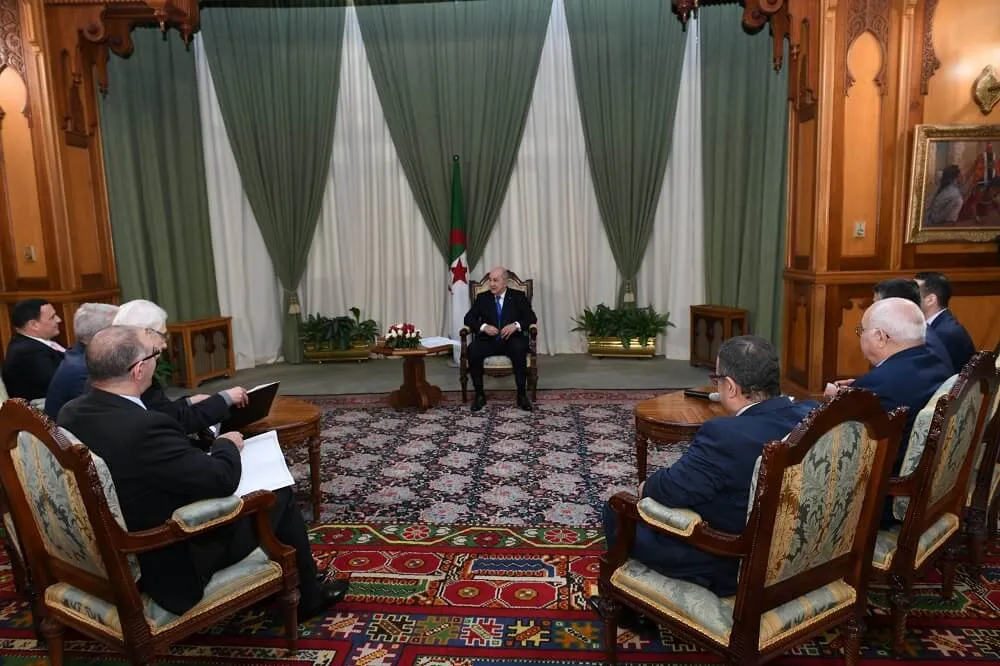
Moreover, the research concludes that the Algerian official media does not merely relay the political positions of the Algerian presidency; instead, it reproduces these positions within journalistic discourse in a manner that makes them appear as objective facts rather than merely political stances. This process represents a form of "propaganda" where language is utilized to shape public perception and craft a specific image of regional issues.
The study also addresses what it describes as the "political parallelism" between authority and media, where the messages and discourses from the Algerian presidency are transmitted to official media institutions, which then reframe and disseminate them within their news coverage, leading to a homogenization of political and media discourse.
In analyzing the coverage of Moroccan-Israeli relations, the study examines how the Algerian official media addresses this topic, asserting that coverage is not presented as a diplomatic issue open for discussion but rather framed within a moral context of condemnation and criminalization. The use of politically and ideologically charged language transforms news into a tool for influencing public opinion, rather than serving as neutral journalistic content.
The source also notes that Algerian official media recontextualizes statements and sources in ways that may alter their original meanings. Some of the analyzed materials include reframing or contextualizing information in a manner that serves the official narrative, which it terms as "misleading contextualization" of sources.
Additionally, the study reveals that Algerian media discourse is characterized by a clear dichotomy between "us" and "them," portraying Algeria as the defender of international legitimacy and just causes, while presenting Morocco within a negative framework of accusation, skepticism, and attributing responsibility for crises to it. This contributes, as noted by the source, to reinforcing division and polarization within the media discourse.
Lastly, the analysis extends to the use of language, as the source argues that the selection of vocabulary, sentence structure, and naming conventions are not neutral elements but rather tools used to direct meaning and entrench a specific political vision among the audience.
As reported by assahifa.com.