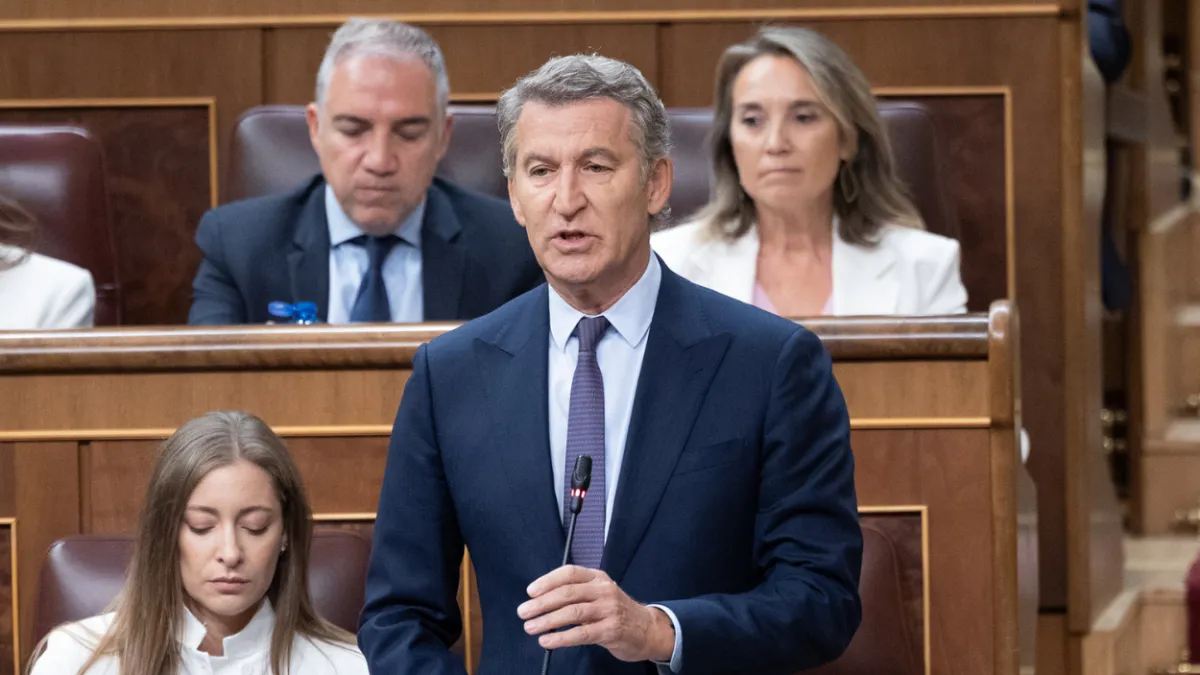

Alberto Núñez Feijóo, the leader of the Popular Party, has leveraged Morocco's recent maneuver in the European Parliament to launch a critique against the Spanish government, specifically targeting Prime Minister Pedro Sánchez. During a session in the Congress of Deputies, Feijóo questioned Sánchez about the last time he engaged directly with Moroccan authorities regarding the escalating situation in Ceuta. He accused the Prime Minister of 'chronicling the problem' in this autonomous city, a sentiment that Sánchez has reciprocated by implying that Feijóo is not addressing the issue constructively.
The face-off between the two leaders continues to be overshadowed by the ongoing migration crisis. Feijóo expressed concern over the deterioration of Spain's international image, but his initial remarks primarily focused on the actions of Brussels. Recently, Morocco sent a letter to several Members of the European Parliament, asserting its willingness to receive all migrants currently in Ceuta, which includes Moroccan citizens, unaccompanied minors, and nationals from other countries. Feijóo highlighted the delays in identifying these individuals, attributing the holdup to one of three possibilities: either Sánchez is unwilling to act, he is incompetent, or someone is lying about the situation.
Feijóo pressed Sánchez further, questioning, 'Why are these individuals still in Ceuta, a month and a half later, causing distress to 80,000 Spaniards and tarnishing the nation's image?' This pointed inquiry reflects a significant concern about how the migration crisis is being managed.
Sánchez Responds: A Facade of Patriotism
In response, Sánchez criticized Feijóo for the Popular Party's proposal to suspend the association agreement with Morocco, arguing that such actions would only exacerbate the ongoing crisis. The Prime Minister touted Spain's image in Europe by referencing three key investment indicators, as well as the robust state of the economy and tourism, concluding that 'Spain is perceived as the country with the best image in Europe.' He contrasted this with the Popular Party's actions in the European Parliament, where they condemned the government's handling of the Ceuta crisis while the European Commission commended the administration's efforts.
Sánchez stated, 'What the Popular Party does is constantly throw obstacles in the way of resolving the problem,' invoking past instances such as the pandemic and natural disasters to illustrate what he perceives as a pattern of undermining government efforts. He dismissed Feijóo's claims of patriotism as superficial, stating, 'Your patriotism is a facade, easily discarded when convenient.'
Feijóo countered by noting that '22 European prime ministers' have rejected Sánchez's policies, labeling the Prime Minister's silence on the matter as a 'disgrace.' He criticized the government's approach to administering nationality and the regularization of migrants, pointing out the disparity in urgency, noting, 'Why the rush for some matters and such lethargy for others?' Furthermore, he accused Sánchez of shielding those responsible for the situation in Ceuta and admonished him for suggesting that residents of Ceuta exercise patience, declaring, 'Do not ask for more patience, as it has run out.'
Sánchez concluded by asserting that 'Ceuta will emerge from this crisis strengthened, thanks to the government's support and despite the opposition.' He also condemned Feijóo's proposal to suspend voting rights for 400,000 Spaniards who were naturalized under the 'grandchildren's law,' which has been halted by the Supreme Court. 'It is a disgrace,' Sánchez remarked, 'You aim to create a hierarchy among citizens, treating some as first-class and others as second-class based on their candidacy.'
As reported by elplural.com.